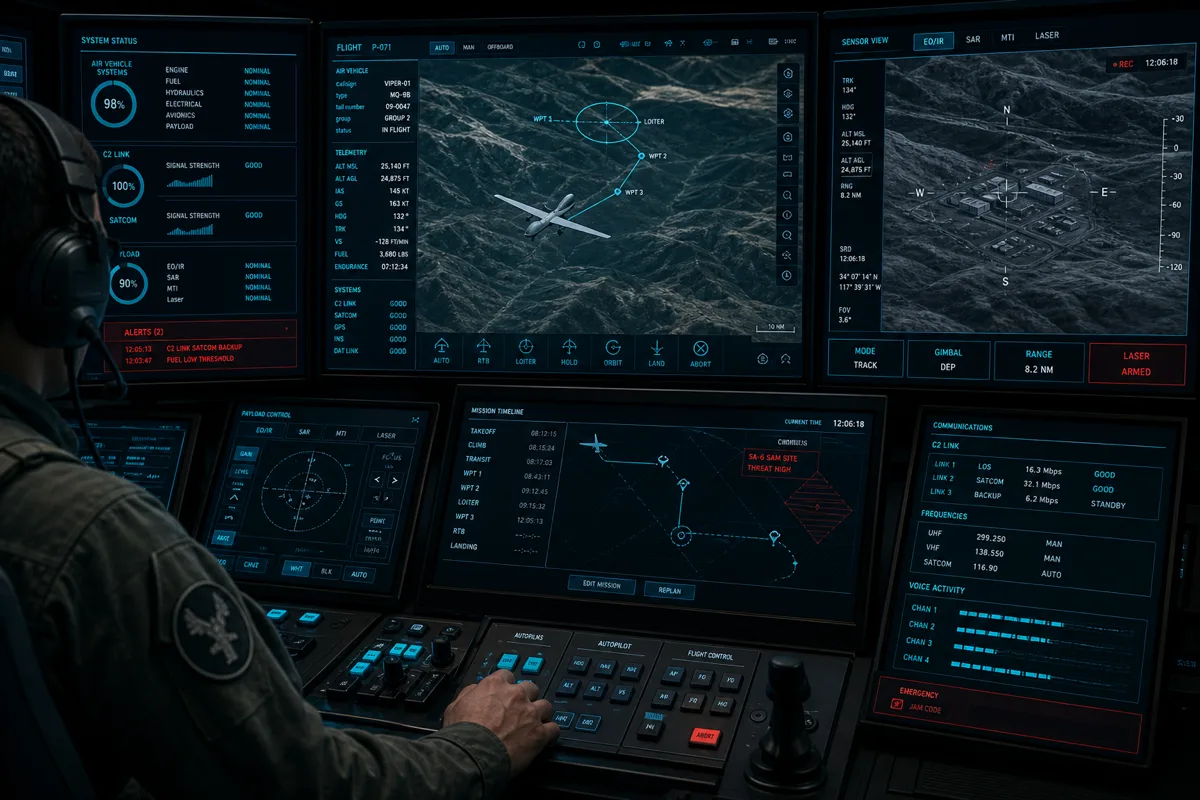
Unmanned aircraft systems (UAS) are increasingly central to defense operations, and the software that runs them — from flight management and autonomy to ground control, data link management, and payload exploitation — is what determines operational capability. As defense programs increasingly recognize that software is the differentiating capability in modern UAS programs, the engineering rigor applied to that software directly determines program success or failure.
This article discusses the software engineering disciplines, quality standards, and system integration challenges that characterize DoD UAS software development programs — and what differentiated engineering teams bring to these programs.
The Software Stack of a Defense UAS
A defense UAS is multiple connected systems with distinct software domains:
Flight management software (airborne): The software stack running on the vehicle itself — flight control laws, navigation, autopilot functions, health monitoring, datalink management, and autonomy/mission management. Safety-critical functions in this category are often developed to DO-178C Design Assurance Level A or B, requiring rigorous process evidence of correctness.
Ground control system (GCS) software: The operator interface for commanding the vehicle, managing waypoints, monitoring vehicle state, controlling payload, and managing the communication link. GCS software is less safety-critical than flight software but directly determines operator effectiveness — poor GCS software leads to operator error and mission failure.
Payload software: Software running on or interfacing with the mission payload — sensors, cameras, signals collection hardware. Payload software manages payload operation, data collection, format conversion, and data transmission to the ground.
Data link and communications: Software managing the air-ground data link — encoding/decoding, link health monitoring, link budget optimization, and in some cases encrypted communications management.
Ground data systems: Software that receives, processes, stores, and distributes mission data collected by the UAS — imagery, sensor data, telemetry archives, and in some programs, real-time exploitation feeds to authorized consumers.
Software Quality Standards for DoD UAS Programs
DoD UAS programs apply varying levels of software quality rigor depending on the platform, mission, and applicable regulations:
DO-178C (Software Considerations in Airborne Systems and Equipment Certification): The dominant standard for safety-critical airborne software. DO-178C defines software development processes and evidence at four Design Assurance Levels (A through D). DAL A (catastrophic failure condition) requires the most rigorous process evidence; DAL D (minor failure condition) requires minimal process evidence. Most defense UAS flight control software targets DAL B or C.
MIL-STD-498 and successor standards: Historical DoD software development standards that defined documentation and process requirements for defense software. While formally superseded, many defense programs still reference MIL-STD-498 documentation artifacts (Software Requirements Specification, Software Design Document, Software Test Plan) in their CDRLs.
CMMI (Capability Maturity Model Integration): Process maturity framework for software development organizations. CMMI Level 3 is a common DoD contractor requirement; some programs specify higher levels. CMMI appraisals are third-party assessments of process compliance.
SAST and DAST for ground systems: For ground control and data system software (not airborne), Static Application Security Testing (SAST) and Dynamic Application Security Testing (DAST) are increasingly specified in DoD software development contracts. These tools identify security vulnerabilities in application code before deployment.
Ground Control System Engineering
The GCS is the human-machine interface for UAS operations — often the most user-facing and operator-impactful software in a UAS program. Engineering considerations:
Workload and human factors: Military UAS operators manage complex, multi-task operational environments. GCS software that creates unnecessary cognitive load, requires excessive manual data entry, or presents critical information poorly directly contributes to operator error. Human factors engineering (HFE) disciplines — task analysis, interface design reviews, usability testing — are applied to GCS development in mature programs.
Scalability to multiple vehicle types: Many defense programs seek GCS software that can control different vehicle types through a common interface. Architecture decisions that expose a common vehicle abstraction layer (rather than tightly coupling the GCS to a specific vehicle's flight management interface) enable this scalability.
Simulation and test environments: GCS development and operator training benefit from simulated vehicle environments — hardware-in-the-loop (HWIL) or software-in-the-loop (SWIL) systems that present realistic vehicle behavior to the GCS without requiring actual flight. These simulation environments are themselves software development projects with their own complexity.
Mission Data System Architecture
Defense UAS missions collect data — imagery, sensor readings, environmental measurements, signals — that must be ingested, processed, and distributed to appropriate consumers in timely ways.
Ground data system architecture for UAS programs increasingly incorporates cloud components:
High-bandwidth data ingest: Full-motion video and wide-area surveillance imagery from UAS sensors generate enormous data rates. Ground data architectures must handle burst ingestion during operational sorties and sustained processing across multiple concurrent missions.
Processing pipeline scalability: Cloud compute enables processing pipelines (image exploitation, data fusion, archive indexing) to scale dynamically with mission tempo — running more processing capacity during high-activity periods and scaling down during gaps.
Secure data distribution: Mission data must reach authorized consumers — ISR analysts, command and control systems, partner agencies — through secure, authorized channels. Access control and audit logging of data access are fundamental requirements.
Rutagon applies software engineering rigor to defense and aerospace programs — from ground system development and integration to cloud-based mission data system architecture for UAS and related programs.
Learn About Rutagon's Defense Engineering Capabilities →
Related reading: - Mission Systems Engineering: The Subcontractor's Role - Space Operations Cloud Systems - Technology Evaluation Criteria for DoD IT
Frequently Asked Questions
What is DO-178C and why does it matter for DoD UAS software?
DO-178C (Software Considerations in Airborne Systems and Equipment Certification) is the standard for safety-critical airborne software development. It defines required development processes and evidence at four Design Assurance Levels (A through D), with DAL A requiring the most rigorous process evidence. DoD UAS flight control software typically targets DAL B or C depending on failure mode criticality. Meeting DO-178C requirements requires disciplined requirements traceability, software verification, and process documentation throughout development.
What software standards apply to UAS ground control systems?
UAS ground control system software is generally not subject to DO-178C (which applies to airborne software), but may be subject to DoD software development standards (MIL-STD-498 artifacts), CMMI process maturity requirements, cybersecurity requirements (NIST 800-53 or CMMC for CUI-handling systems), and program-specific software quality requirements specified in the Statement of Work. SAST and DAST scanning are increasingly specified for ground system software in defense contracts.
How are defense UAS ground data systems using cloud infrastructure?
Defense UAS ground data systems are increasingly using cloud infrastructure — particularly for programs where mission data doesn't require processing at classification levels that preclude commercial cloud. Cloud-based data systems provide scalable ingest pipelines (for high-rate imagery and telemetry), elastic processing capacity, and distributed access for geographically dispersed analyst communities. National security programs at higher classification levels use classified cloud environments.
What is hardware-in-the-loop (HWIL) testing for UAS programs?
Hardware-in-the-loop (HWIL) testing integrates actual hardware components (flight computer, sensor, or actuator hardware) with simulation software that models the rest of the system. For UAS programs, HWIL testing allows flight management software to be tested against a real flight computer with a simulated flight environment — validating behavior that pure software simulation cannot capture. HWIL facilities are a significant investment but are standard practice in mature UAS development programs.
What clearances are typically needed for DoD UAS software engineering work?
Clearance requirements depend on the program classification level. Many UAS programs handling Controlled Unclassified Information (CUI) require Secret clearance for personnel with access to program technical data and sensitive mission information. Programs involving classified vehicle capabilities, mission planning, or collected data may require TS or TS/SCI clearances. Clearance requirements are specified per contract and should be confirmed early in the teaming or subcontracting process.