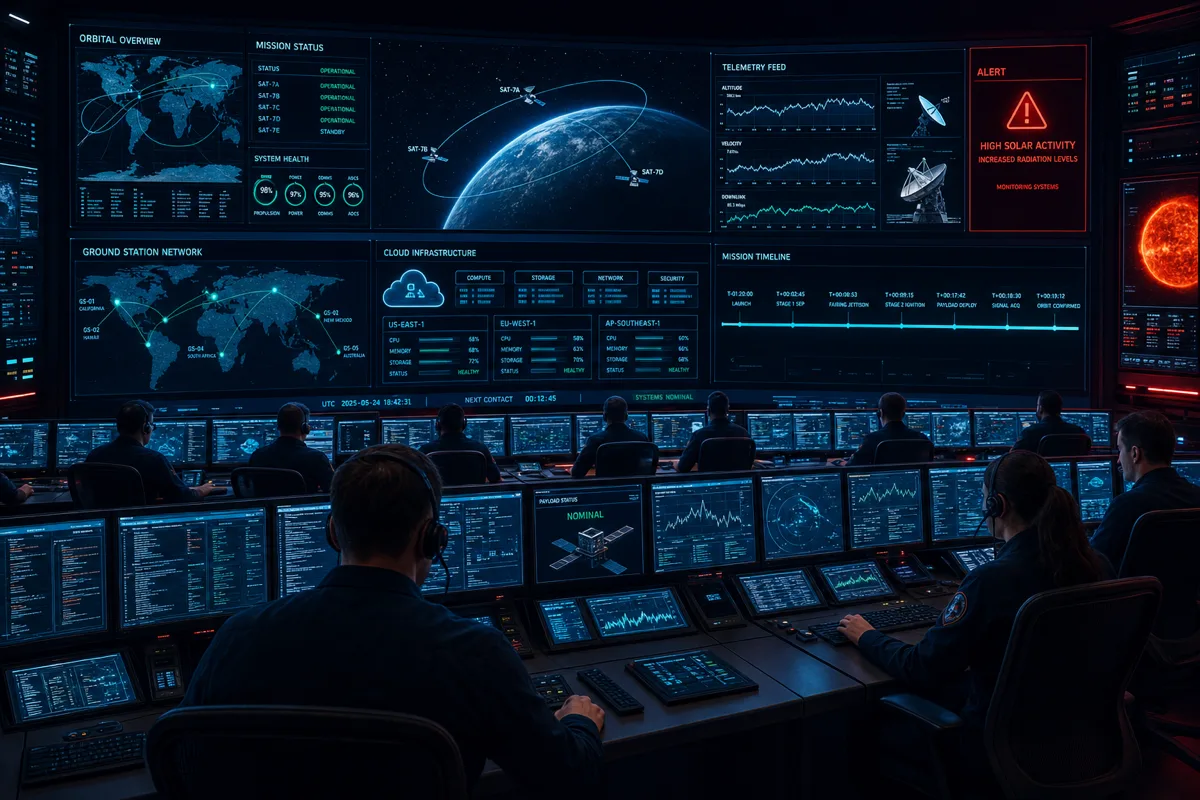
Space operations have always required sophisticated ground segment infrastructure — the systems that track, command, receive telemetry from, and process mission data from spacecraft. Traditionally, ground segment systems were purpose-built, hardware-intensive, and operated in dedicated facilities. Cloud computing is fundamentally changing this model: commercial cloud platforms now provide the computational scale, managed services, and global distribution that enable flexible, software-defined ground segments for a wide range of space programs.
This article examines how cloud infrastructure is being applied to space operations ground systems — the use cases, technical approaches, and engineering considerations for teams building cloud-based space operations infrastructure.
The Shift to Cloud-Based Ground Segments
Legacy space operations ground segments shared common characteristics: dedicated hardware in specific facilities, proprietary interfaces, and system designs that assumed a fixed physical infrastructure. Cloud-based ground segments challenge each of these assumptions:
Elastic compute for telemetry processing: Spacecraft telemetry arrives in bursts — concentrated around contact windows (overpasses). Cloud compute's ability to scale dynamically allows processing capacity to follow contact windows rather than sizing hardware for peak throughput continuously.
Data archival and access: Mission data archives historically lived on tape or local disk. Cloud object storage (with appropriate security controls) provides virtually unlimited capacity, multi-region replication, and access from authorized analysts anywhere — without physical media management.
Managed services for ground system functions: Many ground segment software functions — message queuing, database management, time-series data storage, visualization dashboards — have equivalent managed cloud services that eliminate the need to maintain custom implementations of common infrastructure.
Software-defined ground networks: Commercial ground station services (AWS Ground Station, Microsoft Azure Orbital) allow teams to reserve antenna time through APIs rather than owning and operating dedicated antennas — particularly useful for low-cost LEO missions or programs that need global contact coverage without building a global antenna network.
Telemetry Processing Architecture on Cloud
The core data flow for a cloud-based telemetry processing system:
-
Data ingest: Raw spacecraft telemetry packets arrive from ground station receivers (via antenna) or from commercial ground station services. Ingestion typically uses streaming services (Kinesis Data Streams in AWS) to handle the burst nature of contact windows.
-
Frame synchronization and decommutation: Raw bit streams are synchronized, deframed, and individual telemetry parameters extracted (temperature sensors, power states, attitude data, instrument outputs). This processing is computationally intensive and benefits from cloud horizontal scaling during contact windows.
-
Telemetry storage: Decommutated parameter values are stored in a time-series database (DynamoDB, Aurora, or specialized time-series stores like TimeStream in AWS). Time-series storage enables efficient querying of parameter histories across contact windows.
-
Limit checking and monitoring: Automated limit checking compares telemetry parameter values against operational limits, generating alerts for out-of-limit conditions. Cloud event-driven architecture (Lambda or ECS processing Kinesis events) supports real-time limit checking.
-
Mission data processing: Raw science or sensor instrument data requires mission-specific processing pipelines (calibration, geolocation, data product generation). Cloud batch processing (AWS Batch, Step Functions orchestrating ECS tasks) provides scalable pipelines for data product generation.
-
Visualization and access: Operations teams need real-time telemetry visualization and historical data access. Dashboards (Grafana with CloudWatch or other backend) and data portals (API-driven access to processed data products) are the standard interfaces.
Security Architecture for Space Operations Data
Space operations data has varied sensitivity levels:
Mission-specific data: Mission data classification depends on the program. Civil space (NASA Earth science, heliophysics) may use public cloud with appropriate access controls. National security space programs require classified infrastructure aligned to program classification levels.
Ground system operational security: Command and control systems require strong authentication and authorization controls — unauthorized command injection is a catastrophic risk. Multi-factor authentication, strict RBAC, and comprehensive command audit logging are baseline requirements.
Export control considerations: Space programs and their technical data often fall under ITAR or EAR controls. Personnel with access to ITAR-controlled technical data must be US persons, and cloud systems handling ITAR data must be configured to prevent foreign national access.
Separation of unclassified and classified: Many space programs operate hybrid architectures — unclassified telemetry processing and data distribution on commercial cloud; classified mission data on classified cloud (AWS C2S or equivalent) with appropriate separation.
Commercial Ground Station Services Integration
AWS Ground Station and Azure Orbital provide contact scheduling, antenna access, and raw data delivery as managed services. Integration considerations:
Data delivery format: Commercial ground stations deliver raw baseband or demodulated bit streams to cloud ingestion endpoints (S3 or streaming services). Your ground system software must handle the delivered format (typically VITA 49 digital radio standard or similar).
Contact scheduling APIs: Ground station contact scheduling through APIs enables automated contact planning integrated with your mission operations software.
Latency: Commercial ground station data delivery to cloud processing has inherent latency (seconds to minutes). For near-real-time commanding and telemetry operations, latency constraints must be characterized and accounted for in operations procedures.
DevOps Practices for Space Operations Software
Ground segment software benefits from the same DevOps practices applied to other cloud systems:
- Infrastructure as Code for all ground system infrastructure (Terraform or CloudFormation)
- CI/CD pipelines that run automated tests before deploying telemetry processing software updates (testing with historical playback data)
- Blue/green deployments for mission-critical processing components to enable zero-downtime updates
- Comprehensive telemetry on ground system health (processing lag, limit check latency, data completeness metrics)
Rutagon brings cloud infrastructure engineering to space and defense programs — designing ground system data architectures, telemetry processing platforms, and cloud-based mission data management systems.
Explore Rutagon's Aerospace and Space Capabilities →
Related reading: - Mission Systems Engineering: The Subcontractor's Role - Event-Driven Architecture in Federal Cloud - Observability in Federal Cloud
Frequently Asked Questions
Can commercial cloud be used for space operations ground systems?
Yes. Commercial cloud (AWS, Azure, GCP, including their government cloud variants) is increasingly used for space operations ground systems — particularly for civil and commercial space programs. National security space programs require cloud services authorized at appropriate classification levels (AWS GovCloud for CUI, AWS C2S for classified). The key considerations are data classification, export control (ITAR), and latency requirements for real-time operations.
What is a cloud-based ground segment?
A cloud-based ground segment replaces or supplements traditional dedicated ground station hardware with cloud infrastructure for telemetry processing, data storage, mission data pipelines, and visualization. Antennas may still be dedicated hardware, or may be provided as a service through commercial ground station offerings (AWS Ground Station, Azure Orbital). Cloud-based processing enables elastic scaling for contact windows and eliminates the need to size hardware for peak throughput.
How does AWS Ground Station work?
AWS Ground Station is a managed service that provides antenna access for satellite communication — scheduling contacts, downlinking data, and delivering raw or demodulated data to AWS services (S3, Kinesis, EC2). Customers reserve contact time through an API or console rather than owning antennas. The service supports LEO and MEO satellite operations and is available in AWS GovCloud for government programs.
What time-series database is best for telemetry storage in AWS GovCloud?
AWS TimeStream is a purpose-built time-series database service available in AWS GovCloud that provides efficient ingestion and query of time-series data — well-suited for spacecraft telemetry parameter storage. DynamoDB with composite keys (parameter name + timestamp) is another common approach for high-throughput telemetry storage. Aurora PostgreSQL with TimescaleDB extension provides SQL compatibility for teams with existing SQL-based tooling.
How are command and control systems secured in cloud-based space operations?
Commanding represents the highest-risk function in space operations — unauthorized commands can permanently damage or destroy a spacecraft. Security practices include: multi-factor authentication for all command operators, role-based access control limiting which personnel can generate and uplink commands, command verification workflows requiring independent authorization for specific command types, complete audit logging of all commands generated and uplinked, and separation of command and telemetry networks where architecture permits.