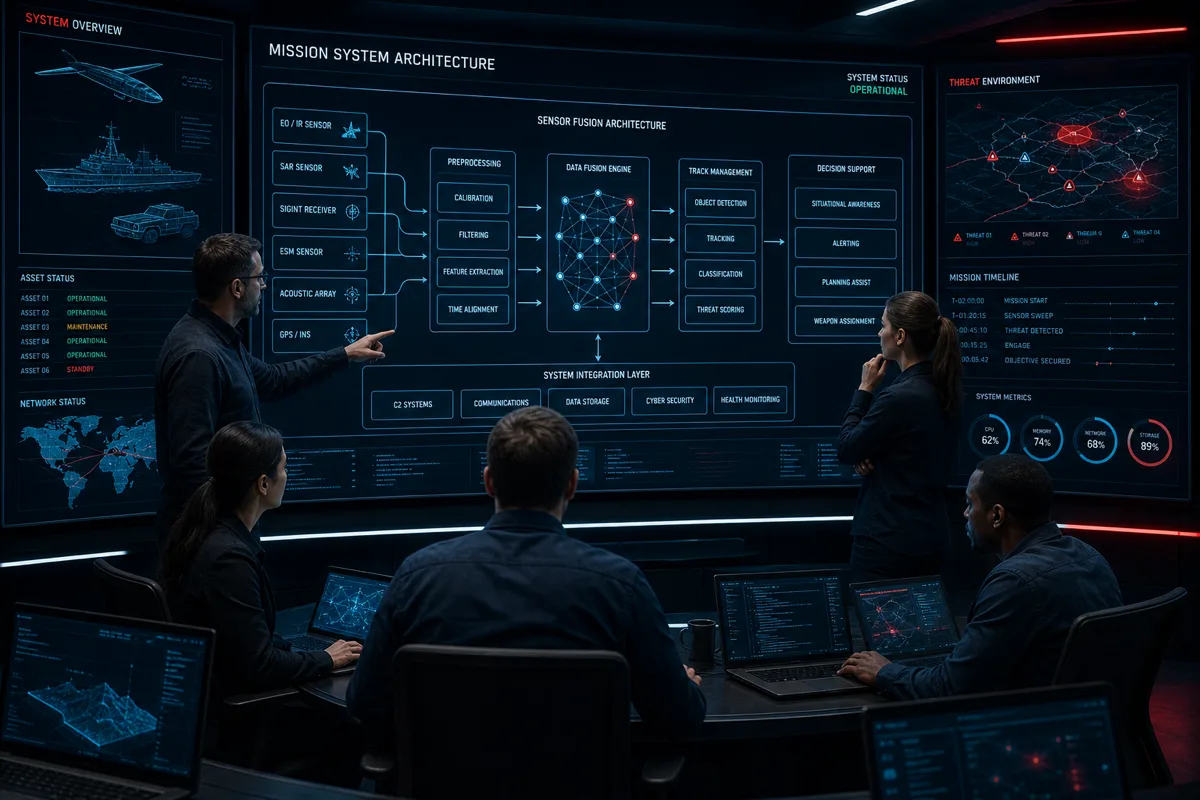
Mission systems — the integrated hardware/software systems that execute an operational mission — represent some of the most technically demanding work in defense and aerospace. Programs involving command and control, sensor fusion, communication relay, navigation, and situational awareness require engineering teams with deep expertise in real-time software, systems integration, and the demanding testing and verification requirements of defense programs.
Large prime contractors hold the primary contracts for most major mission systems programs. But within these large programs, a network of subcontractors contributes specialized capabilities — software development for specific subsystems, integration and test, data processing, ground support systems, and systems engineering analysis. Understanding how small engineering firms participate effectively as subcontractors is the focus of this article.
What Subcontractors Provide in Mission Systems Programs
The primary value a subcontractor brings to a mission systems program is differentiated technical capability that the prime either doesn't have in depth or can acquire more efficiently through subcontracting than through hiring.
Common subcontractor roles in defense and aerospace mission systems:
Embedded software development: Real-time operating system (RTOS) software for sensors, communications, and control subsystems. Subcontractors with deep expertise in VxWorks, INTEGRITY, or LynxOS — combined with understanding of DO-178C software assurance (aviation) or equivalent military software standards — are in consistent demand.
Ground system software engineering: Ground control, mission planning, data archive, and processing systems require significant software engineering capability. For space and UAS programs, ground systems are often subcontracted to specialized software firms while the prime focuses on the vehicle and payload.
Systems integration and test: Integrating hardware and software subsystems into a functioning whole — and verifying that the integrated system meets its requirements — is a distinct discipline. Subcontractors with test bench engineering, hardware-in-the-loop (HWIL) test expertise, and systems verification methodology experience fill a critical role.
Data processing and exploitation: Mission data often requires specialized processing pipelines — from raw sensor output to actionable information. Subcontractors specializing in signal processing, machine learning applied to sensor data, or domain-specific data analysis contribute analytical depth the prime may not maintain internally.
Cloud and IT infrastructure for mission systems: As mission systems increasingly incorporate cloud-connected components — data uplink, ground processing, cross-platform data sharing — subcontractors with cloud engineering and security expertise relevant to defense contexts contribute a relatively newer but growing capability set.
Systems Engineering Process Requirements in Defense Programs
Defense programs follow formal systems engineering processes that subcontractors must understand and participate in:
MIL-STD-882E (System Safety): System safety is a contractual requirement on most defense programs. Subcontractors contributing hardware or software to safety-relevant functions must participate in the Preliminary Hazard Analysis (PHA), Subsystem Hazard Analysis (SSHA), and System Hazard Analysis (SHA) process, documenting how their component's failure modes contribute to (or are mitigated against) system-level hazards.
Technical Reviews: Defense programs hold formal Technical Reviews (System Requirements Review, Preliminary Design Review, Critical Design Review, Test Readiness Review) at which subsystem teams present their design status. Subcontractors responsible for specific subsystems or integration tasks present their elements' readiness at the appropriate reviews.
Configuration Management: Defense programs use rigorous configuration management (CM) to control and document changes to hardware, software, and documentation. Subcontractors must operate within the program's CM system — using controlled drawing numbers, formal change control procedures, and appropriate document control for deliverables.
Data Items: Government contracts typically include a Contract Data Requirements List (CDRL) specifying the documentation deliverables. Subcontracts with CDRLs require the subcontractor to produce specific documentation artifacts (software design documents, test plans, interface control documents) on schedule.
Security Requirements for Mission System Subcontractors
Depending on the program, mission system subcontracting work may require:
Personnel Security Clearances: Active clearances appropriate to the program's classification level are typically required before access to program-sensitive information. Building a cleared team takes time — active clearances are a competitive advantage in this market.
Facility Clearances: Programs requiring work with classified materials in the contractor's facility require a Facility Clearance (FCL) from the Defense Counterintelligence and Security Agency (DCSA). FCL establishment is a significant process investment.
CMMC Compliance: The DoD's Cybersecurity Maturity Model Certification (CMMC) program requires third-party assessment for contractors handling CUI (Controlled Unclassified Information). Most defense subcontracts involving technical data, software, or system integration work require CMMC Level 2 compliance at minimum.
ITAR/EAR Awareness: Export control regulations (ITAR and EAR) govern the sharing of technical data and hardware related to defense articles and dual-use items. Subcontractors must have export control programs in place and understand which program data and hardware items require export licenses or license exceptions before sharing with foreign nationals or foreign entities.
Building a Subcontractor Track Record in Mission Systems
The most direct path to mission systems subcontracting work is demonstrating relevant prior experience: - Technical publications or conference presentations (IEEE Aerospace, AIAA, AUSA) demonstrate domain expertise publicly - Prior government contract work (even at smaller scale) provides CPARS ratings and past performance documentation - Industry group participation (NDIA, AFA, AFCEA) creates relationship opportunities with prime contractor contacts - Demonstrated toolchain proficiency (model-based systems engineering tools, simulation environments, test automation frameworks used in the defense industry)
Rutagon brings cloud infrastructure, systems integration, and software engineering capability to defense and space programs through teaming and subcontracting relationships.
Explore Rutagon's Capabilities →
Related reading: - Space Operations Cloud Systems - Technology Evaluation Criteria for DoD IT - CIO-SP4 Subcontractor Guide
Frequently Asked Questions
What technical disciplines are most in demand for mission systems subcontracting?
Consistent demand exists for: real-time embedded software engineers with RTOS and DO-178C/MIL-standard experience, systems integration and test engineers, software engineers for ground system development, signal processing and data exploitation specialists, and increasingly, cloud engineers with defense-grade security capability for ground data systems and mission data infrastructure.
Do subcontractors need security clearances for mission systems work?
Most mission systems programs involve classified data or classified development environments, requiring personnel with appropriate clearances. The specific level (Confidential, Secret, TS, TS/SCI) depends on the program. Subcontractors without cleared personnel can still pursue unclassified support roles, but clearance levels are a significant differentiator in the mission systems subcontracting market.
What is CMMC and how does it affect mission systems subcontractors?
CMMC (Cybersecurity Maturity Model Certification) is DoD's framework for assessing cybersecurity practices across the defense industrial base. Subcontractors handling CUI (Controlled Unclassified Information) — which includes most technical data on defense programs — must demonstrate CMMC Level 2 compliance through a third-party assessment. CMMC compliance is increasingly a flow-down requirement in defense prime subcontracts.
How do mission systems subcontractors build past performance records?
Small subcontractors build past performance through: government contract work with CPARS ratings (even at small dollar values), past performance letters from prime contractor program managers, and documentation of specific technical contributions to named programs. The quality and relevance of past performance matters more than the contract dollar size — demonstrating the same technical domain at any scale is useful.
What is ITAR and why does it matter for mission systems subcontractors?
ITAR (International Traffic in Arms Regulations) controls the export of defense articles, services, and technical data listed on the United States Munitions List (USML). Mission systems — including avionics, weapon systems, spacecraft, and associated technical data — are frequently ITAR-controlled. Subcontractors working with ITAR-controlled data or hardware must register with the State Department's DDTC and maintain an export control compliance program. Violations carry severe civil and criminal penalties.