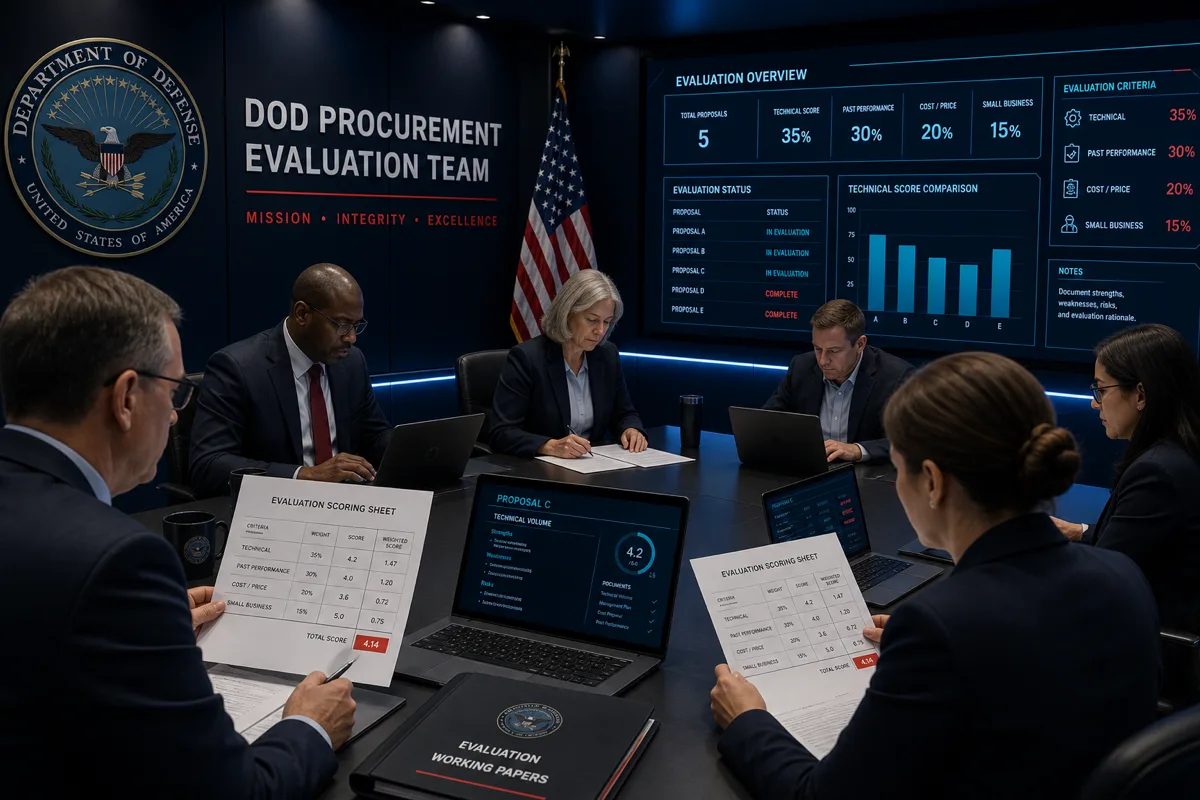
DoD IT procurement is governed by a structured source selection process that evaluates vendors across multiple dimensions — technical approach, management plan, personnel qualifications, past performance, and price. Understanding how DoD evaluators assess technology proposals is essential for IT companies that want to compete effectively for defense IT contracts, whether as a prime contractor or as a subcontractor supporting a prime's proposal.
This article covers the standard DoD IT technology evaluation framework, what differentiates winning proposals from losing ones, and how technical teams can contribute to competitive evaluations.
The DoD Source Selection Process for IT Contracts
DoD source selection for IT contracts follows the Federal Acquisition Regulation (FAR) and Defense Federal Acquisition Regulation Supplement (DFARS), with agency-specific guidance from the relevant service or component.
The standard evaluation factors for DoD IT procurements typically include:
- Technical/Management Approach (often highest weighted factor)
- Personnel Qualifications and Certifications
- Past Performance
- Price or Cost
The relative weighting of these factors varies by contract — technically complex, mission-critical systems tend to weight technical approach heavily; commodity IT services may weight price more equally. The solicitation's Section M specifies the evaluation factors and their relative importance.
Best Value vs. Lowest Price Technically Acceptable (LPTA): DoD has moved away from LPTA for complex IT work following Congressional guidance that LPTA was being overused and resulting in lower-quality solutions. For innovative or complex IT (cloud migration, custom software, cybersecurity architecture), Best Value trade-offs — where technical superiority can justify higher price — are now the expected approach.
Technical Approach Evaluation Criteria
The technical approach volume is evaluated against the government's stated requirements in the Statement of Work (SOW) or Performance Work Statement (PWS). Common evaluation elements:
Understanding of the requirement: Does the offeror demonstrate a clear, accurate understanding of what the government needs — including implied constraints (existing systems, user population characteristics, compliance requirements)? Generic proposals that could apply to any IT program signal lack of engagement with the specific requirement.
Technical solution design: Is the proposed technical solution appropriate for the requirement? For cloud infrastructure work, this includes architecture design, service selection rationale, security control implementation, and migration/integration strategy. Evaluators look for solutions that are both technically sound and appropriately scoped — neither over-engineered nor underbuilt.
Feasibility and realism: Can the offeror actually deliver what they're proposing in the timeframe and with the resources proposed? DoD evaluators are experienced at identifying proposals that describe sophisticated capabilities without showing how they'll be delivered. Proposals that show realistic integration of approach, staffing, and schedule are more credible.
Risk identification and mitigation: Proposals that identify technical and programmatic risks and describe specific mitigation strategies demonstrate mature technical thinking. Proposals that claim no significant risks signal either lack of experience or lack of genuine engagement with the problem.
Cybersecurity and compliance approach: For any DoD IT work, the technical approach must address how the solution meets applicable security requirements — NIST 800-53 controls, CMMC requirements (for CUI), FedRAMP for cloud services, RMF process integration. This is increasingly a differentiating factor rather than a checkbox.
Personnel Qualifications in DoD IT
For services contracts, personnel qualifications are a critical evaluation factor. DoD evaluators review:
Key Personnel: Most proposals name key personnel (Program Manager, Technical Lead, Security Architect) who are evaluated individually for relevant experience, certifications, and clearances. Key personnel commitments are contractual — substitution requires government approval.
Certifications required or credited: Common certifications in DoD IT evaluations include: - Security: CISSP, CISM, Security+, CEH - Cloud: AWS Solutions Architect, Azure Administrator, GCP Associate - Project Management: PMP, DAWIA project management certifications - DoD-specific: DAWIA acquisitions certifications for some hybrid contractor/government hybrid roles
Security clearances: Personnel clearance levels (Public Trust, Secret, TS, TS/SCI) are specified as minimums in the requirement. Proposing personnel with clearances above the minimum (offering TS on a Secret-required contract) can be an evaluated differentiator when it reduces onboarding delays.
Past Performance Evaluation in DoD IT
Past performance is evaluated separately from technical approach and assigned a confidence rating (Substantial Confidence, Satisfactory Confidence, Limited Confidence, No Confidence, Unknown Confidence). Key elements:
Relevance: Past performance must be relevant to the solicitation in scope, size, and complexity. A $500K IT support contract doesn't demonstrate relevance to a $50M cloud migration effort. Size and complexity relevance thresholds are specified in the solicitation.
Recency: Most DoD solicitations limit past performance citations to work completed within the past 3–5 years.
Sources: The government evaluates performance information from: Contractor Performance Assessment Reporting System (CPARS), references provided in the proposal, and information in government knowledge bases. CPARS ratings are the most authoritative source — consistent Exceptional or Very Good ratings in CPARS build a strong past performance record over time.
Teaming partner past performance: Subcontractors and teaming partners can contribute past performance citations — critical for newer companies pursuing opportunities above their individual performance record.
Rutagon pursues DoD IT contracts and subcontracting opportunities with a track record in cloud infrastructure, DevSecOps, and mission system integration for defense programs.
Learn About Rutagon's Defense Capabilities →
Related reading: - CIO-SP4 Subcontractor Guide - GSA MAS 54151S IT Subcontracting - DoD Source Selection Evaluation Insights
Frequently Asked Questions
What is the most important evaluation factor in DoD IT source selection?
In Best Value DoD IT procurements, technical approach is most commonly weighted highest — often described as "more important than price" or given specific multipliers in evaluation scoring. Past performance is typically second. However, the solicitation's Section M specifies the exact weighting, and proposals must be calibrated to the specific opportunity's stated priorities.
How should IT companies document past performance for DoD evaluations?
Build your past performance record through: consistent Exceptional/Very Good CPARS ratings on current contracts, detailed project summaries (scope, dollar value, period of performance, client POC) for all relevant federal work, and letters of past performance from government contracting officers or prime contractor project managers. Maintain a living past performance library that can be quickly tailored to specific opportunity relevance criteria.
What is LPTA and when does DoD use it for IT procurement?
LPTA (Lowest Price Technically Acceptable) is an evaluation approach where the lowest-priced technically acceptable proposal wins — there's no credit for being more technically sophisticated. DoD was directed by Congress to limit LPTA use for complex IT work after concerns that it was driving poor outcomes. LPTA remains appropriate for truly commodity IT services with well-defined specifications and low technical risk.
How do cybersecurity requirements factor into DoD IT technical evaluation?
Increasingly significantly. DoD evaluators look for: NIST 800-53 control implementation plans, CMMC compliance status (for contracts handling CUI), zero trust architecture alignment, and specific security engineering credentials among key personnel. A generic "we will implement security best practices" response is not competitive — specific, demonstrated security engineering approach is expected.
Can a small business compete for large DoD IT contracts?
Yes, particularly through teaming arrangements with larger primes (who may need a small business for SB set-aside compliance), through small business set-aside contracts sized appropriately for small businesses, and through IDIQ vehicles with small business tracks (CIO-SP4 SB, GSA STARS III, etc.). Building past performance as a subcontractor and documenting it in proposal past performance citations is the standard growth path for DoD IT small businesses.