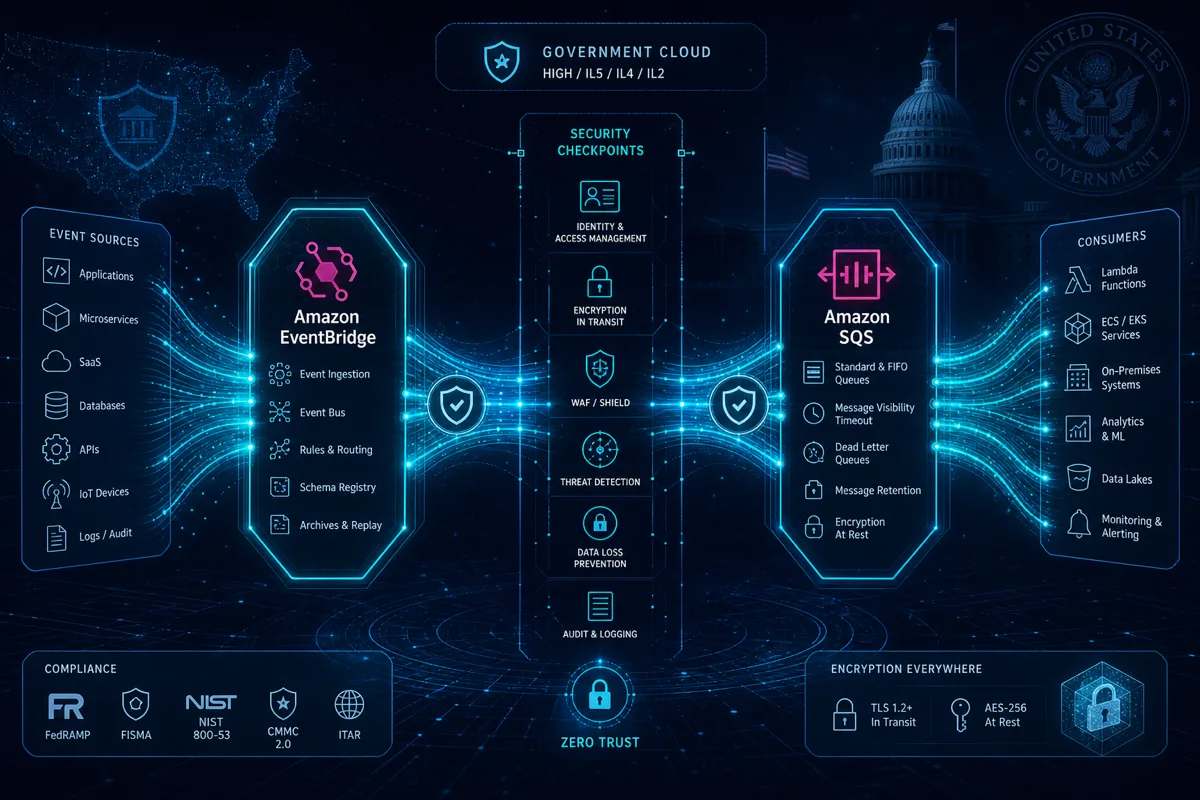
Event-driven architecture (EDA) has become a foundational pattern in modern cloud systems — and federal cloud environments are increasingly adopting it as agencies pursue scalable, decoupled, and observable platforms that meet the stringent requirements of FedRAMP High and DoD IL4/IL5 authorizations. The pattern's strengths align naturally with the challenges of government IT: systems that must handle unpredictable load patterns, support multiple consuming agencies, and maintain complete audit trails of all operations.
This article explores how event-driven architecture applies in federal cloud environments, the specific compliance and engineering considerations that shape implementation decisions, and patterns that have proven effective in government-grade cloud work.
Why Event-Driven Architecture Fits Federal Systems
Federal agencies often operate systems with characteristics that event-driven patterns address well:
Multiple consuming systems: A single data source (agency database, sensor feed, case management system) may feed dozens of downstream consumers — reporting systems, analytics platforms, other agencies' APIs, audit logs, and notification services. Point-to-point integrations between all these systems create brittle, hard-to-maintain complexity. An event bus allows producers to emit events once while consumers subscribe independently.
Unpredictable load patterns: Government systems often experience burst traffic — end-of-fiscal-year submission windows, major program deadlines, emergency response operations. EDA's asynchronous nature decouples processing capacity from peak ingest rates, allowing systems to process bursts from a queue rather than requiring synchronous request/response at peak load.
Auditability requirements: Federal compliance frameworks including NIST 800-53 require comprehensive audit logging of all system operations. An event-driven system's event stream is inherently a complete, immutable log of everything that happened — audit logs become a natural byproduct of the architecture rather than a separate concern bolted on after the fact.
Resilience requirements: Mission-critical government systems must maintain continuity through infrastructure failures. Event queues provide natural buffering — if a downstream consumer is temporarily unavailable, events queue durably and are processed when the consumer recovers, preventing data loss.
Key EDA Components in GovCloud Environments
AWS GovCloud (US) messaging services:
Amazon SQS (Simple Queue Service) in AWS GovCloud provides FIPS 140-2 compliant message queuing. Standard queues support at-least-once delivery; FIFO queues provide exactly-once processing and ordered delivery — critical for workflows where sequence matters (case processing, financial transactions).
Amazon SNS (Simple Notification Service) enables fan-out patterns — a single message published to an SNS topic can simultaneously trigger multiple SQS queues, Lambda functions, or HTTP endpoints. This is commonly used to fan out a single agency event to multiple consuming systems without the producer needing awareness of who's consuming.
Amazon EventBridge provides a fully managed event bus with schema registry, event filtering, and cross-account routing. EventBridge supports routing events to multiple targets based on content-based rules, making it particularly useful for multi-tenant government platforms where different events must route to different agency consumers.
Kinesis Data Streams: For high-throughput event streaming (IoT sensor data, high-frequency telemetry, real-time analytics feeds), Kinesis provides ordered, sharded streams with configurable retention (up to 365 days). Kinesis is available in GovCloud and supports FIPS endpoints.
Compliance Considerations for Federal EDA Implementations
Data classification and event payload design: The contents of event payloads must adhere to data classification requirements. CUI (Controlled Unclassified Information) included in event bodies must be protected at rest and in transit with FIPS 140-2 compliant encryption. In practice, this means: encrypted SQS queues (AWS-managed or customer-managed KMS keys), encrypted Kinesis streams, TLS 1.2+ for all event transport, and careful consideration of what data belongs in the event payload versus referenced via a secure pointer.
Fan-out and authorization: When events fan out to multiple consumers across organizational boundaries (different agencies, contractors, systems), authorization for each consumer to receive specific event types must be explicitly managed. IAM policies, SQS queue access policies, and SNS topic policies must implement least-privilege access so consumers only receive events relevant to their authorized role.
Exactly-once and idempotency: At-least-once delivery semantics (standard in most messaging systems) means consumers may receive duplicate events during failure scenarios. Federal systems processing financial transactions, case updates, or other non-idempotent operations must implement consumer-side idempotency checks. This is a common source of subtle bugs in government system migrations from synchronous to event-driven patterns.
Dead letter queues and visibility: Messages that fail processing after maximum retry attempts should route to a dead letter queue (DLQ) for investigation and reprocessing. In government systems, DLQ depth is a key operational metric — unprocessed messages may represent failed case updates, missed notifications, or incomplete audit records. CloudWatch alarms on DLQ depth are part of a complete operational picture.
Event Schema Management in Federal Platforms
A frequently underestimated challenge in federated government event-driven systems is schema management — ensuring that event producers and consumers have a shared, versioned understanding of event structure.
AWS EventBridge Schema Registry provides automated schema discovery and documentation for events flowing through an EventBridge bus. For multi-agency platforms, maintaining a governed schema registry prevents the brittleness of informal schema evolution where producers change event structure without coordinating with consumers.
Versioning conventions — embedding schemaVersion fields in all events, supporting multiple versions simultaneously during migration windows, and publishing schema changelogs — are the operational practices that keep large federal EDA deployments manageable.
Observability in Federal Event-Driven Systems
Event-driven systems have different observability requirements than synchronous request/response systems. Tracing a request across multiple asynchronous hops requires:
- Correlation IDs: Every event should carry a unique correlation ID that persists across the entire processing chain, enabling end-to-end trace reconstruction
- X-Ray tracing: AWS X-Ray in GovCloud supports distributed tracing across Lambda, SQS, SNS, and EventBridge — enabling visualization of event flow through the system
- CloudWatch metrics: Queue depth, processing latency, DLQ depth, and consumer error rates are the operational metrics that define a healthy EDA system
- Structured logging: Consumer applications should emit structured logs (JSON) with correlation ID, event type, processing duration, and outcome — enabling log aggregation and search across the full event processing pipeline
At Rutagon, we design and implement event-driven cloud architectures for federal and defense clients — building systems that scale to mission requirements while meeting the compliance requirements of FedRAMP High and DoD authorization frameworks.
Explore Our Federal Cloud Engineering →
Related reading: - Observability in Federal Cloud Environments - AWS Network Firewall for Government - Incident Management in Government Cloud
Frequently Asked Questions
Is event-driven architecture compatible with FedRAMP High requirements?
Yes. AWS GovCloud services including SQS, SNS, EventBridge, and Kinesis are FedRAMP High authorized. The architecture pattern itself doesn't conflict with FedRAMP requirements — the compliance work involves properly configuring encryption, access controls, audit logging, and boundary controls consistent with your system's authorization boundary and data classification.
How do you handle exactly-once processing in federal event-driven systems?
AWS SQS FIFO queues provide exactly-once delivery semantics within a 5-minute deduplication window. For longer deduplication windows, consumer-side idempotency — tracking processed message IDs in a persistent store and checking before processing — is the standard approach. The deduplication key strategy must be designed for the specific event type.
What is the best approach for cross-agency event sharing in GovCloud?
EventBridge Event Buses support cross-account event routing within AWS GovCloud, allowing events from one agency's account to be delivered to another agency's account with explicit IAM authorization. For cross-environment or cross-classification-level routing, additional controls (content inspection, data sanitization, classification-level awareness in routing logic) are required.
How do dead letter queues relate to audit requirements in federal systems?
Dead letter queues capture events that couldn't be successfully processed. For audit completeness, DLQ contents must be monitored and investigated — unprocessed events represent gaps in your audit trail. Alarms on DLQ depth trigger operational response; periodic DLQ audits confirm that all failed-processing events are eventually resolved (reprocessed or documented as intentionally discarded).
What monitoring should I set up for a federal EDA system in AWS GovCloud?
Minimum monitoring for a federal EDA system: CloudWatch alarms on SQS/Kinesis DLQ depth, consumer error rates, queue processing age (age of oldest unprocessed message), and Lambda/ECS consumer function error rates. X-Ray distributed tracing for end-to-end latency visibility. CloudTrail for the complete API call audit log of all messaging service configuration changes.