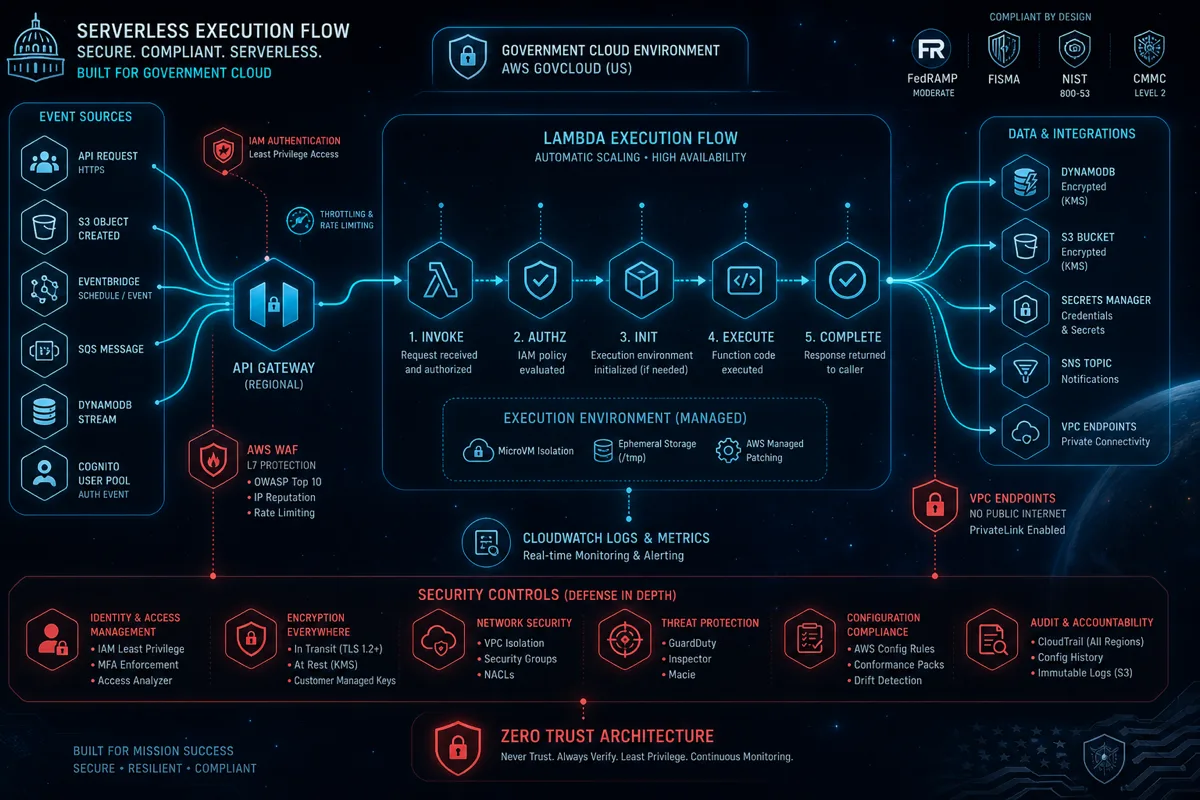
AWS Lambda in AWS GovCloud provides event-driven serverless compute for federal workloads — enabling teams to build scalable, low-maintenance processing pipelines without managing servers. For FedRAMP and DoD authorization boundaries, Lambda requires specific security hardening: IAM permissions must be strictly scoped, VPC configuration must prevent uncontrolled network access, code security scanning must be part of the deployment pipeline, and monitoring must provide the visibility required for compliance.
This article covers Lambda security hardening for government cloud environments across the key dimensions: identity, network, code, and observability.
Lambda in AWS GovCloud: Authorization and Baseline
AWS Lambda is FedRAMP High authorized in AWS GovCloud (US). Key baseline considerations:
Execution environment: Lambda functions run on AWS-managed compute infrastructure — the underlying host is not customer-managed. Lambda's execution environment isolation (Firecracker microVM technology) is part of the AWS security responsibility. Customer responsibility covers function code, IAM permissions, VPC configuration, and environment variable handling.
FIPS endpoints: Lambda invocations and management API calls from within a FedRAMP boundary should use FIPS-validated endpoints where available. For Lambda API calls within GovCloud, use the regional FIPS endpoints.
Concurrency and resource limits: Lambda's default concurrency limits and memory/timeout maximums apply in GovCloud. Reserved concurrency should be configured for critical functions to prevent resource starvation from less-critical functions in the same account.
IAM for Lambda: Execution Role and Resource-Based Policies
Execution role (least privilege):
Every Lambda function has an execution role — the IAM role that provides the function code with permissions to call other AWS services. This is the most commonly over-permissioned element in Lambda security. Common mistakes:
- Using
AWSLambdaFullAccessor other broad managed policies - Permitting
s3:*when onlys3:GetObjecton specific bucket/prefix is needed - Permitting
dynamodb:*instead of specificGetItem,PutItemon specific table ARNs
Federal Lambda execution roles should:
- Be specific to each function (not shared across functions)
- Include only the specific actions needed for that function's operations
- Use resource ARNs instead of * wherever possible
- Include Condition elements to restrict access by resource tag, VPC, or request context where useful
Example execution role policy:
{
  "Effect": "Allow",
  "Action": [
    "dynamodb:GetItem",
    "dynamodb:PutItem",
    "dynamodb:UpdateItem"
  ],
  "Resource": "arn:aws-us-gov:dynamodb:us-gov-west-1:ACCOUNT:table/case-records"
}
Resource-based policies: Lambda resource-based policies control who (which principals) can invoke a function. Functions invoked only by API Gateway or EventBridge should have resource-based policies that restrict invocation to those specific service principals — preventing functions from being invoked by unexpected principals.
VPC Configuration for Government Lambda Functions
Lambda functions can run either in the Lambda service VPC (internet access but no private resource access) or in a customer VPC (private resource access, controlled egress). For government workloads:
Functions accessing private VPC resources (RDS, ElastiCache, internal services): Must run in the customer VPC. Configure: - Private subnet placement (no direct internet route) - Security group with outbound rules restricted to required destinations (RDS port to DB security group, HTTPS to specific endpoints) - No public IP assignment
Functions not needing private VPC resources: Running outside the customer VPC simplifies configuration but still requires internet egress control. Consider whether the function needs outbound internet access at all — many Lambda functions only need access to AWS service APIs (reachable via VPC Endpoints from a VPC deployment).
Cold start and scaling considerations: VPC Lambda has historically suffered from higher cold-start latency, though AWS improvements have reduced this significantly. Reserved concurrency and provisioned concurrency eliminate cold starts for latency-critical functions.
VPC Endpoints for AWS service calls: Lambda functions in a VPC should use VPC Interface Endpoints for AWS services they call — S3, DynamoDB, Secrets Manager, SQS, SNS. This routes service API calls through AWS's private network rather than requiring internet access.
Code Security for Federal Lambda Functions
Dependency scanning: Lambda function code packages include dependency libraries. Known vulnerabilities in dependency packages create function vulnerabilities. Integrate dependency scanning (Snyk, AWS Inspector for Lambda layers, or open-source equivalents) into CI/CD pipelines — fail deployments when Critical-severity vulnerabilities are detected in dependencies.
Environment variable handling: Never store secrets (database passwords, API keys) in environment variable plaintext. Use Secrets Manager or Parameter Store (SecureString) references in function configuration, retrieved at runtime by the execution role. Environment variables in plaintext are visible in the Lambda console to anyone with describe permissions.
Input validation: Lambda functions invoked by API Gateway, SQS, or EventBridge must validate and sanitize all input — including event structure, data types, and size limits — before processing. Insufficient input validation enables injection attacks or unexpected behavior with malformed events.
Timeout and memory configuration: Function timeouts should match the expected maximum execution time for legitimate operations. Excessively long timeouts enable functions to run indefinitely (potentially due to misconfiguration or attack). Memory configuration should be sized appropriately — both for performance and cost.
Lambda Monitoring and Compliance Observability
CloudWatch Logs: Lambda automatically sends function logs to CloudWatch Logs. Enable structured logging (JSON) in function code for queryable log analysis. Log function invocation outcomes, processing duration, errors, and any security-relevant decisions.
Lambda Insights: AWS Lambda Insights (an enhanced CloudWatch monitoring feature) captures additional performance metrics: memory utilization, initialization time, and CPU metrics. Useful for identifying functions experiencing resource pressure.
X-Ray tracing: Enable X-Ray active tracing on functions to capture distributed traces. X-Ray's Lambda integration automatically captures function timing and integrates with downstream service calls (DynamoDB, SQS, etc.) for end-to-end trace visibility.
CloudWatch alarms on error rates and invocation patterns: Alert on function error rate exceeding threshold, invocation count anomalies (potential event injection attack), throttle rate (capacity planning), and concurrent execution spikes.
Rutagon implements serverless architectures with rigorous security hardening for federal cloud programs — from Lambda execution role design and VPC configuration to code security pipeline integration and compliance monitoring.
Explore Our Federal Serverless Engineering →
Related articles: - ECS Fargate in AWS GovCloud - Observability in Federal Cloud - Event-Driven Architecture in Federal Cloud
Frequently Asked Questions
Is AWS Lambda FedRAMP High authorized in GovCloud?
Yes. AWS Lambda is FedRAMP High authorized in AWS GovCloud (US). It is included in the AWS GovCloud FedRAMP High boundary and can be part of your system's authorization boundary for ATOs.
Should federal Lambda functions run in a VPC?
Lambda functions that access private VPC resources (RDS databases, ElastiCache, private application services) must run in a customer VPC. Functions without private VPC resource dependencies can run in the Lambda service VPC, though placing all government workload functions in your VPC provides consistent network control and egress monitoring through Network Firewall or NAT Gateway logging.
How do I prevent hardcoded secrets in Lambda function code?
Never store secrets in environment variable plaintext or in function code. Instead: store secrets in AWS Secrets Manager or Parameter Store (SecureString); grant the Lambda execution role permission to retrieve the specific secret; retrieve the secret at function initialization (cached in memory across invocations for the lifetime of the execution environment, not re-fetched every invocation).
How should Lambda execution roles be scoped in a federal environment?
Each Lambda function should have a dedicated execution role (not shared across functions). The role should grant only the specific API actions the function needs, on specific resource ARNs (not * wildcards), with conditions that further restrict access where possible. Audit execution role policies during security review for any * resource permissions — these should be replaced with specific ARNs or tags.
What Lambda monitoring is required for FedRAMP compliance?
FedRAMP-compliant Lambda monitoring includes: CloudWatch Logs retention configured per AU-11 (typically 3 years), CloudWatch Alarms for error rate anomalies and invocation count spikes, X-Ray tracing for distributed trace capability, and CloudTrail API call logging for all Lambda management operations. Function invocation logs should capture security-relevant events (authentication decisions, authorization results, data access) in a queryable structured format.