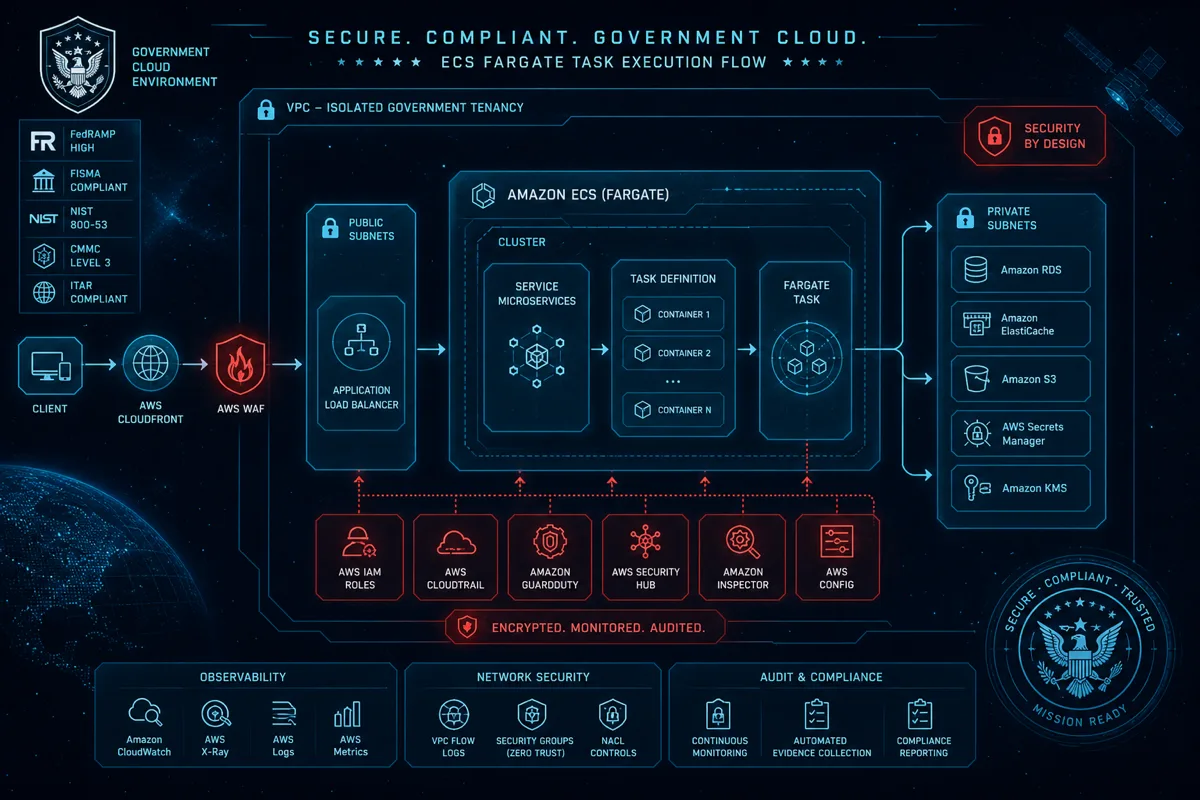
Amazon ECS Fargate provides serverless container compute in AWS GovCloud — allowing teams to run containerized workloads without managing the underlying EC2 instances. For federal cloud teams building microservices, batch processing, or API-driven applications on FedRAMP-authorized infrastructure, Fargate simplifies operational overhead while maintaining the security controls required for government authorization boundaries.
This article covers how to run ECS Fargate workloads in AWS GovCloud with appropriate security hardening, networking configuration, and compliance alignment for FedRAMP High and DoD authorization requirements.
ECS Fargate in GovCloud: What's Different
ECS Fargate is FedRAMP High authorized in AWS GovCloud. Teams familiar with standard commercial AWS Fargate will find the core service identical — task definitions, service configurations, and cluster management work the same way. Key GovCloud-specific considerations:
FIPS 140-2 endpoints: For FedRAMP High workloads, API calls to ECS and ECR (container registry) should use FIPS-validated endpoints. Configure the AWS CLI and SDK with GovCloud FIPS endpoints: ecs-fips.us-gov-west-1.amazonaws.com.
ECR in GovCloud: Container images must be stored in Amazon ECR in GovCloud — not pulled from commercial AWS ECR or public registries like Docker Hub. Pulling from external registries crosses the authorization boundary and introduces uncontrolled software supply chain risk. ECR image scanning should be enabled to detect known vulnerabilities in container images.
VPC networking: Fargate tasks run inside your VPC with the networking configuration you define. Tasks should run in private subnets (no direct internet access) with outbound internet access through a NAT Gateway or Network Firewall for approved egress.
Compute architecture: Fargate in GovCloud supports X86_64 and ARM64 compute platforms, consistent with commercial Fargate.
Task Definition Security Hardening
The task definition controls the security posture of Fargate containers. Federal workloads should configure:
Read-only root filesystem:
"readonlyRootFilesystem": true
Preventing container processes from writing to the root filesystem limits the impact of container compromise — attackers can't persist malicious files or modify the container environment.
Drop all capabilities:
"linuxParameters": {
  "capabilities": {
    "drop": ["ALL"]
  }
}
Dropping all Linux capabilities removes elevated privileges from the container process. Add back only the specific capabilities required by the application.
Non-root user:
"user": "1000"
Running container processes as a non-root user (UID 1000 or any non-zero UID) limits the scope of access in container compromise scenarios.
No privileged mode:
"privileged": false
Privileged mode gives containers near-host-level access — this should never be enabled in federal workloads.
Environment variable secrets from Secrets Manager:
"secrets": [
  {
    "name": "DATABASE_PASSWORD",
    "valueFrom": "arn:aws-us-gov:secretsmanager:us-gov-west-1:ACCOUNT:secret:db-password"
  }
]
Injecting secrets at runtime from AWS Secrets Manager (rather than hardcoding in task definitions or environment variables) prevents secrets from appearing in task definition configuration visible in the console.
IAM for ECS Fargate in GovCloud
ECS Fargate uses two IAM roles:
Task Execution Role: Used by the ECS service infrastructure to pull container images from ECR, write CloudWatch Logs, and retrieve secrets from Secrets Manager. This role should be minimal — just the permissions ECS needs to launch the task.
Task Role: The IAM role assumed by the running container for application AWS API calls. This must follow strict least-privilege — grant only the specific S3 bucket access, DynamoDB tables, SQS queues, or other resources the application actually needs. Using IAM Conditions to restrict access to specific resources (by ARN or tag) rather than * resource access implements the least-privilege principle effectively.
In GovCloud, use arn:aws-us-gov: ARN prefixes in all IAM policies rather than standard arn:aws: prefixes.
Networking Fargate Tasks for Federal Compliance
Private subnet placement: Fargate tasks should run in private subnets with no direct inbound internet access. Security groups restrict inbound access to only what's needed (internal load balancer, specific service endpoints).
Outbound traffic control: Fargate tasks needing external access (OS updates, AWS service endpoints, external APIs) should route through a NAT Gateway or AWS Network Firewall endpoint with domain-allowlist egress rules. Unrestricted outbound internet access from containers is a security risk — a compromised container can communicate freely with attacker infrastructure.
VPC Endpoints: Use VPC Interface Endpoints for ECR, S3, Secrets Manager, CloudWatch Logs, and other AWS services used by Fargate tasks. VPC Endpoints route service calls through AWS's private network rather than the public internet, eliminating the need for internet egress for AWS service calls and avoiding public endpoint data transfer.
Service Connect or Service Discovery: For inter-service communication within the cluster, ECS Service Connect (based on AWS Cloud Map) provides service-to-service routing without exposing endpoints publicly.
Container Image Security Pipeline
Federal Fargate workloads require a controlled software supply chain for container images:
- Base image selection: Use minimal, security-hardened base images. AWS-provided ECS-optimized images or Distroless images minimize attack surface.
- Vulnerability scanning: Enable ECR enhanced scanning (Amazon Inspector) on push. Configure policies that block deployment of images with Critical severity vulnerabilities.
- Image signing: AWS Signer provides container image signing in GovCloud. Configured with ECR, image signing ensures only signed images can be pulled — preventing unsigned or tampered images from running.
- CI/CD pipeline security: Container build pipelines (CodePipeline/CodeBuild in GovCloud) should build from source, scan, sign, and push to ECR as an automated, auditable process — no manual image pushes to production ECR.
Rutagon designs and deploys ECS Fargate-based microservice platforms on AWS GovCloud for federal clients, implementing security hardening, network controls, and IAM configurations aligned to FedRAMP High requirements.
Explore Our Federal Container Engineering →
Related reading: - Service Control Policies in GovCloud - Lambda Security in Government Cloud - AWS Network Firewall for Government
Frequently Asked Questions
Is ECS Fargate FedRAMP High authorized in AWS GovCloud?
Yes. ECS Fargate is FedRAMP High authorized in AWS GovCloud (US). It is included in the AWS GovCloud FedRAMP High boundary and can be incorporated into your system's authorization boundary for FedRAMP High ATOs.
How do I pull container images from ECR in AWS GovCloud?
Configure your task execution role with ecr:GetDownloadUrlForLayer, ecr:BatchGetImage, and ecr:GetAuthorizationToken permissions for your ECR repository ARNs (using arn:aws-us-gov: prefix). Use the GovCloud ECR endpoint (ACCOUNT.dkr.ecr.us-gov-west-1.amazonaws.com). For FIPS-compliant operation, use the FIPS ECR endpoint.
Should Fargate tasks in GovCloud use VPC Endpoints?
Yes. VPC Interface Endpoints for ECR, S3, Secrets Manager, and CloudWatch Logs eliminate public internet exposure for Fargate tasks communicating with AWS services. This reduces the number of services that require outbound internet access, simplifies Network Firewall allowlisting, and keeps data within AWS's private network.
What is the ECS task execution role and what should it include?
The task execution role is used by the ECS infrastructure (not your application code) to launch Fargate tasks — specifically to pull images from ECR, retrieve secrets from Secrets Manager, and write logs to CloudWatch Logs. Scope it to exactly these operations on your specific resources. Your application's own AWS API calls use the separate task role.
How do I handle outbound internet access for ECS Fargate tasks in GovCloud?
Place Fargate tasks in private subnets with no internet gateway route. For required external access (OS patches, external APIs, AWS service calls not covered by VPC endpoints), route outbound traffic through a NAT Gateway or AWS Network Firewall endpoint. Configure Network Firewall with domain allowlists for approved egress destinations. Deny all other outbound traffic.