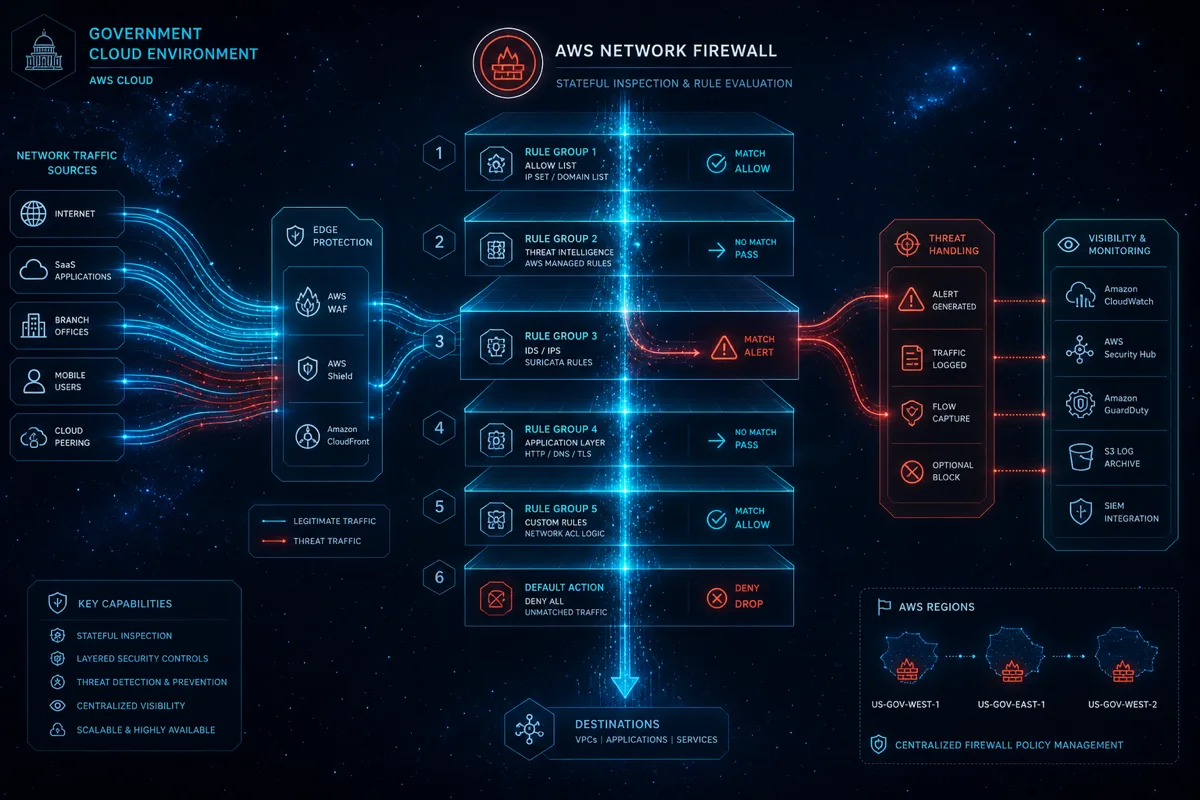
AWS Network Firewall is a managed, stateful network firewall service available in AWS GovCloud (US) that provides deep packet inspection, intrusion detection and prevention, and domain-based traffic filtering for federal cloud workloads. For teams implementing FedRAMP High or DoD IL4/IL5 authorization boundaries, Network Firewall is a critical control layer that supports NIST 800-53 boundary protection controls (SC-7 and related) with a native AWS service rather than a third-party virtual appliance.
This article covers AWS Network Firewall deployment patterns for federal cloud environments, rule group design, operational considerations, and how Network Firewall maps to compliance control requirements.
AWS Network Firewall in GovCloud: Capabilities and Authorization
AWS Network Firewall is FedRAMP High authorized in AWS GovCloud (US). Key capabilities:
Stateful traffic inspection: Network Firewall maintains connection state, enabling rules that consider traffic direction, connection context, and protocol-level parsing beyond simple IP/port matching.
Suricata-compatible rule engine: Network Firewall uses a Suricata-compatible rules engine for stateful rules, enabling detection of application-layer threats using standard Suricata rule syntax and access to the extensive public Suricata rule ecosystem.
Domain-name filtering: Network Firewall can allow or deny traffic based on DNS domain names rather than IP addresses — useful for controlling egress to known-malicious domains or implementing allowlist-based egress control without maintaining IP address lists.
Intrusion Prevention System (IPS): Network Firewall's managed rule groups from AWS and third-party providers provide IPS capabilities without maintaining custom threat signatures.
TLS inspection: Network Firewall supports TLS inspection (decrypting and inspecting encrypted traffic) for outbound flows — important for detecting threats that hide in encrypted traffic.
Network Firewall Deployment Patterns for Federal VPCs
Centralized inspection VPC pattern (most common for government):
In this pattern, a dedicated Inspection VPC houses the Network Firewall endpoints. All inter-VPC traffic and internet-bound egress routes through the Inspection VPC via AWS Transit Gateway. This centralizes security control in a single choke point, simplifies compliance evidence (all inspected traffic flows through one managed service), and allows a single team to manage firewall policy for multiple workload accounts.
The Traffic flow: 1. Workload VPC → Transit Gateway 2. Transit Gateway → Inspection VPC (firewall endpoints) 3. Network Firewall inspects traffic 4. Clean traffic → Transit Gateway → destination
Distributed inspection pattern: Network Firewall endpoints deployed in each VPC's dedicated subnet. Traffic inspection happens locally rather than centrally. More complex to manage but may be appropriate when workloads have different inspection requirements that don't suit a shared policy.
East-west (inter-VPC) inspection: Network Firewall can inspect lateral traffic between VPCs in a Transit Gateway topology, implementing micro-segmentation between application tiers or between environments (dev/test/prod). This supports zero trust segmentation principles for multi-account federal environments.
Rule Group Design for Federal Compliance Requirements
Network Firewall policies contain ordered rule groups — stateless rules processed first, then stateful rules for matching traffic. Effective rule group design for federal environments:
Baseline deny-all with explicit allowlist: Start from a default deny posture. Explicitly permit only required traffic flows. This inverts the traditional "allow all, deny specific threats" model and aligns with NIST 800-53 SC-7 boundary protection requirements.
FQDN allowlist for egress: Use domain-name based stateful rules to restrict egress to known-necessary destinations — AWS service endpoints, NTP servers, OS patch repositories, threat intelligence feeds. Reject all other egress by default. This significantly limits the blast radius of a compromised instance attempting to communicate with command-and-control infrastructure.
Threat detection rule groups: AWS Managed Rule Groups (AWS-ManagedThreatSignatures, AWSNF-ManagedDomainList, etc.) provide maintained threat signatures. Third-party managed rule groups from security vendors add additional coverage. Evaluate managed rule groups against false positive rates before deploying in blocking mode — start in alert mode to tune.
Protocol enforcement: Stateful rules can enforce protocol compliance — reject traffic that doesn't match expected protocol behavior on permitted ports (detecting port-misuse techniques).
Logging all blocked and allowed flows: Network Firewall supports logging of Alert actions (threat detections) and Drop/Reject actions to CloudWatch Logs, S3, or Kinesis Data Firehose. For compliance, logging all blocked traffic is essential — blocked traffic logs provide evidence of security control effectiveness and surface traffic patterns that may indicate reconnaissance or attack activity.
Compliance Mapping: NIST 800-53 SC Controls
AWS Network Firewall directly implements several NIST 800-53 SC (System and Communications Protection) controls:
SC-7 Boundary Protection: Network Firewall implements the monitored network boundary with traffic inspection and access control list functionality. Centralized inspection topology provides the "managed interfaces" required by SC-7.
SC-7(4) External Telecommunications Services: Controls requiring that external telecommunication services have appropriate interface protections. Network Firewall's egress filtering and domain allowlisting implements this control for workloads communicating with external services.
SC-7(5) Deny by Default: Denying all traffic by default with explicit allowances for required flows is the NIST SC-7(5) enhancement. Network Firewall's stateful rule engine supports this explicitly.
SC-7(8) Route Traffic to Managed Interfaces: The centralized inspection VPC pattern routes all egress through a managed Network Firewall interface, directly implementing this enhancement.
SI-3 Malicious Code Protection (network layer): Managed threat signature rule groups provide a network-layer malicious code detection capability.
Operational Considerations
Capacity planning: Network Firewall scales automatically but pricing is per firewall endpoint (not per traffic unit), so network topology affects cost. The centralized inspection pattern with shared endpoints is typically more cost-efficient than distributed endpoint-per-VPC patterns.
Rule group capacity units (CUs): Each firewall policy has a capacity limit for rule groups. Complex stateful rules consume more CUs. Monitor rule group utilization and plan capacity before deploying large third-party managed rule groups alongside custom rules.
Failopen vs. failclosed behavior: Network Firewall supports configuring failclosed (traffic dropped if firewall is unhealthy) behavior. For strict boundary protection, failclosed is the appropriate setting, accepting traffic disruption risk in exchange for maintaining security posture during firewall health events.
Rutagon designs and implements network security architectures for federal cloud environments — including AWS Network Firewall deployment, rule group engineering, and compliance documentation for FedRAMP and DoD authorization boundaries.
Explore Our Network Security Engineering →
Related reading: - Service Control Policies in GovCloud - Observability in Federal Cloud - Incident Management in Government Cloud
Frequently Asked Questions
Is AWS Network Firewall FedRAMP High authorized?
Yes. AWS Network Firewall is FedRAMP High authorized in AWS GovCloud (US). It is an authorized service within the AWS GovCloud FedRAMP High boundary and can be included in your system's authorization boundary for FedRAMP High ATOs.
What is the centralized inspection VPC pattern for AWS Network Firewall?
In the centralized inspection pattern, a dedicated Inspection VPC houses Network Firewall endpoints. All cross-VPC and internet-bound egress traffic routes through this inspection VPC via AWS Transit Gateway, with routing tables configured to pass traffic through the firewall before delivery to its destination. This centralizes security policy management and compliance evidence in a single, auditable choke point.
How does AWS Network Firewall compare to third-party virtual firewall appliances in GovCloud?
AWS Network Firewall is a fully managed service with no infrastructure to manage, built-in high availability, automatic scaling, and native integration with CloudWatch, S3, and Kinesis for logging. Third-party appliances (Palo Alto, Checkpoint, Fortinet) offer more advanced features (user-identity-based rules, advanced threat prevention, SSL inspection with full PKI management) at the cost of higher operational complexity and EC2 instance management. The choice depends on your security requirements and operational team capabilities.
What NIST 800-53 controls does AWS Network Firewall help implement?
AWS Network Firewall directly supports SC-7 (Boundary Protection) and its enhancements SC-7(4), SC-7(5), and SC-7(8). It also contributes to SI-3 (Malicious Code Protection) at the network layer through threat signature rule groups. Your System Security Plan should document which specific control implementations Network Firewall contributes to, with references to your specific rule group configuration.
How should I log AWS Network Firewall traffic for federal compliance?
Enable flow logging (all traffic, alert, or drop modes) to CloudWatch Logs, S3, or Kinesis Data Firehose. For compliance, log at minimum: all Alert-mode findings (threat detections), all Drop/Reject decisions, and all Accept decisions for flows crossing the authorization boundary. Implement log retention consistent with NIST 800-53 AU-11 requirements (typically 3 years for federal systems). Use S3 with lifecycle policies for long-term log archival.