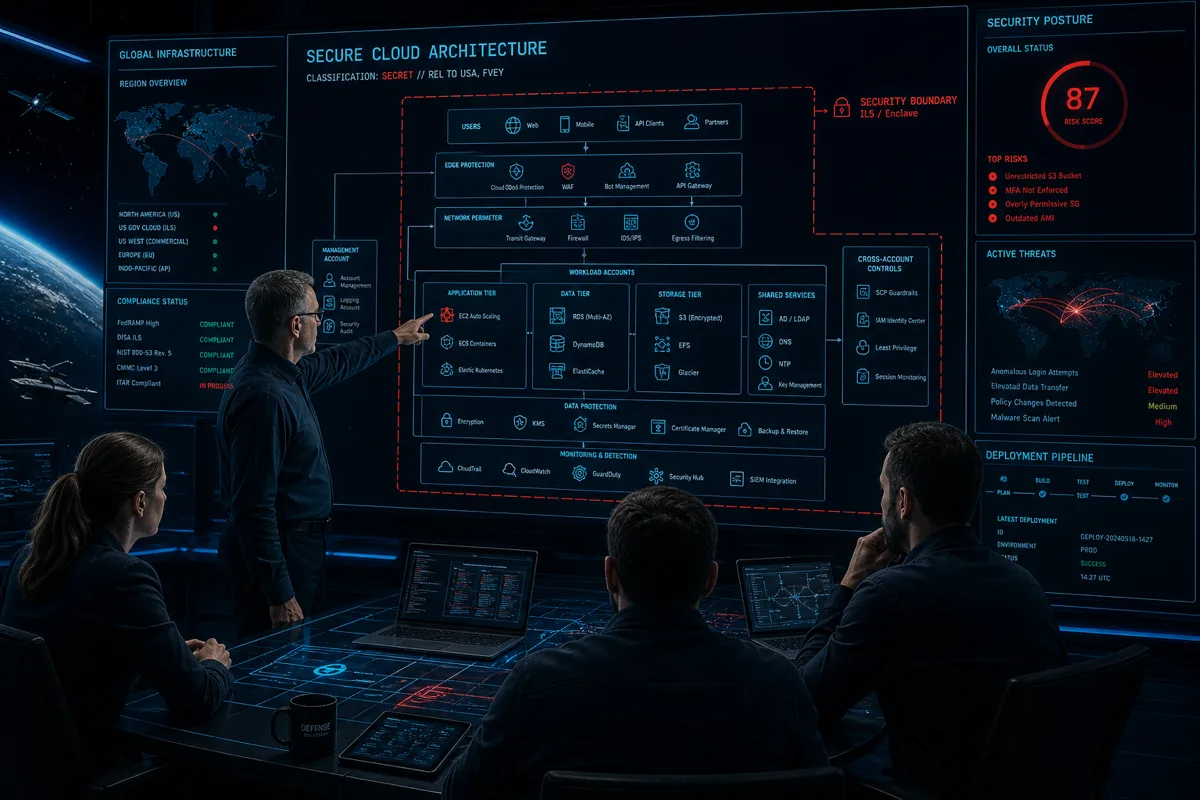
Cloud architecture reviews in defense programs serve a different purpose than reviews in commercial contexts. Commercial architecture reviews primarily optimize for scalability, performance, and operational cost. Defense cloud architecture reviews add mandatory dimensions: NIST 800-53 control coverage, authorization boundary integrity, ITAR/data classification adherence, and operational resilience requirements that reflect mission-critical dependencies. An architecture that would pass commercial review may fail a defense program review due to a single boundary protection gap or insufficient encryption implementation.
This article examines what effective cloud architecture reviews look like in defense contexts — the review dimensions, common findings, and practices that distinguish mature defense cloud architecture.
The Five Dimensions of a Defense Cloud Architecture Review
1. Authorization Boundary Integrity
The authorization boundary defines what systems and services are within scope of the Authority to Operate (ATO). Every component in a defense cloud system must either be: - Inside the authorization boundary (covered by the system's ATO or inheriting controls from the Cloud Service Provider's FedRAMP package), or - Explicitly excluded with documented justification
Common authorization boundary findings: - Third-party SaaS services used by the system that are not FedRAMP authorized - External APIs called from within the boundary to services without appropriate authorization - Development or CI/CD tooling that touches production systems but is outside the authorization boundary - Interconnections with external systems that lack appropriate ISA/MOU documentation
2. Encryption in Transit and at Rest
All data in a federal system must be encrypted in transit (TLS 1.2+ minimum, with TLS 1.3 strongly preferred) and at rest using FIPS 140-2 validated cryptographic modules. Common findings:
- Services using non-FIPS TLS cipher suites
- Data stored in S3 without default encryption or with non-customer-managed keys where CMK is required
- Database storage without encryption enabled
- Messaging services (SQS, Kinesis) without encryption configuration
- Internal service-to-service calls over plaintext HTTP rather than HTTPS
- Secret management using environment variable plaintext instead of Secrets Manager or Parameter Store (SecureString)
3. Network Segmentation and Traffic Control
FedRAMP and DoD authorization boundaries require controlled network interfaces. Review dimensions:
- All traffic crossing the authorization boundary passes through a controlled, monitored interface (Network Firewall, WAF, or equivalent)
- Least-privilege security groups (no 0.0.0.0/0 inbound rules except for intended public-facing services)
- Egress control for resources that should not initiate outbound connections
- VPC Flow Logs enabled for all VPCs with log retention consistent with AU-11 requirements
- Private subnet placement for all non-public-facing resources
4. Identity and Access Control
IAM architecture review covers:
- No overly-permissive IAM policies (particularly
*resource in production contexts) - No long-lived credentials (IAM access keys) for services that can use IAM roles
- MFA enforcement for all human user access (SCPs, IAM password policies, Cognito MFA for user-facing applications)
- Service account credential management (Secrets Manager rotation, no hardcoded credentials in code or configuration)
- External identity federation configuration (Okta, Active Directory) and SAML assertion validation
- Privileged access management — how emergency break-glass access works, who can escalate privileges, and how it's logged
5. Operational Resilience
Defense systems often support mission-critical operations. Architecture review examines:
- Recovery Time Objective (RTO) and Recovery Point Objective (RPO) defined and designed to
- Multi-AZ deployment for all stateful services (RDS Multi-AZ, DynamoDB Global Tables or regional replication, S3 Cross-Region Replication where needed)
- Backup configuration and restoration testing evidence
- Failure mode analysis — what fails if a specific component is unavailable? Is the failure contained or cascading?
- Auto-scaling and load balancing configuration for expected peak load scenarios
- Runbooks for common failure modes
Common Defense Cloud Architecture Findings
After reviewing multiple federal cloud architectures, recurring findings include:
Overpermissive IAM policies: The most common finding. Roles with "Resource": "*" where specific ARNs should be used, Administrator policies attached to functional roles, and execution roles shared across multiple functions or services.
Uncontrolled egress: Lambda functions, ECS tasks, or EC2 instances in VPCs with NAT Gateway access but no egress filtering. Any internet-accessible compute resource without egress control can exfiltrate data or phone home to attacker infrastructure.
Missing FIPS endpoint configuration: Services making AWS API calls using standard regional endpoints rather than FIPS-validated endpoints in GovCloud contexts.
Logging gaps: CloudTrail not enabled in all regions (including regions with no active workloads — attackers target unused regions), CloudWatch Log Groups without retention policies (defaulting to indefinite, which is not FedRAMP compliant for retention management), or application logs without sufficient detail for incident reconstruction.
Unencrypted secrets: API keys, database passwords, or certificates stored in SSM Parameter Store without SecureString designation, or in environment variable plaintext.
How Architecture Reviews Fit into the ATO Process
Cloud architecture reviews are directly relevant to the Risk Management Framework (RMF) process:
- Initial architecture reviews inform the System Categorization (FIPS 199) and Control Selection (SP 800-53 tailoring)
- Detailed architecture review findings surface control weaknesses that become POA&M items requiring remediation before authorization
- Annual continuous monitoring includes periodic architecture reviews to catch drift from the authorized baseline
For defense programs pursuing ATOs, documenting architecture review results and showing closure of identified findings is a positive signal to the Authorizing Official.
Rutagon conducts cloud architecture reviews for federal programs — from initial design review to pre-ATO assessment of AWS GovCloud architectures against FedRAMP High and DoD IL4/IL5 control baselines.
Explore Our Architecture Review Services →
Related articles: - Service Control Policies in GovCloud - AWS Network Firewall for Government - Lambda Security in Government Cloud
Frequently Asked Questions
What is a cloud architecture review and why does it matter for defense programs?
A cloud architecture review is a structured assessment of a cloud system's design against security, compliance, and operational requirements. In defense contexts, it examines authorization boundary integrity, encryption, network controls, IAM, and resilience against FedRAMP, NIST 800-53, and program-specific requirements. Architecture reviews identify control gaps before they become POA&M items in an ATO assessment — catching problems at design time is dramatically less expensive than remediating after deployment.
Who should conduct a defense cloud architecture review?
Effective reviews require people with both cloud engineering depth (understanding of specific AWS service configurations and their security implications) and defense compliance expertise (NIST 800-53 control mapping, FedRAMP inheritance models, RMF process understanding). The combination is rare — most cloud architects know engineering; most compliance professionals know the framework. The most valuable reviewers know both.
How often should defense cloud architectures be reviewed?
Initial review at system design phase; a pre-ATO architecture review before submitting the authorization package; and annual or semi-annual reviews as part of continuous monitoring. Reviews should also be triggered by significant changes: adding a new AWS service, changing a network boundary, modifying IAM architecture, or adding an external system interconnection.
What is the most common architecture finding in federal cloud systems?
IAM over-permission is consistently the most common finding — roles with * resource access, administrator policies attached to functional service roles, or execution roles shared across multiple components. Overpermissive IAM dramatically increases the blast radius of any compromise — a compromised function or service can access far more than it should.
How does an architecture review relate to FedRAMP ATO evidence?
Architecture review findings and their closure become part of the authorization package documentation — specifically in the System Security Plan (SSP) and the Plan of Action and Milestones (POA&M). Showing that you conducted rigorous architecture review, identified weaknesses, and addressed them before authorization demonstrates security process maturity to the Authorizing Official. Unreviewed architectures that surface major findings during the formal ATO assessment create delays and compliance risk.