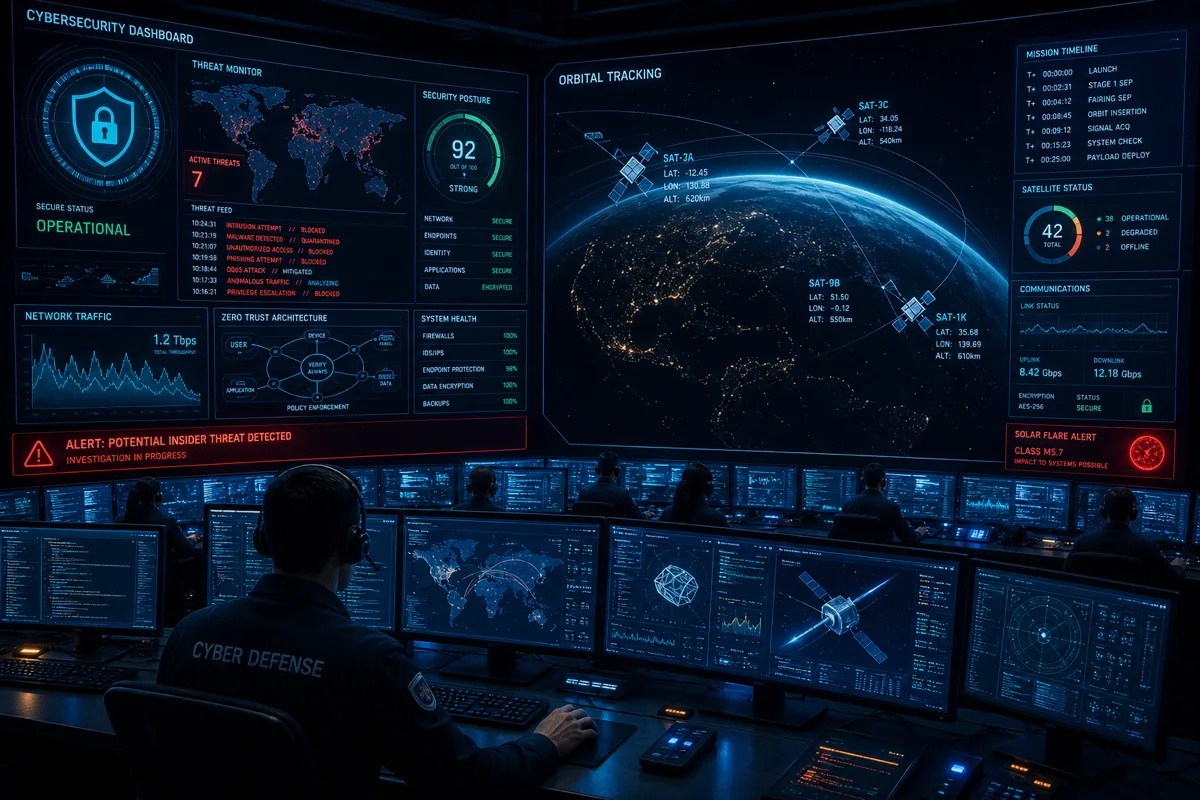
Space systems occupy a unique position in the cybersecurity threat landscape: once a satellite is on orbit, physical access for remediation is impossible. A software defect that corrupts a spacecraft's flight software, an attack that compromises ground control authority, or a cyberattack on mission data infrastructure can have irreversible consequences — lost capability, wasted resources, or operational failure at critical moments. This inherent unrecoverability elevates the stakes of cyber resilience engineering for space programs.
Cyber resilience in space systems — the ability to anticipate, withstand, recover from, and adapt to adverse cyber conditions — requires engineering disciplines that span ground systems, space-ground communications, and mission data infrastructure.
The Cyber Threat Landscape for Space Systems
Space systems face a distinctive threat profile:
Ground segment attacks: The ground control system is the primary interface to the spacecraft — and the most commonly targeted element. Compromising ground control could enable unauthorized commands, denial of service to the spacecraft, or exfiltration of mission data. Ground segment cybersecurity is the most tractable element for conventional defensive measures.
Command link spoofing and jamming: The command uplink — the RF link from ground to spacecraft — is a potential attack vector. Spoofed commands (appearing legitimate to the spacecraft) could disrupt operations; jamming blocks legitimate commands. Encryption and authentication of command links is the primary mitigation.
Data exfiltration: Mission data, particularly from intelligence-collecting space systems, is a high-value target. Data exfiltration from ground processing or archive systems is a persistent concern.
Supply chain risk: Space system software and hardware components have complex supply chains. Compromised components — whether hardware trojans or malicious software — can undermine the security of systems where post-integration validation cannot detect the compromise.
Insider threat: Space program operations involve a limited set of highly trusted individuals with significant operational authority. Insider threat programs and separation of duties controls are particularly important in space operations contexts.
Ground System Cyber Resilience Engineering
Ground control systems are the most directly defensible element of a space system. Engineering practices for ground system resilience:
Defense in depth: No single control should be the last line of defense. Layer perimeter controls (Network Firewall, WAF), host controls (EDR, OS hardening), application controls (authentication, authorization, input validation), and data controls (encryption, access logging). An attacker who penetrates one layer faces additional barriers.
Command authorization and authentication: - All commanding must require strong authentication (MFA for operators) - High-impact command types (mode changes, payload configuration, orbit maneuvers) should require independent authorization (two-person integrity) - Every command must be logged with operator identity, timestamp, and command content - Command validation logic should reject malformed or out-of-range command parameters before uplink
Separation of network domains: Network separation between mission operations networks, mission data processing networks, and administrative/enterprise networks is a fundamental architectural principle. Mission-critical command and control functions should not share network infrastructure with enterprise IT.
Continuous monitoring: Ground system security monitoring must detect anomalies in real time — unusual operator behavior patterns, unexpected system-to-system communications, credential usage from unexpected locations. Security information and event management (SIEM) or equivalent monitoring capability should ingest and correlate events across all ground segment components.
Vulnerability management: Ground system software requires continuous patching against known vulnerabilities. The tension between operational continuity (avoiding unplanned maintenance windows) and security (patching promptly) is a design challenge that must be explicitly addressed in operational procedures.
Command Link Security Principles
Space-ground command link security has been a focus of the space industry and government sponsors:
Command encryption: Encrypting the command uplink prevents passive interception and replay of commands. NSA Type 1 encryption is the standard for classified space programs; commercial space programs use varying levels of cryptographic protection.
Command authentication: Even if an adversary cannot encrypt their own commands, they might attempt to replay captured legitimate commands. Sequence counters, timestamps, and authentication codes that prevent replay are part of a robust command authentication scheme.
Uplink frequency and pattern protection: Regular patterns in uplink frequency and timing can aid adversary jamming and spoofing. Variable uplink parameters reduce predictability for adversaries attempting to exploit the command link.
Mission Data Resilience
Mission data — the product of the space system's operational mission — requires resilience across its lifecycle:
Archive integrity: Mission data archives must maintain integrity over time. Periodic integrity verification of archived data (hash verification of archived files) detects corruption or tampering.
Access control and audit: Access to mission data must be controlled (authorized users and systems only) and audited (comprehensive logs of who accessed what data, when). In programs with multiple consumer organizations, access control granularity matters — different consumers should see only the data they're authorized to access.
Availability and redundancy: Mission data that is only stored in one location is vulnerable to hardware failure, natural disaster, or targeted attack. Multi-site data replication (using appropriate classification-level infrastructure at each site) ensures operational continuity.
Assured delivery to consumers: Mission data that doesn't reach authorized consumers in time has failed its purpose. Resilient delivery architectures — with queued delivery, acknowledgment-based protocols, and fallback paths — ensure data reaches consumers even when components fail.
Incorporating Resilience Requirements into Space Program Engineering
Cyber resilience doesn't emerge from cybersecurity overlays applied late in a space program — it must be designed in from the beginning:
- System requirements should include specific cyber resilience requirements (not just vague "shall be secure" language)
- System architecture reviews should explicitly evaluate resilience against defined threat scenarios
- Test and evaluation should include adversarial testing of security controls (penetration testing of ground systems, command link security testing)
- Operations procedures should define responses to specific cyber incidents
Rutagon brings cloud infrastructure and software engineering expertise to space program ground systems and mission data architectures — designing systems with the resilience and security assurance that mission-critical space programs require.
Learn About Rutagon's Aerospace Capabilities →
Related articles: - Space Operations Cloud Systems - Mission Systems Engineering: The Subcontractor's Role - Cloud Architecture Reviews for Defense Programs
Frequently Asked Questions
Why are space systems uniquely challenging from a cybersecurity perspective?
Space systems are uniquely challenging because the primary asset (the spacecraft) is physically inaccessible once on orbit — remediation of a compromised spacecraft computer, whether through software update or physical intervention, is impossible or extremely limited. This means cyber resilience must be engineered in from design rather than patched after the fact. A successful attack on spacecraft flight software or the ground command system could cause irreversible mission loss.
What is two-person integrity in space command and control?
Two-person integrity (TPI) requires that high-consequence actions — particularly orbit maneuvers, mode changes, or other commands with large operational impact — be independently authorized by a second qualified operator before execution. This prevents a single individual (whether through error or malicious intent) from unilaterally executing high-consequence commands. TPI is a standard requirement in national security space operations and is increasingly adopted in commercial programs.
How does cyber resilience relate to space mission assurance?
Mission assurance is the discipline of ensuring that a space system can accomplish its mission despite failures, threats, and adverse conditions. Cyber resilience is a component of mission assurance — specifically addressing the adversary-created aspects of the threat environment. A comprehensive mission assurance program addresses both non-adversarial risks (hardware failure, radiation effects, debris) and adversary-created risks (cyber attacks, jamming, spoofing).
What standards or frameworks guide space system cybersecurity?
Key frameworks include: NIST SP 800-82 (Industrial Control Systems Security, applicable to spacecraft commanding) and NIST 800-53 for ground information systems; CNSS Policy 12 for government space programs; Space ISAC threat intelligence; and emerging DoD Space Security guidance. For national security space programs, program-specific classified security requirements supplement these frameworks.
How should space program ground systems handle insider threat?
Insider threat programs for space ground systems typically include: access control limiting each operator to only required functions (least privilege), separation of duties for high-consequence actions (TPI), comprehensive audit logging of all system access and commanding, behavioral monitoring for anomalous patterns, personnel security clearance maintenance and periodic reinvestigation, and security awareness training that includes threat reporting procedures.