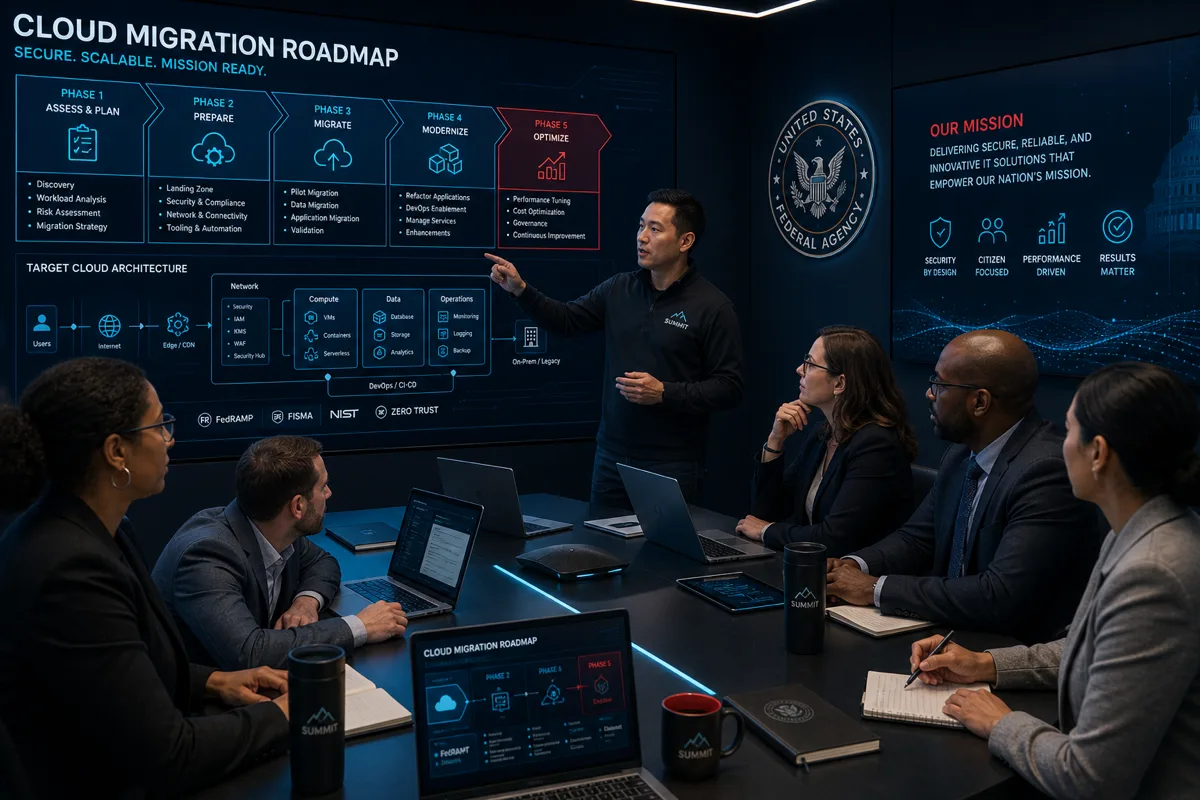
Federal cloud migration has been a government-wide priority since the Federal Cloud Computing Strategy, and the pace of migration continues as agencies move off legacy data centers and on-premises infrastructure toward FedRAMP-authorized cloud services. For small IT businesses with cloud engineering expertise, federal cloud migration programs represent one of the most durable and substantive opportunity areas in government IT.
This article examines how small IT firms engage in federal cloud migration programs — the capabilities that are most valued, the acquisition paths that create opportunities, and the technical approaches that differentiate smaller firms from large system integrators.
The Federal Cloud Migration Landscape
Federal cloud migration encompasses a wide range of activities:
Application assessment and portfolio rationalization: Evaluating legacy applications against a migration framework (the classic 6 Rs: Rehost, Replatform, Refactor, Repurchase, Retire, Retain) to determine the right approach for each system. This analysis work is a natural entry point for smaller firms with cloud expertise.
Infrastructure migration: Moving servers, databases, and storage from on-premises data centers to IaaS (Infrastructure as a Service) cloud environments. "Lift and shift" migrations can be straightforward in concept but complex in execution across large application portfolios.
Application modernization: Refactoring legacy monolithic applications into cloud-native architectures (microservices, containers, serverless functions). This requires deep software engineering capability and is where smaller specialist firms can genuinely outperform large integrators on quality and speed.
Cloud-native development: Building new systems directly on cloud-native services from the ground up, leveraging managed services to reduce operational overhead. Federal teams increasingly prefer this approach for new capabilities.
DevSecOps platform implementation: Building the CI/CD pipelines, infrastructure-as-code frameworks, and security automation that allow agency development teams to deliver software continuously.
Why Small IT Firms Have an Advantage in Federal Cloud
Large system integrators offer broad coverage and massive scaling capacity, but they carry overhead that shows up in program execution: bureaucratic decision-making, senior talent deployed elsewhere replaced by junior staff, and a billing-hours model that rewards complexity over efficiency.
Small firms with genuine cloud engineering depth offer:
Direct access to senior engineers: In a small firm, the person who scoped and proposed the work is often the person doing the work. Federal program managers report significantly better technical outcomes when they have direct access to engineers rather than rotating through layers of project management.
Agility in technical decisions: Smaller teams make technical decisions faster. When a migration approach hits a technical obstacle, a small firm team can pivot without going through multiple approval layers.
Specialization depth: A small firm that exclusively does AWS GovCloud infrastructure engineering develops institutional knowledge that a large integrator's horizontal IT practice can rarely match.
Cost efficiency: Small business overhead rates are typically significantly lower than large business fully loaded rates — the same number of engineer-hours costs less through a small business.
FedRAMP's Role in Federal Cloud Migration Opportunities
Federal cloud migrations specifically require FedRAMP-authorized services, which creates a well-defined market. Agencies must transition workloads to FedRAMP-authorized cloud service offerings. The implementation of those migrations — architecture design, data migration, application adaptation, security configuration, ATO package support — is where service firm opportunity lies.
Small IT businesses that develop expertise in FedRAMP-authorized service deployments (AWS GovCloud, Azure Government, Google Cloud for Government) and can demonstrate an understanding of the RMF/ATO process are positioned for federal cloud migration work. Certifications and documented past performance with FedRAMP systems are the primary credentialing mechanisms.
Acquisition Paths for Small Business Cloud Migration Work
GSA MAS 54151S: As discussed in our GSA MAS guide, IT services including cloud migration are procured through MAS by many civilian agencies. Small businesses can hold their own MAS contracts or pursue work as subcontractors.
SEWP (NASA Solutions for Enterprise-Wide Procurement): SEWP is a government-wide acquisition contract that includes cloud-related IT services. SEWP holders include both large businesses and small businesses.
Agency-specific BPAs and IDIQs: Many agencies establish Blanket Purchase Agreements (BPAs) against MAS or standalone IDIQs for their recurring IT needs, including cloud support. Small businesses that develop relationships with specific agencies can pursue BPA placement.
Subcontracting under OASIS, CIO-SP4, or 8(a) STARS III: Small businesses participate in large IT contract vehicle orders as subcontractors when they have specific cloud capability the prime contractor lacks.
Differentiated Capabilities That Win Cloud Migration Work
Multi-account Landing Zone implementation: Designing and building the foundational cloud account structure (Control Tower or custom), networking topology, identity federation, and security service baseline that all workloads share. This foundational work is high-leverage and creates ongoing engagement opportunities as the agency migrates workloads.
Infrastructure as Code (IaC) development: Terraform, AWS CDK, or CloudFormation templates for all infrastructure, enabling repeatable, auditable deployments. IaC expertise is consistently valued in federal cloud programs.
Container platform engineering: ECS or EKS environments for application modernization programs. Container expertise differentiates cloud migration firms in agencies pursuing microservices modernization.
Database migration and modernization: Migrating legacy Oracle, SQL Server, or mainframe data to cloud-native databases (RDS, DynamoDB, Aurora, Redshift) is technically complex work where deep expertise matters.
Rutagon brings AWS GovCloud engineering depth to federal cloud migration programs — from landing zone design and IaC development to application modernization and DevSecOps platform implementation.
Learn About Rutagon's Cloud Migration Capabilities →
Related articles: - ECS Fargate in AWS GovCloud - Service Control Policies in GovCloud - Cloud Architecture Review for Defense Programs
Frequently Asked Questions
What federal cloud migration opportunities are best suited for small IT businesses?
Small IT businesses with cloud engineering depth are well-positioned for: application assessment and portfolio analysis, infrastructure-as-code development and landing zone implementation, container platform engineering, DevSecOps pipeline implementation, and specific application modernization efforts. These engagements reward technical depth over organizational scale.
Does a small business need its own FedRAMP ATO to work on federal cloud migrations?
No. Small IT service businesses provide engineering services to help agencies implement FedRAMP-authorized cloud services — they don't need a FedRAMP ATO themselves (that's required for cloud service providers, not service firms). However, familiarity with the FedRAMP authorization process, NIST 800-53 controls, and RMF documentation is essential for credibility in this market.
How does a small IT firm build past performance for federal cloud migration?
Build federal past performance through: smaller agency IT work that includes cloud components, subcontracting on larger cloud migration programs (with CPARS ratings from prime contractors), contributing to open-source federal cloud tools, and documenting technical contributions with specific outcomes (systems migrated, cost savings achieved, ATO timelines reduced). Start with any federal agency work that includes cloud components, regardless of scope.
What certifications matter most for federal cloud migration work?
AWS certifications (Solutions Architect Professional, Security Specialty, DevOps Engineer Professional) are the most recognized credentials for AWS GovCloud work. CompTIA Security+ is commonly required for personnel working in federal environments. CISSP is valued for security-forward roles. For senior technical roles, combination of AWS certifications with Security+ and documented FedRAMP experience is a strong credential set.
What is a Cloud Landing Zone and why does it matter for federal cloud migration?
A Cloud Landing Zone is the foundational multi-account structure, networking topology, identity configuration, and security service baseline that agencies deploy before migrating workloads to the cloud. Getting the landing zone right determines how secure, scalable, and cost-efficient the eventual cloud environment is. Small firms that specialize in GovCloud landing zone design and implementation with IaC provide high-value, foundational work that creates long-term relationships.