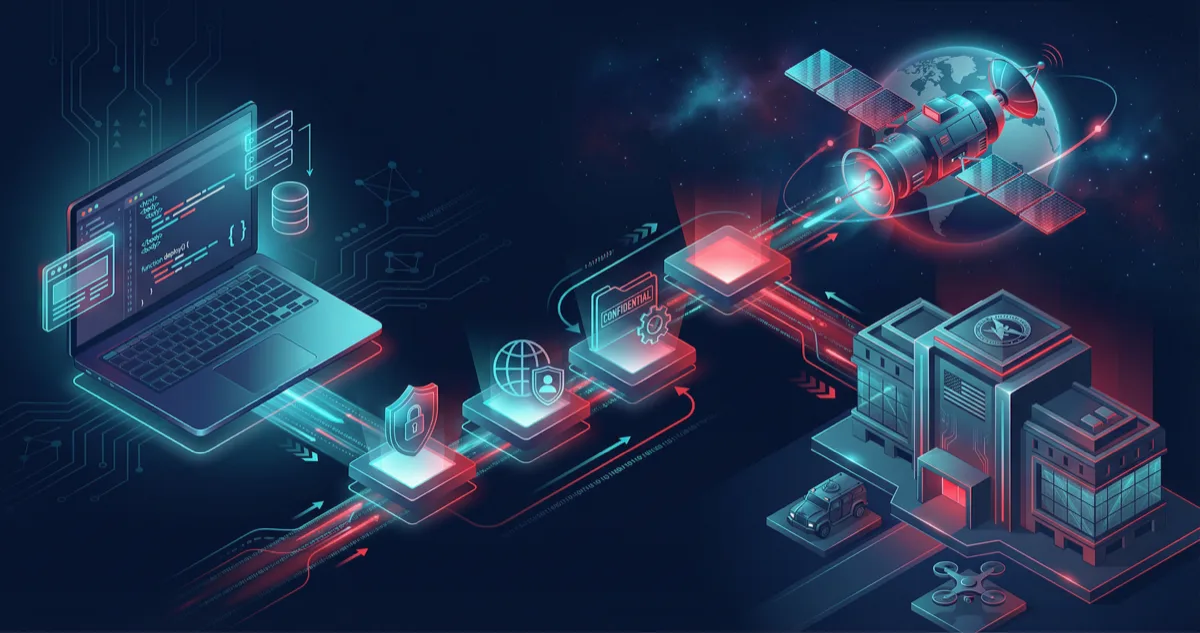
Most defense contractors did not start as defense contractors. They started as something else — often something much smaller, much scrappier, and much closer to the ground. Rutagon started as a web development company in Alaska. Today, we are a federally trademarked technology company (US Reg. #8133222) with the tagline "Software. AI. Defense. Space." — building production software, implementing CMMC-level security architecture, and positioning for aerospace and defense contracts.
This is the honest story of that web dev to defense contractor journey: what we built, what we learned, the decisions that mattered, and the parts that were harder than anyone tells you.
Starting with Commercial Web Development
Every defense contractor needs past performance. The catch is that you cannot win contracts without past performance, and you cannot get past performance without contracts. The way out of that loop — the only legitimate way — is building real products that serve real customers.
Rutagon's first commercial products were not government systems. They were applications that solved real problems for real users, built with the same engineering discipline we now apply to government work.
The commercial web development phase was not a stepping stone we endured on the way to government work. It was where we developed the engineering practices that make us credible today. Production applications that serve real users with real uptime requirements teach lessons that proposals and theoretical architectures never will.
Building a Real SaaS Product
Our commercial SaaS platform serves professionals across iOS, Android, web dashboard, and a backend spanning 25+ AWS services. Building a production SaaS product taught us what production software actually requires.
Infrastructure complexity is multiplicative. A mobile app is not just a frontend. It is a frontend, a backend API, a database, authentication, push notifications, file storage, CDN, monitoring, and the CI/CD pipelines to deploy all of it. The platform's backend uses Aurora Serverless v2 (PostgreSQL), Lambda, API Gateway, S3, CloudFront, Cognito, SES, Pinpoint, and more — 25+ AWS services, each configured, secured, monitored, and maintained.
Multi-platform development demands discipline. Shipping features simultaneously across iOS, Android, and web requires shared API contracts, consistent behavior specifications, and test coverage that validates all three clients. A bug in the API affects three platforms, not one.
Users do not care about your architecture. The app needs to launch fast, work reliably, and never lose data. Every architectural decision is ultimately measured by user experience, not technical elegance.
The platform gave us production experience with the full AWS ecosystem, mobile and web development, and the operational reality of keeping a SaaS platform running. When we discuss our AWS capabilities with government clients, we are not talking about labs or proofs of concept. We are talking about a production system that runs today.
Content Platform Engineering
Our content platform delivers 30+ pages with sub-second load times, managed entirely through Terraform-deployed AWS infrastructure.
Building the content platform refined a different set of skills:
Infrastructure as code from day one. Every resource — CloudFront distributions, S3 buckets, Route 53 records, WAF rules — is defined in Terraform and deployed through CI/CD. No console-clicked resources. No configuration that exists only in someone's memory. This discipline translates directly to the infrastructure-as-code requirements of government contracts.
Performance engineering. Sub-second load times on a content-heavy site require CDN configuration, image optimization, efficient rendering, and caching strategies. The platform serves pages fast because we engineered it to, not because we got lucky with simple content.
Accessibility-first development. Building with Section 508 and WCAG 2.1 AA standards from the component level up, not retrofitting accessibility before launch. This practice — detailed in our article on building 508-compliant websites — positions us for government web development where accessibility is a contractual requirement.
Content operations at scale. Managing 30+ pages of content with consistent quality, SEO optimization, and regular publishing cadence requires systems and processes, not just good writing. The content operations practices we built scale to larger publishing operations.
The Decision to Pursue Government Contracting
The move from commercial products to government contracting was deliberate, not accidental. Several factors drove the decision:
Engineering depth matched government needs. The skills required to build secure, scalable, well-architected production systems are exactly what government agencies need — and often struggle to get from contractors who staff projects with junior developers managed by senior proposal writers.
Alaska's defense ecosystem. Operating in Alaska puts Rutagon near JBER, Eielson Air Force Base, Clear Space Force Station, and the broader Arctic and space defense mission. These installations need software, cybersecurity, and systems engineering from companies with local presence and the right certifications.
Small business set-asides. The federal government mandates that a significant percentage of contracting dollars go to small businesses. Rutagon qualifies as a small business for all our relevant NAICS codes (541511, 541512, 541519, 518210). The market structure creates real opportunity for small companies with genuine capability.
Long-term strategic alignment. Government and defense contracts provide revenue stability that complements the cyclical nature of commercial product revenue. Building a company that serves both commercial and government clients diversifies risk and creates compound capability — technology developed for one market often applies to the other.
Building Security Architecture Before You Need It
The most counterintuitive lesson in government contracting: implement security before you have a contract that requires it.
Rutagon runs zero long-lived credentials across all AWS accounts. Our CI/CD pipelines authenticate through OIDC federation with 15-minute session tokens. Multi-account AWS Organizations architecture isolates workloads. GuardDuty, CloudTrail, and AWS Config monitor everything. This is our CMMC-level security architecture — described in detail in our CMMC security architecture approach article.
We did not build this because a contract required it. We built it because it is the right way to operate, and because demonstrating an existing security posture is far more credible than promising to implement one after contract award.
The cost of implementing security architecture for a small company is real — time, tooling, and operational overhead. But the cost of trying to bolt on CMMC compliance after winning a contract that requires it is higher, and the risk of failing the assessment is unacceptable.
The Registration and Certification Gauntlet
Government contracting requires an alphabet of registrations and certifications:
SAM.gov — System for Award Management. Registration is required to bid on federal contracts. The process involves UEI assignment, entity validation, and representations and certifications that take 2-4 weeks to process. Our registration is pending.
NAICS codes — North American Industry Classification System codes define what work your company does. Selecting the right codes matters — they determine which set-aside opportunities you can pursue and what size standard applies. We registered under 541511 (Custom Computer Programming), 541512 (Computer Systems Design), 541519 (Other Computer Related Services), and 518210 (Computing Infrastructure Providers).
Federal trademark — Our "Rutagon" trademark (US Reg. #8133222) establishes brand identity and protects our name in the government marketplace.
CMMC — Cybersecurity Maturity Model Certification is required for DoD contracts handling CUI. We implement CMMC Level 2 controls now, positioning for formal certification when contract requirements dictate.
Each registration and certification is a gate, not a barrier. They take time and attention but are navigable for any company willing to invest the effort.
Looking Forward: Aerospace and Space
Rutagon's tagline is "Software. AI. Defense. Space." The first three words describe what we do today. The fourth describes where we are building toward.
Our aerospace vision builds on three foundations:
Technical capability. Production software engineering, secure cloud infrastructure, and AI/ML data processing are the building blocks of space domain awareness and satellite data systems.
Geographic advantage. Alaska's position for polar orbit ground stations, Arctic domain awareness, and proximity to space-focused military installations creates natural alignment between our location and our mission.
Innovation pathways. Government programs fund technology development at small businesses through micro-purchases, simplified acquisitions, and other transaction authorities. These mechanisms are the on-ramp for companies transitioning from commercial software to defense and aerospace technology.
The journey from web development to defense contractor is not fast. It takes years of building real products, developing security practices, navigating registration requirements, and establishing credibility. But each step — each production application, each security improvement, each certification — compounds into a capability portfolio that large competitors cannot replicate with their overhead structures and legacy technology investments.
Rutagon is early in its government contracting journey. We are farther along than most companies that talk about government work and not as far as companies that have been doing it for decades. The difference is that we build from a foundation of real products, real infrastructure, and real engineering — not proposals about what we plan to do.
For more on how we position within Alaska's defense ecosystem, see Alaska: a strategic hub for space and defense tech.
Frequently Asked Questions
How long does it take to transition from commercial software to government contracting?
Realistically, 1-3 years from the decision to pursue government work to the first contract award. SAM registration takes weeks. Building past performance that government evaluators respect takes longer. Security certifications require significant investment. The timeline compresses if you have relevant commercial past performance — production SaaS platforms, cloud infrastructure management, and security architecture work all translate directly.
Do you need existing government contracts to break into defense contracting?
No, but you need credible past performance. Commercial production applications count. Agencies evaluate whether your company can deliver similar technical work, not whether you have previously done it for the government specifically. Our production SaaS platform and content platform demonstrate the ability to architect, build, deploy, and maintain production software — which is what IT contracts require. Subcontracting and micro-purchase wins are common entry points that build government-specific past performance.
How much does it cost to get started in government contracting?
SAM registration is free. CMMC implementation costs depend on your existing security posture — for a company already running modern cloud infrastructure with good security practices, the marginal cost is modest. The primary cost is time — registration, proposal writing, capability briefings, and business development all require hours that would otherwise go to billable engineering work. Budget for $5,000-$20,000 in direct costs (legal, compliance, proposal tools) and significant founder time investment.
Is government contracting profitable for small software companies?
Government IT contracts typically carry margins of 10-20% for services work and higher for product licenses. The profitability advantage for small businesses is lower overhead — we do not maintain a business development office in Crystal City, we do not employ a proposal factory, and our engineering team writes code rather than managing subcontractors. Lower overhead means higher margins on the same contract value. The challenge is winning enough contract volume to sustain the company through the inherently lumpy procurement cycle.
What advice would you give to a software company considering government contracting?
Build real products first. Not demos, not proofs of concept — production applications with real users, real uptime, and real engineering challenges. Implement security architecture before you need it. Register on SAM.gov. Start with micro-purchases or subcontracting to build government-specific past performance. And be honest about the timeline — this is a multi-year investment, not a pivot that pays off in a quarter.
Discuss your project with Rutagon
Contact Us →