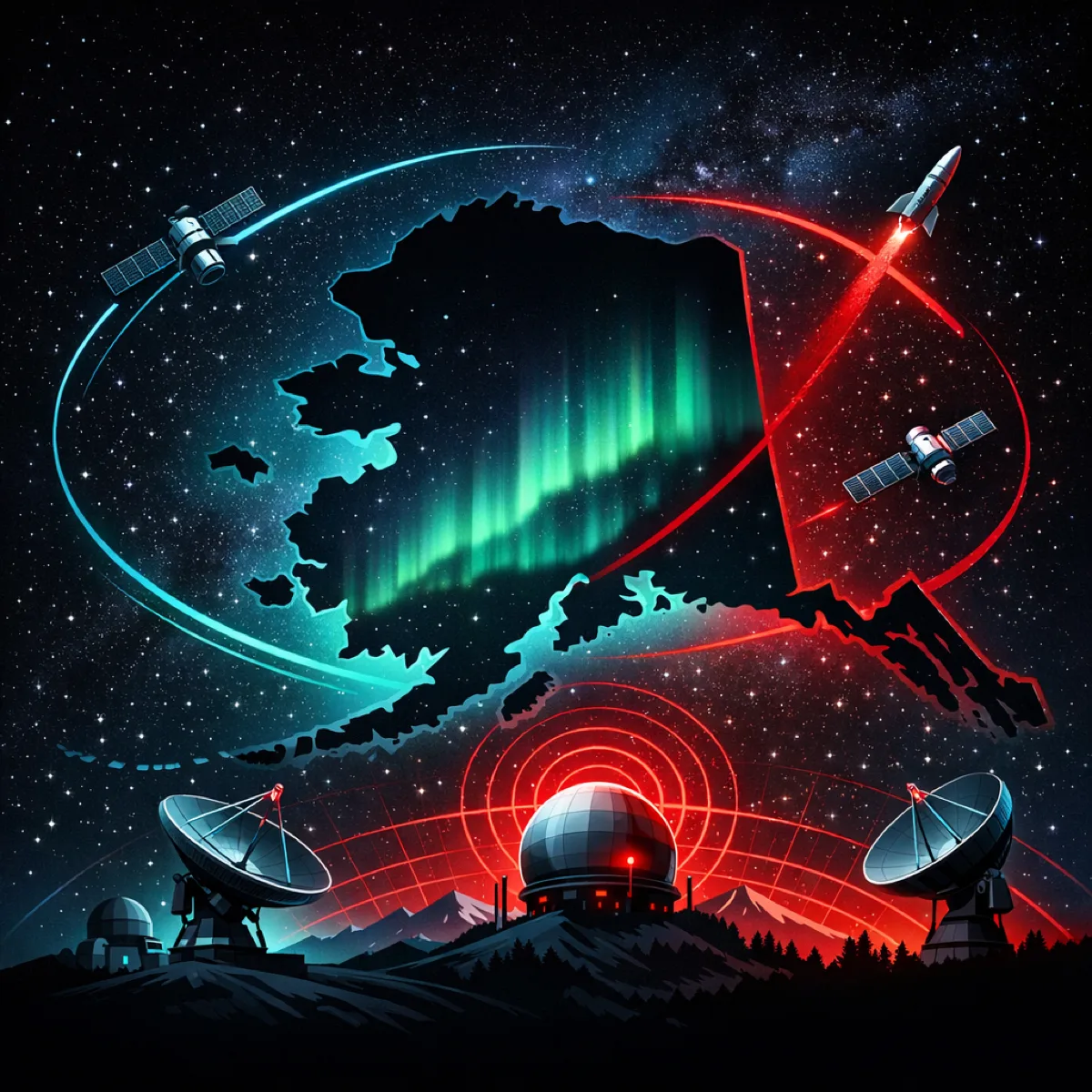
Alaska is not where most people imagine defense technology companies operate. Silicon Valley, the Washington D.C. corridor, and Colorado Springs dominate the conversation. But Alaska's geography, military infrastructure, and research institutions make it a strategic hub for space and defense tech that is increasingly difficult for the industry to overlook — and increasingly attractive for companies like Rutagon that build at the intersection of software, security, and space.
This is not boosterism. The strategic advantages are geographic, institutional, and operational. Alaska's position on the globe, its concentration of military assets, and its direct relevance to the space and Arctic domains create an environment where defense technology companies can build capabilities that cannot be replicated from the Lower 48.
Polar Orbit Access
The single most significant geographic advantage Alaska offers for space technology is access to polar orbits. Satellites in sun-synchronous and polar orbits — used for Earth observation, weather monitoring, reconnaissance, and communications — pass over Alaska on nearly every revolution.
A ground station at 64° North latitude can communicate with a polar-orbiting satellite on 12-14 of its daily passes, compared to 4-6 passes visible from mid-latitude stations in the continental United States. This means more contact time per day, faster data downlink, and lower latency between collection and processing.
The practical impact is substantial:
- Earth observation satellites downlink imagery to Alaska ground stations within minutes of collection over the Arctic, Pacific, or Asian theaters
- Weather satellites in polar orbit provide data to Alaska-based facilities faster than to CONUS stations
- Communications satellites in Molniya and highly elliptical orbits have extended visibility windows from Alaska
The Alaska Satellite Facility (ASF) at the University of Alaska Fairbanks operates one of the most active satellite ground station complexes in the world, supporting NASA, NOAA, ESA, and commercial operators. This infrastructure exists today and continues to expand.
For a defense technology company focused on space domain awareness, proximity to this ground station infrastructure is not a convenience — it is a competitive necessity. Real-time satellite data processing, as we described in our satellite data processing with AI article, depends on minimizing the time between satellite pass and data availability.
Military Installations
Alaska hosts some of the most strategically significant military installations in the United States.
Joint Base Elmendorf-Richardson (JBER)
JBER is the largest military installation in Alaska, home to the 11th Airborne Division, the 3rd Wing (F-22 Raptors), and Pacific Air Forces elements. The base supports power projection into the Pacific and Arctic theaters.
For defense technology companies, JBER represents both a customer and a neighbor. IT modernization, cybersecurity, and mission support systems at JBER create contracting opportunities for companies with local presence and security clearance capability.
Eielson Air Force Base
Eielson hosts F-35A Lightning II squadrons and supports Red Flag-Alaska — one of the largest tactical fighter exercises in the world. The base's role in fifth-generation fighter operations drives demand for advanced data processing, mission planning systems, and secure communications infrastructure.
Clear Space Force Station
Clear SFS operates the Long Range Discrimination Radar (LRDR) — a next-generation missile defense sensor that tracks ballistic missile threats and space objects. Clear SFS is a cornerstone of the U.S. missile defense architecture and a key node in the space surveillance network.
The LRDR's space surveillance mission generates massive volumes of tracking data that require processing, analysis, and integration with the broader space domain awareness picture. Companies building software for space surveillance and missile defense benefit from proximity to the sensor and the operators who use the data.
Fort Greely
Fort Greely hosts Ground-Based Midcourse Defense (GMD) interceptors — the United States' primary defense against intercontinental ballistic missile threats. The installation's missile defense mission creates demand for secure computing, real-time data processing, and systems integration.
Arctic Domain Awareness
The Arctic is no longer a strategic backwater. Climate change has opened new shipping routes, exposed new natural resources, and created new security challenges. Russia, China, and the United States are all increasing their Arctic presence, and Alaska is America's Arctic.
Arctic domain awareness requires:
- Maritime surveillance — tracking vessel traffic through increasingly navigable Arctic waters
- Environmental monitoring — observing ice conditions, weather patterns, and environmental changes that affect military operations and civilian safety
- Undersea awareness — monitoring submarine activity in Arctic waters
- Communications — maintaining connectivity in a region where traditional satellite coverage is limited by orbital geometry (geostationary satellites cannot cover the poles)
These requirements create demand for exactly the kind of technology Rutagon builds: cloud-based data processing platforms, real-time dashboards, secure communications systems, and AI-enabled analytics.
The Department of Defense's Arctic Strategy explicitly calls for enhanced domain awareness capabilities. Alaska-based companies are positioned to deliver these capabilities with the geographic context and operational proximity that remote contractors lack.
University of Alaska Research
The University of Alaska system — particularly the Fairbanks campus (UAF) — conducts research directly relevant to space and defense technology.
Geophysical Institute — Research in space physics, atmospheric science, and remote sensing. The institute operates the Poker Flat Research Range — the only university-owned rocket launch facility in the United States — and a network of geophysical observatories.
Alaska Satellite Facility — Operated by UAF, ASF is a NASA Distributed Active Archive Center that processes, archives, and distributes satellite data. ASF handles data from SAR satellites (Sentinel-1, ALOS PALSAR), creating a concentration of satellite data expertise in Fairbanks.
Arctic research — UAF's International Arctic Research Center conducts research on Arctic climate, ecosystems, and human dimensions that inform defense and intelligence requirements for the region.
For a defense technology company, university research partnerships provide access to domain expertise, student talent pipelines, and collaborative R&D opportunities — particularly through STTR (Small Business Technology Transfer) awards that require a research institution partner.
The Growing Defense Tech Ecosystem
Alaska's defense technology ecosystem is smaller than Northern Virginia's or Colorado Springs', but it is growing — and its growth is driven by structural factors that are not going to reverse.
Increasing Arctic competition drives demand for Arctic domain awareness capabilities.
Expanding space mission at Clear SFS and other installations drives demand for space-related software and data processing.
Military modernization at JBER and Eielson creates IT contracting opportunities.
Alaska Native Corporations (ANCs) — unique to Alaska, these entities hold SBA 8(a) certification and are significant participants in federal contracting. ANCs bring local presence, cultural expertise, and contracting advantages that create teaming opportunities for technology companies.
State investment — Alaska's economic diversification goals increasingly include technology and defense sectors. The Alaska Aerospace Corporation, which operates the Pacific Spaceport Complex on Kodiak Island, represents state-level investment in space infrastructure.
Rutagon is building within this ecosystem deliberately. As a small business registered for government contracting with NAICS codes spanning custom software (541511), systems design (541512), and computing infrastructure (518210), we are positioned to serve the defense technology needs of Alaska-based installations and the broader DoD missions they support.
Our commercial products — a production SaaS platform and content platform — demonstrate engineering capability with production systems. Our security architecture implements CMMC-level controls. Our infrastructure runs on AWS with Terraform, CI/CD with OIDC, and zero long-lived credentials. For more on how small businesses participate in this ecosystem, see our article on small business advantages in government IT.
Alaska is not the easiest place to build a defense technology company. It is one of the most strategically important.
Frequently Asked Questions
Why would a defense tech company choose Alaska over established hubs like Northern Virginia?
Alaska offers geographic advantages that no other state can replicate — polar orbit ground station access, proximity to Pacific and Arctic theaters, and co-location with critical military installations. Northern Virginia offers proximity to Pentagon decision-makers and a mature contractor ecosystem. The best strategy for many companies is presence in both — Alaska for operational proximity and geographic advantage, D.C. for business development and policy engagement. Rutagon starts from Alaska because the technical advantages align with our space and defense focus.
How does Alaska's remoteness affect hiring for tech companies?
Alaska attracts a specific type of talent — people who value the quality of life, outdoor lifestyle, and community that Alaska offers alongside their technical careers. Remote work has expanded the talent pool significantly. Rutagon operates with a distributed capability that draws on both Alaska-based and remote engineers. The key is offering meaningful technical work — engineers want to build production systems, not attend meetings.
What space-related facilities currently operate in Alaska?
Major facilities include Clear Space Force Station (LRDR radar for missile defense and space surveillance), the Alaska Satellite Facility at UAF (NASA data archive and ground station), the Poker Flat Research Range (sounding rocket launch facility), and the Pacific Spaceport Complex on Kodiak Island (orbital launch facility). Additionally, multiple commercial ground station operators maintain facilities in Alaska for polar orbit satellite communication.
Is the Alaska defense tech market large enough to sustain new companies?
The Alaska defense market is driven by long-term strategic factors — Arctic competition, missile defense, and space surveillance — that represent growing rather than shrinking demand. The market is not as large as the D.C. corridor, but it offers less competition and more direct access to end users. For a small business, capturing a meaningful share of Alaska-based defense contracts is achievable and provides a foundation for broader national growth.
How does Rutagon plan to contribute to space domain awareness?
Rutagon combines production software engineering — AWS infrastructure, CI/CD pipelines, secure architecture — with a focus on space data processing and visualization. Our roadmap includes satellite data ingestion and processing pipelines, real-time orbital visualization dashboards, and AI-enabled analysis tools. We build on the same infrastructure patterns that power our commercial products, adapted for the space domain's specific data and security requirements.
Discuss your project with Rutagon
Contact Us →