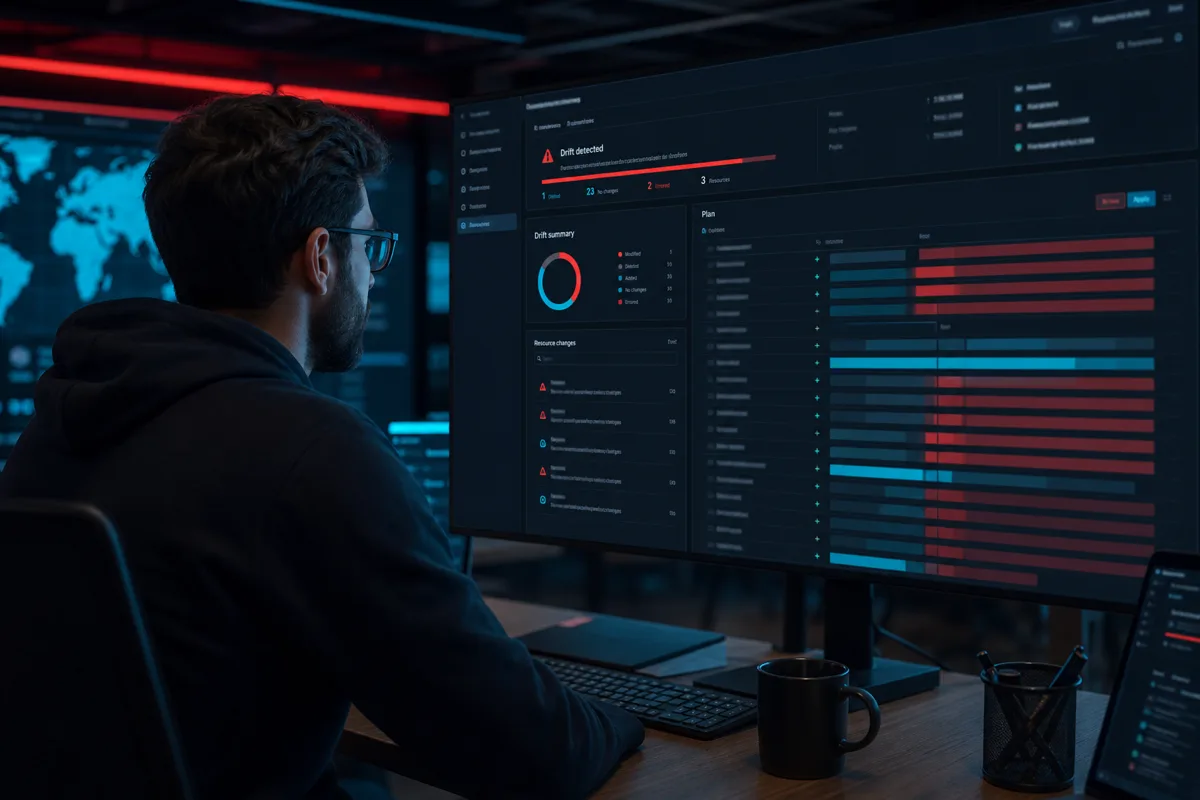
Console clicks feel harmless until production security groups disagree with Git and nobody knows why. Terraform drift detection automation is the Rutagon control loop that continuously plans, routes owners, and gates remediation so infrastructure truth stays in code.
Buyer Pain: Git Said One Thing, AWS Said Another
- Hotfix in console during incidents never backported
- Multiple Terraform roots overlap on the same resources
- No owner for drifted state — alerts rot
terraform applyon Monday undoes Friday’s silent click — or worse, fails mysteriously
Related: Terraform infrastructure as code consultant, AWS landing zone setup, AWS Well-Architected review guide. Capabilities: AWS cloud infrastructure, security automation.
What Rutagon Built
Scheduler / CI
    → terraform plan -detailed-exitcode (per root)
        → parse drift
            → ticket / Slack to codeowners
            → optional auto-remediate for safe classes
            → block merge if unmanaged critical resources appear
terraform plan -detailed-exitcode -out=tfplan
code=$?
if [ "$code" -eq 2 ]; then
  ./scripts/post_drift_alert.sh tfplan
fi
Exit code 2 means changes detected — that is the signal, not a failure to hide.
Ownership Routing
Every root maps to CODEOWNERS. Drift without owners is ignored drift. We also detect resources created outside Terraform via account inventory vs state — a second channel beyond plan.
Safe vs Unsafe Auto-Remediation
Auto-apply may be fine for tag drift on non-prod. Auto-apply on database schemas or IAM is how you create new incidents. We classify remediation policies explicitly.
Production Lessons
Lesson 1 — Split state to reduce blast radius. Lesson 2 — Plan frequency beats quarterly archaeology. Lesson 3 — Incident runbooks must include “backport the console fix.” Lesson 4 — Import unknown resources or destroy them — limbo is debt.
Official Terraform workflows are documented at developer.hashicorp.com; we operationalize them in your CI and accounts.
Ready for Terraform drift detection automation that pages the right owner? Talk to Rutagon — contact@rutagon.com or 907-841-8407.
Delivery Cadence With Rutagon
We run these builds as time-boxed delivery, not open-ended advisory:
- Discovery — baselines, owners, constraints, success metrics
- Thin slice — one production path that proves the architecture
- Hardening — observability, access control, failure modes
- Operate — runbooks, dashboards, and a named handoff
Clients keep source, IaC, and operational docs. The goal is a system your team can run — with optional ongoing help if you want a fractional or managed follow-on.
Anti-Patterns We Refuse
- Big-bang rewrites without a strangler seam
- “AI will figure it out” without validators and human gates
- Cost cuts that delete observability or break RTO
- Security theater that claims certifications you do not hold
- Undocumented break-glass paths that become permanent
If a proposed shortcut fails those tests, we say no and offer a safer sequence.
How We Measure Done
Done means the agreed metric moved — latency, cycle time, dollars, or readiness — and the operating model exists. A demo without owners, alerts, and a rollback story is not done.
Why Teams Hire Rutagon for Terraform Drift Detection Automation
Buyers hire us because we ship the working path in their stack — AWS accounts, repos, identity providers, ERPs, and CRMs they already run — with production lessons included. We are not a slide shop. Commercial CTOs and founders get architecture decisions, code, and an operating cadence. Defense-adjacent private companies get the same delivery discipline with security boundaries treated as design inputs, not paperwork afterthoughts.
Internal links stay on topic: pair this build with related FinOps consulting services or fractional CTO services when leadership bandwidth is the bottleneck, and with AWS cloud infrastructure when landing zones and networking are in scope.
CI Shape That Survives Busy Repos
We wire drift pipelines separate from apply pipelines so a noisy plan does not block feature merges incorrectly. Typical pattern:
- Nightly plan across all roots
- On-demand plan for a root when its directory changes
- Slack/Teams digest with collapsed diffs and deep links to artifacts
- Ticket auto-open only when drift persists beyond a grace window (filters flapping tags)
State locking and remote backends remain mandatory. Drift automation without locking is how two applies collide.
Inventory Diff Beyond Terraform State
Some resources never entered state. We compare tagged account inventory (or Config / cloud inventory exports) against state addresses for critical resource types: security groups, IAM roles, public buckets. Unmanaged critical resources open a high-priority ticket even when terraform plan is clean.
Human Process During Incidents
Runbook line we insist on: every console change gets a follow-up PR within the same shift or with an explicit defer ticket. Drift detection catches failures of that process — it does not replace it.
Terraform drift detection automation is successful when owners get actionable diffs quickly, unmanaged critical resources surface, and console hotfixes reliably return to Git the same day.
Pair drift alerts with CODEOWNERS so the right team sees the diff first — unowned alerts decay into noise.
Alert Routing That Engineers Actually Use
Drift alerts go to the owning team’s Slack channel with the resource ARN, the Terraform address, and a one-click link to the plan output in CI. We suppress known break-glass windows with a labeled exception ticket so on-call is not woken for intentional hotfixes. After two weeks, mean time to reconcile dropped because the signal was actionable instead of noisy.
Frequently Asked Questions
What is Terraform drift detection automation?
Continuous plan checks and inventory diffs that detect when live infrastructure diverges from code, then route owners and optionally remediate within policy.
Will this auto-apply everything?
No. Auto-remediation is opt-in per resource class. Most clients start alert-only in production.
How do you handle multiple workspaces/accounts?
Per-root pipelines with account-scoped roles via OIDC — no long-lived keys. Landing zone structure informs the map.
Does this replace code review?
No. It catches out-of-band changes reviews never see.
How fast to value?
First drift reports for priority roots can appear within days once OIDC and state backends are wired.