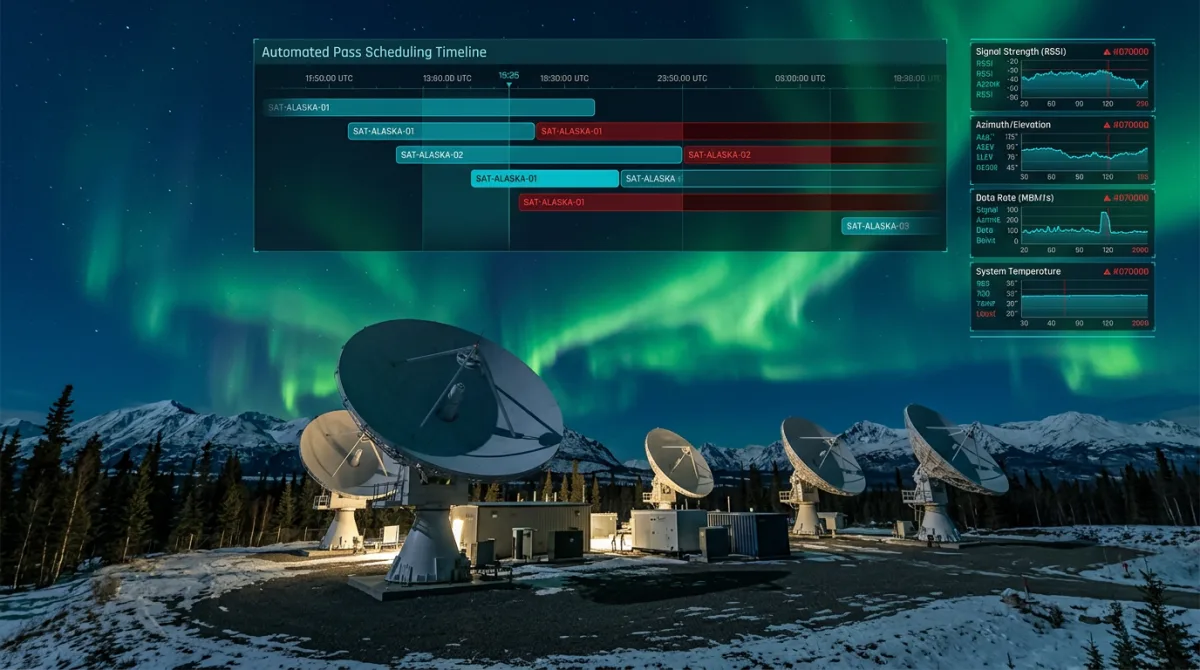
Automating satellite ground station operations transforms ground systems from manual, operator-intensive installations into software-defined infrastructure that scales with constellation size. As satellite operators move from single-asset missions to multi-orbit constellations with dozens or hundreds of spacecraft, the traditional model — human operators scheduling passes, monitoring telemetry, and diagnosing anomalies in real time — breaks down. The math doesn't work: a 100-satellite constellation with 6 passes per day per satellite generates 600 daily contact events. No operations team can manage that manually.
Rutagon builds ground station automation software that handles pass scheduling, telemetry routing, health monitoring, and anomaly detection with minimal human intervention. This article covers the architecture patterns, the integration challenges, and the operational intelligence that makes autonomous ground operations reliable.
Ground Station Operations: What Gets Automated
A satellite ground station contact follows a predictable sequence:
- Pre-pass: Antenna slews to acquisition position, RF systems configure for the target spacecraft's frequency and modulation
- Acquisition of Signal (AOS): The antenna acquires the satellite signal as it rises above the elevation mask
- Data transfer: Telemetry downlink, command uplink, payload data transfer
- Loss of Signal (LOS): The satellite drops below the elevation mask, contact ends
- Post-pass: Data processing, health assessment, handoff to next ground station
Each step has traditionally required operator attention. Automation targets every phase, starting with the highest-value opportunity: pass scheduling.
Software-Defined Pass Scheduling
Pass scheduling determines when each ground station contacts each satellite. For a single satellite with one ground station, this is a simple orbital prediction problem. For a constellation with multiple ground stations, it becomes a constraint optimization problem:
- Orbital mechanics: Each satellite's ground track determines which stations have line-of-sight and when
- Priority: Emergency health checks override routine telemetry downloads
- Conflicts: Two satellites visible to the same station simultaneously require prioritization
- Latency requirements: Time-sensitive data (weather imagery, ISR) needs the earliest available pass
- Station maintenance: Scheduled downtime windows must be respected
Scheduling Architecture
from dataclasses import dataclass
from datetime import datetime, timedelta
from typing import Optional
import numpy as np

@dataclass
class SatellitePass:
    satellite_id: str
    station_id: str
    aos_time: datetime
    los_time: datetime
    max_elevation: float
    priority: int
    data_volume_mb: float
    scheduled: bool = False

@dataclass
class ScheduleConstraints:
    min_elevation_deg: float = 10.0
    antenna_slew_time_sec: float = 30.0
    setup_time_sec: float = 15.0
    min_pass_duration_sec: float = 120.0

class PassScheduler:
    def __init__(self, constraints: ScheduleConstraints):
        self.constraints = constraints
        self.schedule: list[SatellitePass] = []

    def generate_schedule(
        self,
        predicted_passes: list[SatellitePass],
        window_hours: int = 24,
    ) -> list[SatellitePass]:
        candidates = sorted(
            predicted_passes,
            key=lambda p: (-p.priority, -p.max_elevation),
        )

        station_timeline: dict[str, list[tuple[datetime, datetime]]] = {}

        for candidate in candidates:
            if candidate.max_elevation < self.constraints.min_elevation_deg:
                continue

            duration = (candidate.los_time - candidate.aos_time).total_seconds()
            if duration < self.constraints.min_pass_duration_sec:
                continue

            if self._check_conflicts(candidate, station_timeline):
                continue

            candidate.scheduled = True
            self.schedule.append(candidate)

            timeline = station_timeline.setdefault(candidate.station_id, [])
            buffer = timedelta(
                seconds=self.constraints.antenna_slew_time_sec
                + self.constraints.setup_time_sec
            )
            timeline.append((
                candidate.aos_time - buffer,
                candidate.los_time + timedelta(seconds=self.constraints.setup_time_sec),
            ))

        return self.schedule

    def _check_conflicts(
        self,
        candidate: SatellitePass,
        timeline: dict[str, list[tuple[datetime, datetime]]],
    ) -> bool:
        station_slots = timeline.get(candidate.station_id, [])
        buffer = timedelta(
            seconds=self.constraints.antenna_slew_time_sec
            + self.constraints.setup_time_sec
        )
        for start, end in station_slots:
            if (candidate.aos_time - buffer) < end and candidate.los_time > start:
                return True
        return False
The scheduler runs every propagation cycle (typically every 6-12 hours) using updated Two-Line Element sets from Space-Track.org or proprietary orbit determination solutions. Results feed into the ground station control system as an execution timeline.
For larger constellations, this greedy approach gives way to mixed-integer linear programming (MILP) formulations that optimize globally across all stations and satellites. The architecture supports both — the scheduler interface is pluggable, allowing operators to select the optimization strategy appropriate for their constellation size.
Telemetry Routing and Processing
Once a pass is scheduled and executed, telemetry flows from the antenna system through a processing pipeline:
┌──────────┐    ┌───────────┐    ┌──────────────┐    ┌──────────────┐
│ Antenna   │───▶│ Front-End │───▶│ Frame Sync & │───▶│ Telemetry    │
│ System    │    │ Processor │    │ Decommutation│    │ Database     │
└──────────┘    └───────────┘    └──────────────┘    └──────────────┘
                                        │
                                        ▼
                                 ┌──────────────┐
                                 │ Real-Time     │
                                 │ Display &     │
                                 │ Alerting      │
                                 └──────────────┘
Event-Driven Telemetry Pipeline on AWS
module "telemetry_pipeline" {
  source = "./modules/telemetry-processing"

  kinesis_stream_config = {
    name             = "satellite-telemetry"
    shard_count      = 4
    retention_hours  = 168
    encryption_type  = "KMS"
  }

  processing_config = {
    lambda_memory_mb = 2048
    batch_size       = 100
    batch_window_sec = 5
    parallelization  = 4
  }

  storage_config = {
    timestream_database      = "satellite-ops"
    timestream_table         = "telemetry"
    retention_memory_hours   = 24
    retention_magnetic_days  = 365
    s3_archive_bucket        = "telemetry-archive"
  }
}
Amazon Timestream handles the time-series telemetry data — temperature readings, power levels, attitude quaternions, and subsystem status — with built-in time-based retention policies. Hot data (last 24 hours) stays in memory for sub-millisecond queries; historical data moves to magnetic storage for trend analysis.
This pipeline architecture extends the event-driven patterns we deploy across production systems, adapted for the unique characteristics of satellite telemetry: bursty ingestion during passes, deterministic data formats (CCSDS packets), and strict ordering requirements within each spacecraft's telemetry stream.
Health Monitoring and Anomaly Detection
Satellite health monitoring compares incoming telemetry against expected ranges and historical baselines. The challenge is distinguishing genuine anomalies from expected variations — a battery voltage drop during eclipse is normal, the same drop during sunlight exposure is a potential failure.
Rule-Based Monitoring
@dataclass
class TelemetryLimit:
    parameter: str
    red_low: Optional[float]
    yellow_low: Optional[float]
    yellow_high: Optional[float]
    red_high: Optional[float]
    context_dependent: bool = False

LIMITS_DATABASE = {
    "battery_voltage": TelemetryLimit(
        parameter="battery_voltage",
        red_low=26.0, yellow_low=27.0,
        yellow_high=33.0, red_high=34.0,
    ),
    "solar_array_current": TelemetryLimit(
        parameter="solar_array_current",
        red_low=0.0, yellow_low=0.5,
        yellow_high=12.0, red_high=13.0,
        context_dependent=True,
    ),
    "reaction_wheel_speed_rpm": TelemetryLimit(
        parameter="reaction_wheel_speed_rpm",
        red_low=-6000, yellow_low=-5000,
        yellow_high=5000, red_high=6000,
    ),
}

def check_limits(parameter: str, value: float, context: dict) -> str:
    limits = LIMITS_DATABASE.get(parameter)
    if not limits:
        return "nominal"

    if limits.context_dependent:
        if context.get("eclipse") and parameter == "solar_array_current":
            return "nominal"

    if limits.red_low and value < limits.red_low:
        return "red_low"
    if limits.red_high and value > limits.red_high:
        return "red_high"
    if limits.yellow_low and value < limits.yellow_low:
        return "yellow_low"
    if limits.yellow_high and value > limits.yellow_high:
        return "yellow_high"

    return "nominal"
ML-Based Anomaly Detection
Rule-based limits catch known failure modes. For novel anomalies — degradation patterns not captured in limit databases — we deploy statistical models trained on historical telemetry:
from sklearn.ensemble import IsolationForest
import numpy as np

class TelemetryAnomalyDetector:
    def __init__(self, contamination: float = 0.01):
        self.model = IsolationForest(
            contamination=contamination,
            n_estimators=200,
            random_state=42,
        )
        self.is_fitted = False

    def train(self, historical_telemetry: np.ndarray):
        self.model.fit(historical_telemetry)
        self.is_fitted = True

    def detect(self, current_telemetry: np.ndarray) -> list[dict]:
        if not self.is_fitted:
            raise RuntimeError("Model not trained")

        predictions = self.model.predict(current_telemetry)
        scores = self.model.decision_function(current_telemetry)

        anomalies = []
        for i, (pred, score) in enumerate(zip(predictions, scores)):
            if pred == -1:
                anomalies.append({
                    "index": i,
                    "anomaly_score": float(score),
                    "severity": "high" if score < -0.3 else "medium",
                })

        return anomalies
The combination of rule-based and ML-based detection mirrors the approach we've detailed in our work on AI anomaly detection for space systems. Rule-based systems provide deterministic, explainable alerts for known failure modes. ML models catch the subtle degradation trends that precede failures — bearing wear in reaction wheels, gradual solar cell degradation, thermal coating deterioration.
Alaska's Ground Station Advantage
Alaska's high-latitude position provides a strategic advantage for satellite ground operations. Polar-orbiting satellites — which include the majority of Earth observation, weather, and reconnaissance constellations — pass over Alaska on nearly every orbit. A ground station at 64°N latitude can contact a polar-orbiting satellite 12-14 times per day, compared to 4-6 times for a mid-latitude station.
This geographic advantage is why Alaska hosts critical ground infrastructure for federal satellite programs. Rutagon's location in Alaska provides direct proximity to these operations, and our space and aerospace practice is built around this strategic positioning.
The automation patterns described here are particularly valuable for Alaska-based ground stations, where extreme weather and remote locations make continuous on-site staffing expensive and operationally challenging. Automated systems maintain operations through conditions that would prevent manual operation.
Integration with AWS Ground Station
AWS Ground Station provides antenna-as-a-service, eliminating the need for operators to own physical ground infrastructure. The automation patterns integrate directly:
- Pass scheduling maps to AWS Ground Station contact reservation APIs
- Telemetry routing flows from AWS Ground Station data delivery into Kinesis streams
- Health monitoring processes telemetry from AWS-managed antenna systems identically to owned infrastructure
For operators building new constellations, the combination of AWS Ground Station for antenna access and custom automation software for operations management provides ground capabilities without capital investment in physical infrastructure — a pattern that aligns with the cloud infrastructure approach we bring to every domain.
Frequently Asked Questions
How many satellites can a single automated ground station support?
A well-automated ground station with a single antenna can support 30-50 LEO satellites, depending on orbit distribution and pass overlap. Multi-antenna stations or electronically steered arrays push this to hundreds. The scheduling algorithm handles conflict resolution — the bottleneck shifts from operator capacity to antenna availability and RF system switching time.
What telemetry protocols do ground station automation systems support?
Most satellite ground systems use CCSDS (Consultative Committee for Space Data Systems) standards for telemetry and telecommand. The automation layer handles CCSDS Space Packet Protocol for telemetry decommutation and CCSDS Telecommand for command encoding. Proprietary protocols from specific spacecraft manufacturers require custom adapters in the front-end processing chain.
How does automation handle spacecraft emergencies?
Emergency contacts (safing events, anomaly response) receive the highest scheduling priority, preempting routine passes. The automation system can execute pre-defined emergency command sequences — uploading safe-mode configurations or diagnostic command scripts — without waiting for human authorization. Operators are alerted simultaneously and can override or extend the automated response.
What latency is achievable for real-time telemetry display?
From antenna reception to dashboard display, end-to-end latency in an automated system is typically 200-500ms. The dominant contributors are frame synchronization, decommutation processing, and network transit. For mission-critical parameters (attitude, power, thermal), dedicated fast-path processing bypasses batch pipelines to achieve sub-100ms display latency.
Can ground station automation work with hosted payload missions?
Yes. Hosted payload operators typically receive a dedicated telemetry allocation within the host spacecraft's downlink. The automation system treats each payload as a separate telemetry source within the same pass, demultiplexing and routing to the appropriate processing pipeline. Scheduling remains unified since the antenna contact is shared between host and payload operations.
Discuss your project with Rutagon
Contact Us →