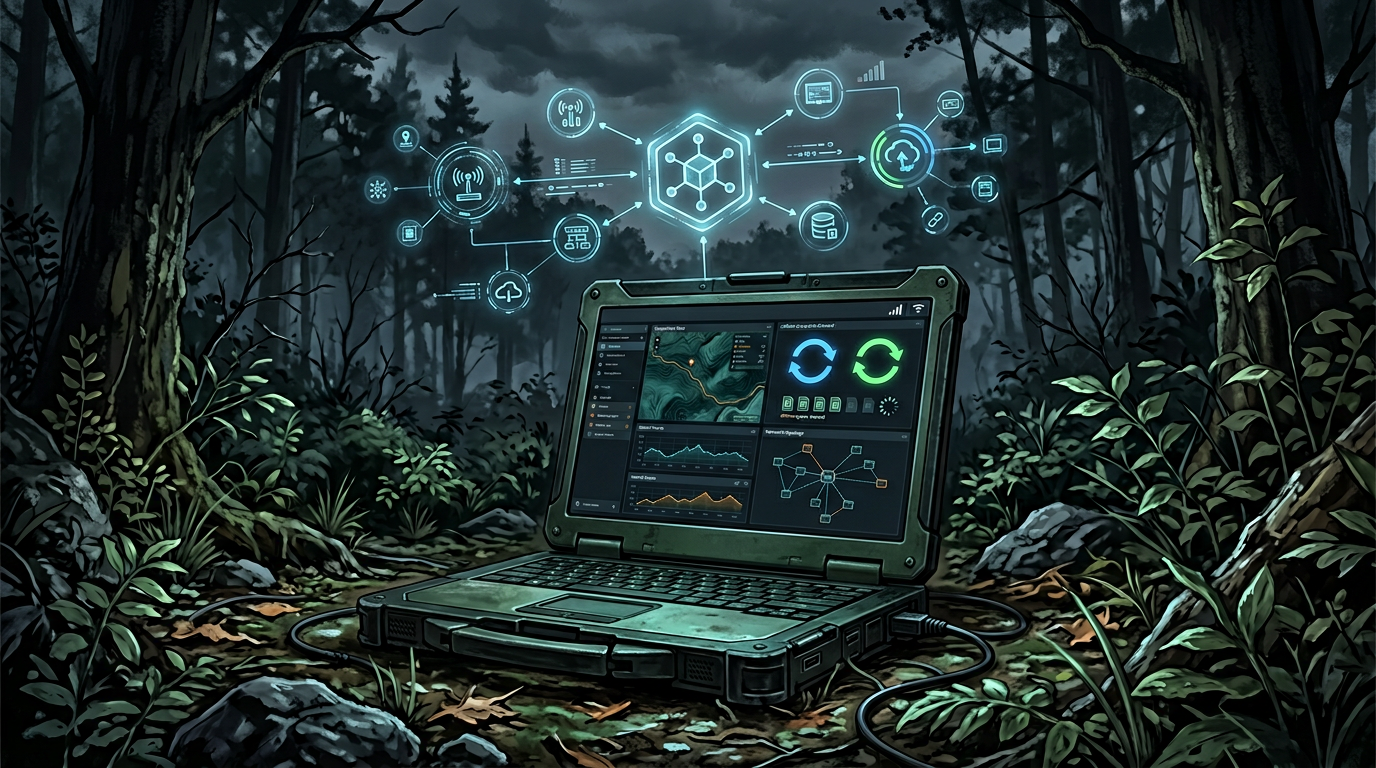
Connectivity in military operational environments is not a given. Degraded, Disrupted, Intermittent, and Limited (DDIL) connectivity is the default assumption for tactical edge software — not an edge case to be handled as a fallback. Software designed for reliable networks first and DDIL tolerance bolted on later fails in the field. Software designed for DDIL from the architecture level operates correctly whether the network is up, degraded, intermittent, or completely absent.
This article covers the architectural patterns Rutagon applies to mission-critical software that must operate in DDIL environments — from edge data stores to sync reconciliation to conflict resolution at the cloud layer.
Offline-First Architecture
The core principle of DDIL software design: the application must be fully functional with zero network connectivity. This is a stronger requirement than "graceful degradation" — graceful degradation means features degrade when connectivity is lost. Offline-first means the application's primary operational mode requires no connectivity, and connectivity (when available) triggers synchronization rather than enabling core function.
This inverts the typical cloud-native architecture. In a standard cloud application, the database is remote and the application makes API calls for data. In an offline-first DDIL application, the application works against a local data store, and the remote cloud is a synchronization endpoint that the application reaches when connectivity allows.
Local data store choices:
- SQLite — appropriate for structured operational data on embedded or low-resource edge devices. Lightweight, zero-server, ACID-compliant.
- RocksDB / LevelDB — appropriate for high-throughput write scenarios and large data volumes on capable edge hardware.
- CouchDB / PouchDB — designed specifically for offline-first sync, with built-in conflict resolution and a sync protocol (CouchDB replication) that handles intermittent connectivity cleanly.
For containerized edge applications on capable hardware (AWS Snowball Edge, ruggedized servers), a local Postgres or SQLite instance with a custom sync layer is the pattern Rutagon deploys most frequently.
Store-and-Forward Data Sync
When connectivity is available, edge nodes must synchronize accumulated data to the cloud without loss, without duplication, and without blocking local operations during the sync window.
Queue-based forwarding. Every data record written locally is also written to a local outbound queue (SQLite-backed queue, RocksDB queue, or a lightweight FIFO file store for embedded systems). When connectivity is established, the queue drains to the cloud endpoint — records are acknowledged and removed from the queue only after the cloud confirms receipt. If connectivity drops mid-sync, unacknowledged records remain in the queue and retry on the next connectivity window.
class DDILSyncQueue {
  private db: Database; // SQLite local queue

  async enqueue(record: OperationalRecord): Promise<void> {
    await this.db.run(
      `INSERT INTO outbound_queue (id, payload, created_at, status)
       VALUES (?, ?, ?, 'pending')`,
      [record.id, JSON.stringify(record), Date.now()]
    );
  }

  async drainToCloud(endpoint: string): Promise<SyncResult> {
    const batch = await this.db.all(
      `SELECT * FROM outbound_queue WHERE status = 'pending'
       ORDER BY created_at ASC LIMIT 100`
    );

    if (batch.length === 0) return { synced: 0, failed: 0 };

    const results = await this.sendBatch(endpoint, batch);

    // Only mark as synced after cloud confirmation
    const syncedIds = results.succeeded.map(r => r.id);
    await this.db.run(
      `UPDATE outbound_queue SET status = 'synced'
       WHERE id IN (${syncedIds.map(() => '?').join(',')})`,
      syncedIds
    );

    return { synced: results.succeeded.length, failed: results.failed.length };
  }
}
Idempotent cloud ingestion. The cloud endpoint must handle duplicate deliveries correctly — the edge node may deliver the same record multiple times if connectivity is lost between delivery and acknowledgment. The cloud ingestion API uses the record ID as an idempotency key; duplicate submissions update the existing record rather than creating duplicates.
Conflict Resolution at Cloud Layer
When multiple edge nodes operate independently and sync to the same cloud store, conflicts arise — two nodes may update the same entity in different ways during a connectivity gap. The conflict resolution strategy depends on the data type:
Last-write-wins (LWW): Appropriate for sensor readings and position data where the latest value is authoritative. Each record carries a logical_clock or vector_clock timestamp; the cloud applies the record with the highest clock value.
Merge semantics: Appropriate for structured operational data where both updates may be partially correct. The cloud merge function applies a defined merge strategy for each field type — numeric aggregations sum, sets union, scalar fields apply LWW, and flagged conflicts are queued for manual resolution.
Append-only logs: Appropriate for audit trails and event logs where no record should be lost. All edge node records are appended to the cloud log with their origin node ID and edge timestamp. No records are merged or overwritten.
Connectivity Detection and Sync Orchestration
The sync process must run opportunistically — triggering when connectivity is detected, running as fast as the connection allows, and suspending cleanly when connectivity drops.
class ConnectivityMonitor {
  private syncInProgress = false;
  private listeners: Set<(connected: boolean) => void> = new Set();

  async start(): Promise<void> {
    // Probe endpoint every 30 seconds
    setInterval(async () => {
      const connected = await this.probe();
      this.listeners.forEach(l => l(connected));
    }, 30_000);
  }

  private async probe(): Promise<boolean> {
    try {
      const response = await fetch(CLOUD_HEALTH_ENDPOINT, {
        method: 'HEAD',
        signal: AbortSignal.timeout(5000), // 5-second timeout
      });
      return response.ok;
    } catch {
      return false;
    }
  }

  onConnectivityChange(listener: (connected: boolean) => void): void {
    this.listeners.add(listener);
  }
}

// Sync orchestrator: trigger drain on connectivity restoration
monitor.onConnectivityChange(async (connected) => {
  if (connected && !syncInProgress) {
    syncInProgress = true;
    try {
      await syncQueue.drainToCloud(CLOUD_ENDPOINT);
      await syncQueue.pullUpdatesFromCloud(CLOUD_ENDPOINT);
    } finally {
      syncInProgress = false;
    }
  }
});
Security in DDIL Environments
Security requirements do not relax in disconnected environments. Data at rest on edge nodes must be encrypted with CMKs that are pre-provisioned (not pulled from cloud KMS at runtime — the node may be offline when encryption keys are needed).
Pre-provisioned key packages. Before deployment, edge nodes receive a sealed key package containing encryption keys for the deployment period. Keys are wrapped with a device-specific key that can only be unwrapped on the specific hardware. This eliminates cloud key management as a dependency while maintaining cryptographic security.
Tamper detection. Local data stores carry integrity hashes that detect unauthorized modification during the offline period. On reconnection, the cloud validates data integrity before accepting sync uploads.
For related edge and tactical patterns, see Arctic Edge Computing for Military Systems and Edge Computing for Defense and Tactical Systems.
Working With Rutagon
Rutagon designs and implements DDIL-resilient mission software — offline-first applications, store-and-forward sync pipelines, and edge-cloud architectures that operate correctly with or without connectivity.
Frequently Asked Questions
What does DDIL mean in military software?
DDIL stands for Degraded, Disrupted, Intermittent, and Limited — a framework describing the connectivity conditions that tactical edge military systems must operate within. A DDIL environment may have no network connectivity at all (Disrupted), intermittent short connectivity windows (Intermittent), bandwidth-limited connections (Degraded), or low-latency but capacity-constrained links (Limited). Mission-critical software in DDIL environments must be designed to operate fully in the absence of connectivity, using it opportunistically for synchronization when available.
What is offline-first architecture for military applications?
Offline-first architecture designs the application to function completely without network connectivity, using a local data store as the primary operational data layer. The cloud or central server is treated as a synchronization target rather than a dependency. When connectivity is available, the application synchronizes accumulated local data to the cloud and pulls updates. This is the inverse of cloud-first architecture, where remote APIs are the primary data source. Offline-first is mandatory for tactical edge applications in DDIL environments.
How does store-and-forward work for military data synchronization?
Store-and-forward data synchronization queues every locally-generated data record in a local outbound queue. When connectivity is available, the queue drains to the cloud endpoint — records are removed from the queue only after the cloud confirms receipt. If connectivity drops mid-sync, unacknowledged records remain in the queue and are retried on the next connectivity window. This pattern guarantees no data loss regardless of connectivity interruptions, at the cost of potential duplicate deliveries (which the cloud endpoint handles via idempotency keys).
How do you handle conflicts when multiple edge nodes sync independently?
Conflict resolution strategy depends on the data type. Sensor readings and position data typically use last-write-wins with vector clock timestamps — the latest measurement is authoritative. Structured operational data may use merge semantics where both updates are applied according to field-level merge rules. Audit logs and event records use append-only semantics — no records are merged or overwritten. The appropriate strategy must be defined at the data model level during design, not as an afterthought during sync implementation.
What security controls apply to data on disconnected edge devices?
Data at rest on edge devices must be encrypted with pre-provisioned customer-managed keys (CMKs) that do not require cloud key management service access at runtime. Keys are sealed to the specific device hardware before deployment. Data integrity is protected through cryptographic hashes stored alongside the data, validated during sync to detect unauthorized modification during the offline period. Device-level full-disk encryption provides a secondary protection layer against physical device compromise.