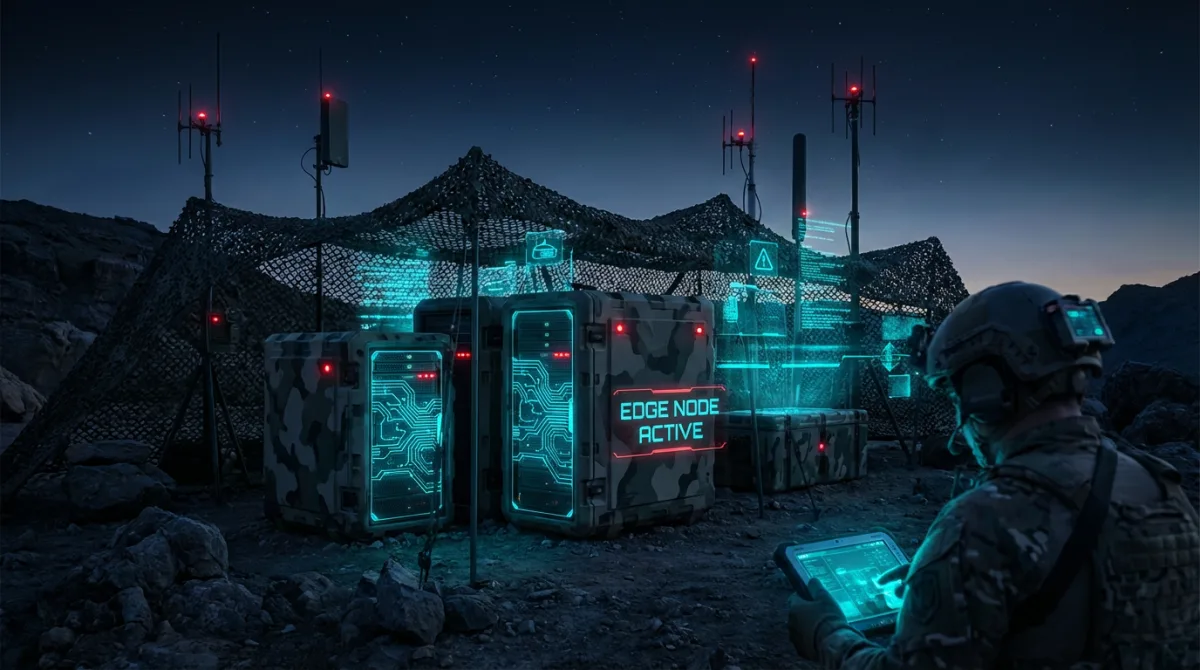
# Edge Computing for Defense and Tactical Systems
Edge computing in defense isn't a buzzword — it's a operational requirement born from a simple reality: tactical systems can't always reach the cloud. When a forward-deployed unit loses satellite connectivity, when a ship enters a communications-denied environment, when latency to a centralized data center means the data arrives too late to act on — the computing must happen where the mission is.
We've built systems that operate across the connectivity spectrum, from always-connected cloud environments to fully disconnected tactical nodes. The architecture patterns that bridge these worlds are what separate systems that work in demos from systems that work in the field.
The Disconnected/Intermittent/Limited Problem
Defense systems operate in what's formally called DIL environments — Disconnected, Intermittent, or Limited connectivity. This isn't an edge case to plan for; it's the primary operating condition for tactical systems.
A cloud-native application designed for constant connectivity fails immediately in DIL. API calls time out. State synchronization breaks. Authentication tokens can't be refreshed. The system becomes a brick when the operator needs it most.
Designing for DIL means inverting the cloud-native assumption. The edge node must be fully autonomous — capable of executing its mission without any connectivity to higher echelons. When connectivity returns, it synchronizes state. When connectivity is degraded, it prioritizes critical data. When connectivity is gone, it keeps working.
Architecture Patterns for Tactical Edge
Local-First with Eventual Synchronization
The foundational pattern is local-first computing. Every edge node maintains a complete local data store and processing capability. Cloud connectivity is an optimization, not a dependency.
apiVersion: apps/v1
kind: Deployment
metadata:
  name: tactical-data-processor
  namespace: edge-workload
spec:
  replicas: 1
  selector:
    matchLabels:
      app: tactical-processor
  template:
    spec:
      containers:
        - name: processor
          image: registry.local/tactical-processor:v2.4.1
          env:
            - name: SYNC_MODE
              value: "opportunistic"
            - name: LOCAL_DB_PATH
              value: "/data/local.db"
            - name: SYNC_PRIORITY
              value: "critical-first"
          volumeMounts:
            - name: persistent-data
              mountPath: /data
          resources:
            limits:
              memory: "512Mi"
              cpu: "1000m"
      volumes:
        - name: persistent-data
          persistentVolumeClaim:
            claimName: tactical-data-pvc
The SYNC_MODE: opportunistic configuration means the application actively processes locally and syncs when bandwidth allows. Critical data gets priority. Routine telemetry waits.
Conflict Resolution at the Edge
When multiple edge nodes modify the same data during disconnected periods, conflicts are inevitable. The resolution strategy depends on the domain:
- Last-write-wins: Acceptable for telemetry and sensor data where the most recent reading is what matters
- Operational priority: Higher-echelon changes override lower-echelon changes for command data
- Merge with audit: Both versions are preserved with a conflict record for human review
class ConflictResolver:
    def resolve(self, local_record, remote_record, data_type):
        if data_type == "sensor_telemetry":
            return max(local_record, remote_record, key=lambda r: r.timestamp)

        if data_type == "command_directive":
            return max(local_record, remote_record, key=lambda r: r.authority_level)

        return ConflictRecord(
            local=local_record,
            remote=remote_record,
            requires_review=True,
            created_at=datetime.utcnow()
        )
Store-and-Forward Messaging
When connectivity is intermittent, you can't rely on synchronous communication. Store-and-forward messaging queues outbound data locally and transmits when a link is available, prioritizing by message criticality.
This pattern is analogous to how we build event-driven architectures on AWS — but the queue is local, the retry logic accounts for satellite link availability windows, and the priority system reflects operational urgency rather than business logic.
Containerized Workloads at the Tactical Edge
Containers have transformed edge computing for defense. A containerized workload is portable, versioned, and reproducible. The same container image that passes testing in a lab environment runs identically on a ruggedized server in a tactical operations center.
Lightweight Kubernetes Distributions
Full Kubernetes is too heavy for most tactical hardware. Distributions like K3s reduce the control plane footprint to run on resource-constrained systems — single-board computers, ruggedized laptops, and small-form-factor servers.
The key design decisions for Kubernetes in regulated environments apply doubly at the edge:
- Air-gapped registries: Container images must be pre-staged. There's no pulling from Docker Hub in a SCIF or a tactical vehicle.
- Resource constraints: Edge hardware has limited CPU, memory, and storage. Resource limits aren't optional — they prevent a runaway workload from killing the node.
- Automated recovery: If a container crashes, Kubernetes restarts it. This self-healing capability is critical when there's no admin available to SSH in and fix things.
apiVersion: v1
kind: ResourceQuota
metadata:
  name: edge-workload-quota
  namespace: tactical-apps
spec:
  hard:
    requests.cpu: "2"
    requests.memory: 2Gi
    limits.cpu: "4"
    limits.memory: 4Gi
    pods: "20"
    persistentvolumeclaims: "10"
Container Security at the Edge
Container security in production CI/CD is critical everywhere, but the edge adds unique challenges. Images must be signed and verified before deployment because there's no network path to validate against a remote registry. Vulnerability scanning happens in the build pipeline, before images are staged to edge media.
# Sign container image with Cosign before staging to edge media
cosign sign --key cosign.key registry.internal/tactical-app:v2.4.1

# Verify signature at the edge before deployment
cosign verify --key cosign.pub registry.local/tactical-app:v2.4.1
Runtime security policies prevent container escape and restrict system call access. On tactical systems, a compromised container isn't just a security incident — it's a mission-critical failure.
Data Synchronization Strategies
The synchronization layer between edge nodes and cloud infrastructure is where most tactical systems break down. Bandwidth is precious. Latency is unpredictable. The link might disappear mid-transfer.
Delta Synchronization
Never send full datasets over tactical links. Compute deltas locally and transmit only changes. For structured data, this means row-level change tracking. For file-based data, this means binary diff algorithms similar to rsync.
class DeltaSync:
    def __init__(self, local_store, sync_client):
        self.local_store = local_store
        self.sync_client = sync_client

    def compute_outbound_delta(self, last_sync_timestamp):
        changes = self.local_store.get_changes_since(last_sync_timestamp)
        prioritized = sorted(changes, key=lambda c: c.priority, reverse=True)
        return self._compress_delta(prioritized)

    def apply_inbound_delta(self, delta):
        for change in delta.records:
            local = self.local_store.get(change.id)
            if local and local.modified_at > change.modified_at:
                self._queue_conflict(local, change)
            else:
                self.local_store.apply(change)

    def sync_with_bandwidth_limit(self, max_bytes):
        delta = self.compute_outbound_delta(self.last_sync)
        truncated = self._truncate_to_size(delta, max_bytes)
        self.sync_client.send(truncated)
        self.last_sync = datetime.utcnow()
Priority-Based Bandwidth Allocation
When a 9.6 kbps satellite link is all you have, every byte matters. Implement priority queues for outbound data:
- Flash priority: Critical operational data — immediate transmission
- Immediate: Time-sensitive data — within minutes
- Priority: Important but not urgent — next available window
- Routine: Telemetry, logs, bulk data — when bandwidth allows
This mirrors military message precedence for good reason — the problem space is identical.
Reduced Latency for Decision Support
The latency argument for edge computing goes beyond convenience. In defense applications, the time between sensor input and actionable output directly impacts mission effectiveness.
Processing sensor data at the edge — image classification, signal processing, anomaly detection — and sending only the results to higher echelons reduces latency from seconds to milliseconds and bandwidth consumption by orders of magnitude.
We apply this same latency-sensitive thinking to space and aerospace software where ground processing delays can mean missed observation windows or delayed maneuver commands.
Deployment and Update Patterns
Updating software on tactical edge nodes is fundamentally different from updating cloud services. You can't do rolling deployments when nodes are disconnected. You can't roll back instantly when the node is in a vehicle convoy.
Pre-staged Updates
Updates are packaged, signed, and loaded onto portable media or queued for the next connectivity window. The update process must be:
- Atomic: The update either completes fully or rolls back. No partial states.
- Verified: Cryptographic signatures are validated before installation.
- Reversible: The previous version is preserved for rollback.
- Unattended: The operator shouldn't need to babysit a software update during a mission.
GitOps at the Edge
A GitOps model adapted for disconnected environments uses a local Git repository as the source of truth. When connectivity allows, the local repo syncs with the central repo. Flux or ArgoCD running locally reconciles the desired state with the actual state on the edge cluster.
This gives you the benefits of declarative infrastructure management without requiring constant connectivity to a central Git server.
Frequently Asked Questions
What hardware runs Kubernetes at the tactical edge?
K3s runs on ARM and x86 hardware with as little as 512MB RAM. Common tactical platforms include ruggedized servers from vendors building MIL-STD-810G certified hardware, small-form-factor PCs, and even single-board computers for sensor-level processing. The key requirement is reliable storage — edge workloads need persistent volumes that survive power loss and vibration.
How do you handle security updates on disconnected edge nodes?
Security updates are packaged into signed update bundles during the build process, validated in a staging environment, and distributed via the next available connectivity window or portable media. Critical vulnerabilities get flash-priority distribution. The update mechanism itself must be hardened — if an attacker can compromise the update process, they own every edge node.
What's the difference between edge computing and fog computing in defense?
Edge computing processes data at or near the source — on the tactical device or local server. Fog computing is an intermediate layer between edge and cloud, often at a base or operations center with better connectivity. In practice, defense architectures use both: edge nodes for immediate processing, fog nodes for aggregation and regional analytics, and cloud for enterprise-scale analysis and long-term storage.
How do you test edge applications that depend on disconnected behavior?
Build network simulation into your CI/CD pipeline. Use traffic control tools to simulate bandwidth constraints, latency, and complete disconnection. Test every code path: connected, degraded, and fully disconnected. The most critical tests verify that the application degrades gracefully and recovers cleanly when connectivity returns — data integrity across sync boundaries is where bugs hide.
Can commercial cloud patterns be adapted for tactical edge?
Many can, with modification. Event-driven patterns, container orchestration, and infrastructure as code all apply. But the assumptions change: you can't assume network availability, you can't assume unlimited compute, and you can't assume centralized management. Every cloud pattern needs a "what happens when the network is gone?" answer before it's viable at the edge.
---
Tactical systems demand software that works without the cloud. Reach out to Rutagon to discuss edge computing architecture for defense and aerospace applications.