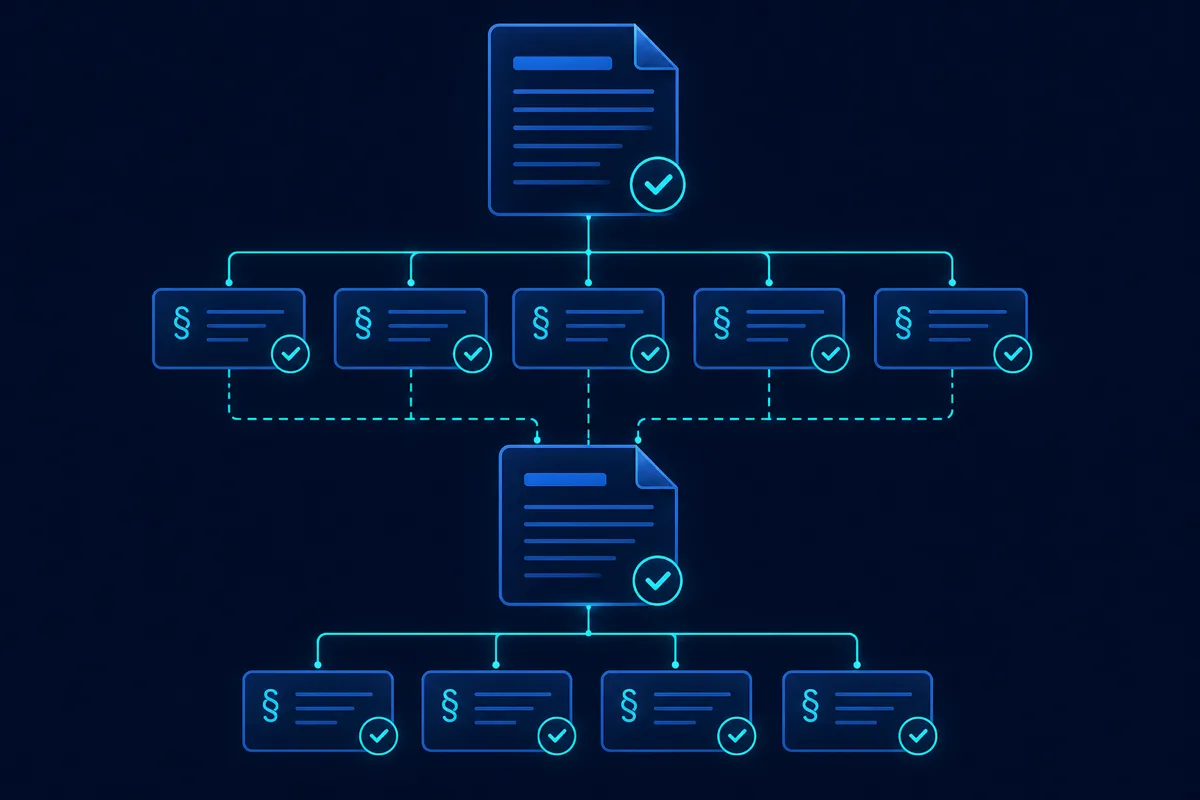
When a prime contractor subcontracts cloud IT work on a federal contract, certain Federal Acquisition Regulation (FAR) and Defense Federal Acquisition Regulation Supplement (DFARS) clauses don't stop at the prime — they flow down to every subcontractor in the chain by operation of law.
This isn't a best practice. It's a legal requirement. Failure to flow down mandatory clauses creates liability for both parties and compliance gaps that surface during audits, DCAA reviews, or after a cybersecurity incident.
For prime contractors evaluating cloud IT subs, the question isn't whether these clauses will apply — they will. The question is whether your sub already operates in compliance or whether flowing them down creates a post-award scramble burning schedule, budget, and goodwill.
This article covers the critical flow-down clauses for cloud IT subcontracts, what each requires, and what a ready sub already has in place.
What "Flow-Down" Actually Means
Flow-down refers to the legal mechanism by which certain prime contract clauses become binding on subcontractors. FAR 52.244-6 and various DFARS clauses contain explicit language: "The Contractor shall include the substance of this clause, including this paragraph, in all subcontracts..." When this language appears, the prime has no discretion — the clause must flow down, and the sub must comply.
For cloud IT work, flow-down requirements concentrate in three areas: cybersecurity, small business utilization, and regulatory compliance.
Critical DFARS Flow-Down Clauses for Cloud IT
DFARS 252.204-7012 — Safeguarding Covered Defense Information
This is the single most consequential flow-down clause for cloud IT subcontractors working on defense contracts. It requires:
- Implementation of NIST SP 800-171 security controls on any system processing, storing, or transmitting Covered Defense Information (CDI)
- Cyber incident reporting to the DoD within 72 hours
- Preservation of forensic evidence for 90 days following an incident
- Medium assurance certificates for accessing government systems
What this means for cloud subs: Every infrastructure component touching CDI must implement all 110 NIST 800-171 controls. Cloud architecture must be designed from inception with these controls integrated, not bolted on after deployment.
What a compliant sub has in place: A documented System Security Plan (SSP) mapping each control to specific implementation, a Plan of Action and Milestones (POA&M) for gaps, an incident response plan ready for 72-hour reporting, and infrastructure designed for CDI isolation.
For a deeper dive into this clause's implications, see our DFARS 252.204-7012 compliance breakdown.
DFARS 252.204-7020 — NIST SP 800-171 DoD Assessment Requirements
This clause requires contractors and subcontractors to:
- Conduct self-assessments against NIST 800-171 and submit scores to the Supplier Performance Risk System (SPRS)
- Allow the government to conduct higher-level assessments
- Maintain current assessment scores (assessments expire after three years)
What this means for cloud subs: Before performing work, the sub must have a current SPRS score on file. Inflated scores discovered during government assessment create significant legal exposure under the False Claims Act.
What a compliant sub has in place: A current SPRS score based on honest gap assessment, documentation supporting each control's implementation status, and readiness for government-conducted assessments.
DFARS 252.204-7021 — Cybersecurity Maturity Model Certification (CMMC)
As CMMC requirements appear in contracts, they flow down to subcontractors handling Controlled Unclassified Information (CUI) or Federal Contract Information (FCI). The required CMMC level depends on the sensitivity of information the sub handles:
- Level 1: Basic safeguarding of FCI (17 practices from FAR 52.204-21)
- Level 2: Protection of CUI (110 practices aligned to NIST 800-171)
- Level 3: Advanced protection against APTs (additional practices beyond 800-171)
What a compliant sub has in place: Certification at the level required for the information they'll handle. For most cloud IT subcontractors working with CUI, this means Level 2 readiness at minimum.
Section 889 — Prohibition on Certain Telecommunications Equipment
FAR 52.204-25 implements Section 889 of the FY2019 NDAA, prohibiting the use or procurement of covered telecommunications equipment from specific Chinese manufacturers (Huawei, ZTE, Hytera, Hikvision, Dahua, and their subsidiaries).
What this means for cloud subs: Every component in the technology stack must be verified against the prohibition list — not just obvious hardware but embedded components, firmware, and cloud service provider dependencies.
What a compliant sub has in place: A documented supply chain verification process, technology stack attestation, and procurement controls preventing introduction of prohibited components.
Critical FAR Flow-Down Clauses
FAR 52.204-21 — Basic Safeguarding of Covered Contractor Information Systems
This clause applies to all federal contracts (not just DoD) and requires 15 basic security controls for systems handling Federal Contract Information (FCI). It's the baseline — the absolute minimum any federal IT sub must meet.
What a compliant sub has in place: Implementation of all 15 controls including access control, identification and authentication, media protection, physical protection, system and communications protection, and system and information integrity measures.
FAR 52.219-8 — Utilization of Small Business Concerns
This clause requires contractors to provide maximum practicable opportunity to small business concerns. It flows down to first-tier subcontractors with subcontracting plans. For small business cloud subs, this clause is often satisfied by their own small business status.
FAR 52.222-26 — Equal Opportunity
Prohibits discrimination and requires affirmative action. Flows down to all subcontracts exceeding $10,000. A compliant sub maintains an equal opportunity policy and record-keeping demonstrating compliance with Executive Order 11246.
FAR 52.222-50 and FAR 52.203-13
Combating Trafficking in Persons (52.222-50) flows to all subcontracts. Contractor Code of Business Ethics (52.203-13) flows to subcontracts exceeding $5.5 million on contracts over 120 days. Both carry termination risk for non-compliance regardless of service type.
The Compliance Gap Problem
The scenario that creates real problems: you award a subcontract, flow down required clauses, and discover post-award the sub cannot actually comply. Common gaps include:
- No SSP or POA&M for NIST 800-171 — the sub signed the contract but hasn't actually implemented the security controls
- No SPRS score — DFARS 252.204-7020 requires it, but the sub hasn't submitted one
- Section 889 ignorance — the sub uses prohibited components in their development or deployment toolchain without realizing it
- Incident response gaps — the 72-hour reporting requirement under 7012 requires pre-established processes, not improvisation during a crisis
Each of these gaps creates liability for the prime. The government holds the prime accountable for ensuring flow-down compliance throughout the subcontracting chain.
What Primes Should Verify Before Award
Before executing a subcontract for cloud IT work, primes should verify:
Cybersecurity readiness:
- Current SPRS score on file
- Documented SSP with control-level detail
- Incident response plan with 72-hour reporting capability
- Section 889 attestation
- CMMC certification at required level
Regulatory documentation:
- Active SAM.gov registration
- CAGE code assigned and current
- Small business certifications verified in SAM
- Equal opportunity compliance documentation
Operational evidence:
- Infrastructure designed for CUI protection where applicable
- Supply chain controls documented
- Code of ethics policy established
- Record-keeping systems adequate for audit
For a comprehensive evaluation framework, see our guide on how primes evaluate cloud IT subs.
Accepting Flow-Downs Without Friction
The distinction between a ready sub and an unprepared one comes down to pre-existing compliance infrastructure. A sub already operating under these frameworks accepts flow-down clauses as contractual formalization of existing posture — no new systems to build, no controls to implement.
Rutagon maintains continuous compliance across the FAR and DFARS requirements that flow down to cloud IT subcontractors:
- DFARS 252.204-7012: NIST 800-171 controls implemented across all infrastructure handling CUI. Incident response procedures tested and documented with 72-hour reporting capability.
- DFARS 252.204-7020: Current SPRS assessment on file reflecting honest implementation status.
- Section 889: Technology stack verified against prohibition list. No covered telecommunications equipment in any layer of service delivery.
- CMMC: Level 1 certified. Infrastructure architecture designed to support Level 2 assessment requirements.
- FAR 52.204-21: All 15 basic safeguarding controls implemented and documented.
- Registration: Active SAM.gov registration, CAGE 19ZR7, UEI FB2FHEJHM493.
This readiness means primes can flow down required clauses on day one without introducing compliance schedule risk. No gap period, no remediation timeline, no risk to the prime's compliance posture. For more on how Rutagon handles CUI in cloud engineering work, see our dedicated breakdown.
Frequently Asked Questions
Which FAR/DFARS clauses are mandatory flow-downs versus optional?
Clauses containing language like "The Contractor shall include the substance of this clause in all subcontracts" are mandatory flow-downs — the prime has no discretion. DFARS 252.204-7012, FAR 52.204-21, and FAR 52.222-26 are examples of mandatory flow-downs. Optional flow-downs are those the prime chooses to include for risk management purposes but aren't legally required.
What happens if a prime fails to flow down required clauses?
The prime bears primary liability. If a cybersecurity incident occurs and the sub wasn't contractually bound by 7012, the prime is still responsible to the government for the compliance gap. Additionally, the government may question the prime's management capability in CPARS evaluations, impacting future competitiveness.
Can a subcontractor negotiate flow-down terms?
Subcontractors can negotiate how they demonstrate compliance but cannot negotiate away mandatory requirements. A sub might negotiate reporting format or evidence timelines, but cannot refuse to implement NIST 800-171 controls if 7012 flows down.
How should primes verify subcontractor compliance with flowed-down clauses?
Request the sub's SSP and POA&M before award, verify SPRS scores, require periodic compliance attestations, and reserve audit rights in the subcontract. Post-award, include compliance verification in regular program management reviews.
Do flow-down requirements change based on subcontract value?
Some do. FAR 52.203-13 (Code of Ethics) only flows down to subcontracts exceeding $5.5 million. FAR 52.222-26 (Equal Opportunity) flows to subcontracts over $10,000. However, cybersecurity clauses like DFARS 252.204-7012 flow down regardless of value — they're triggered by the presence of CUI, not dollar thresholds.
Flow-down clauses aren't administrative formalities — they're the legal mechanism that extends federal contract requirements through the entire performance chain. For cloud IT work, these requirements concentrate heavily in cybersecurity and regulatory compliance, creating real liability exposure for primes whose subs aren't already compliant. The safest path forward: team with subs who treat flow-down acceptance as routine because they already operate at the required compliance level.