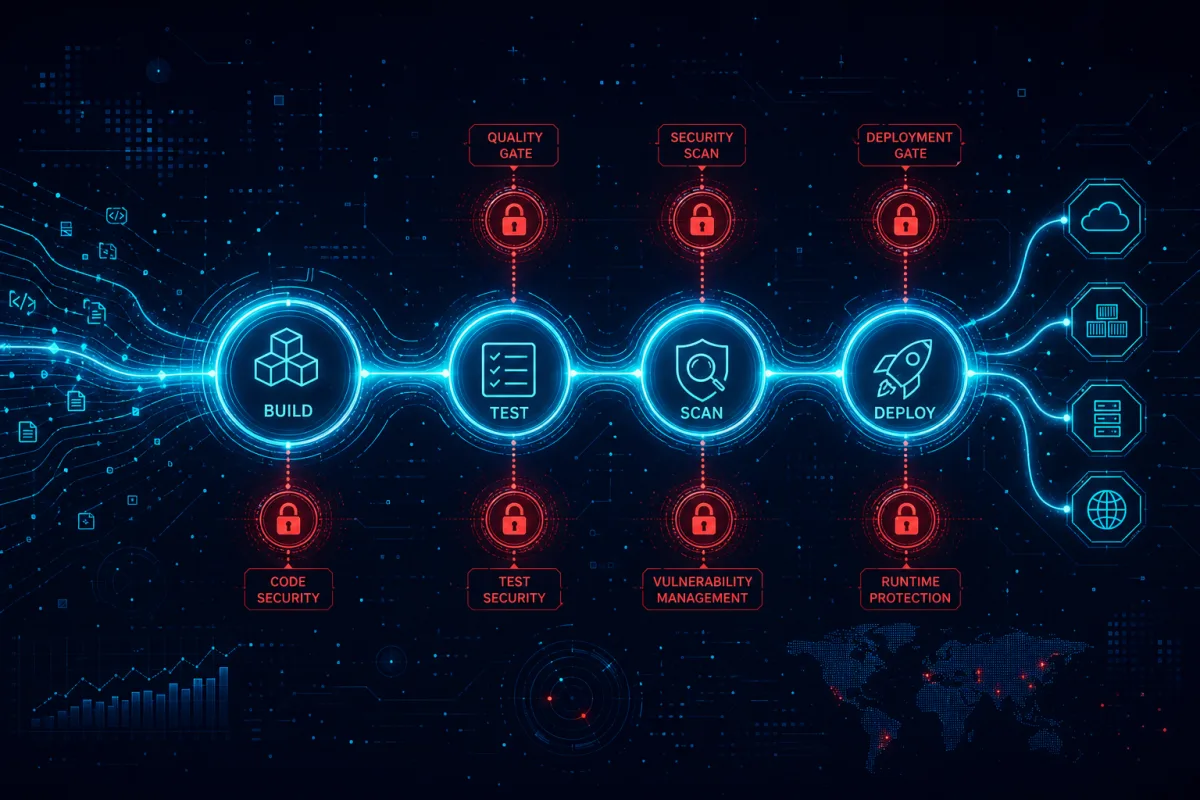
A cleared DevSecOps subcontractor is a specific capability profile: engineers who can operate within classified or CUI-handling environments and deliver production-quality CI/CD pipelines aligned to DoD security standards. For prime contractors running software programs in classified networks, this combination of clearance and DevSecOps technical depth is difficult to find and critical to delivery.
What "Cleared DevSecOps" Actually Means
Two separate qualifications converge:
Clearance: Personnel Security Clearances (PCLs) allow engineers to work on classified systems — Confidential, Secret, or Top Secret/SCI depending on program requirements. Facility Security Clearances (FCLs) authorize the company to hold classified information and perform classified work. Both take time to obtain and are sponsored by cleared contracts.
DevSecOps: Not just "we have a CI/CD pipeline." True DevSecOps in the DoD context means:
- Pipeline generates ATO evidence artifacts automatically (OSCAL output, STIG validation reports, vulnerability scan results)
- Container images sourced from or validated against Platform One Iron Bank (DoD's hardened container registry)
- Policy-as-code gates prevent non-compliant infrastructure from deploying
- Security is shift-left — controls validated at commit, not at AO review
The combination is rare. Many cleared firms are traditional defense IT shops. Many DevSecOps shops are commercial-first with no clearance history. Rutagon operates at the intersection — production DevSecOps infrastructure applied to DoD compliance requirements.
Pre-Built Infrastructure: The Speed Advantage
Primes working DevSecOps contracts on tight task order timelines can't afford a sub that starts from scratch. The value of a mature cleared DevSecOps sub is the pre-built, battle-tested components that compress delivery timelines significantly:
GitLab Government pipeline template: Pre-configured GitLab CI/CD pipeline with:
- Trivy and Grype container scanning (vulnerability detection)
- Checkov and OPA/Rego infrastructure compliance scanning
- OWASP ZAP DAST integration
- Cosign container image signing (supply chain integrity)
- Automated STIG compliance report generation
Terraform module library: Pre-validated GovCloud modules for VPC design, EKS clusters, RDS with FIPS encryption, S3 with GuardDuty integration, AWS Config rules aligned to NIST 800-53. These modules eliminate weeks of infrastructure design time.
Iron Bank image catalog: Documented integration patterns for Iron Bank hardened base images. Using Iron Bank images reduces container vulnerability findings by 80-90% at the source, directly compressing ATO timelines.
Kubernetes STIG baseline: Pre-validated Kubernetes DISA STIG configuration for EKS. Implements network policies, pod security admission, audit logging, and RBAC according to STIG requirements. See DISA STIG cloud deployment for detailed implementation guidance.
How Cleared DevSecOps Delivery Differs From Traditional IT Subcontracting
Traditional IT staff augmentation on a DoD program provides cleared people who integrate into the prime's existing processes. This is valuable but different from what a DevSecOps sub delivers.
A DevSecOps sub brings the process — the pipeline, the templates, the compliance automation — in addition to the people. The artifacts produced by the pipeline (scan results, STIG validation reports, SSP sections) are program deliverables, not internal tools. This changes the value equation significantly.
Traditional IT sub (staff aug):
- Provides cleared engineers who work inside prime's processes
- Prime owns and operates the pipeline and tools
- Sub's value is headcount and skill
DevSecOps sub model:
- Provides the pipeline, templates, and compliance automation
- Sub and prime co-own the delivery artifacts
- Value is velocity + compliance depth + automated evidence generation
- Cloud-native sub vs staff augmentation covers this distinction in detail
The ATO Impact
Authorization to Operate is the bottleneck on most DoD software programs. Traditional ATO packages take 6-18 months of documentation effort. DevSecOps changes this when implemented correctly:
- Automated control evidence: Each pipeline run generates NIST 800-53 control validation artifacts. CA-7 continuous monitoring evidence is generated automatically, not manually assembled.
- STIG compliance on every commit: Every container image and infrastructure deployment is STIG-validated before it reaches the AO's review. Finding and fixing at commit is orders of magnitude cheaper than finding at AO review.
- Living SSP: System Security Plan maintained as code alongside the infrastructure it describes. When infrastructure changes, the SSP stays current. No stale documentation.
- cATO path: Continuous ATO frameworks recognize pipeline-generated compliance evidence, enabling perpetual authorization rather than point-in-time snapshots.
For programs behind on ATO, a cleared DevSecOps sub can accelerate RMF Steps 4-6 significantly. See ATO acceleration cloud sub for the specific approach at each RMF step.
CPARS Protection Through Sub Delivery Quality
Prime contractors' past performance evaluations (CPARS) have 6 evaluation areas: Technical, Schedule, Cost Control, Management, Small Business Subcontracting, and Regulatory Compliance. Poor subcontractor performance affects scores across multiple categories.
A cleared DevSecOps sub who:
- Delivers on sprint commitments
- Produces ATO evidence on schedule
- Documents everything in program repositories
- Escalates risks proactively
...directly protects the prime's Technical, Schedule, and Management CPARS scores.
See CPARS subcontractor performance government for how sub delivery maps to all six CPARS evaluation areas.
Frequently Asked Questions
What clearance levels does Rutagon's team hold?
We discuss clearance specifics on a case-by-case basis with primes evaluating us for specific programs. Our general capability includes engineers with active clearances appropriate for programs in the Secret and above space. Contact us directly to discuss clearance requirements for your program.
How long does it take a cleared DevSecOps sub to integrate into an active program?
With our pre-built infrastructure components, technical integration is typically 2-4 weeks from kickoff to first sprint demo. We bring the pipeline template, review the program's existing architecture, adapt to the specific IL tier and cloud environment, and execute. The bottleneck is typically administrative — CAC provisioning, system access, and government-side onboarding — not technical integration.
Can Rutagon provide DevSecOps pipelines for classified networks (SIPR, NIPR, JWICS)?
Cloud-native DevSecOps at higher classification levels requires specific program authority and infrastructure access. We discuss requirements for specific programs on a case-by-case basis. Our foundational pipeline and compliance automation patterns are adaptable to air-gapped and classified environments.
How do you handle Iron Bank dependencies for programs without internet access?
Air-gapped deployments using Iron Bank require a container registry mirror within the classified environment. We've implemented air-gapped Kubernetes deployments using Harbor or JFrog as internal registry mirrors, with offline sync processes for Iron Bank updates. This is standard practice for classified cloud deployments.
What's the teaming arrangement for a cleared DevSecOps sub?
We operate under a standard subcontract agreement from the prime. Teaming agreements executed early (pre-proposal) define work share, exclusivity terms for the specific opportunity, and flow-down clause obligations. We're direct about what we will and won't sub to — our delivery quality requires us to execute the technical scope directly, not layer sub-tier relationships underneath.
If your DoD program needs a cleared DevSecOps sub who delivers pipeline infrastructure, not just headcount, contact Rutagon to discuss your program's requirements.