Why ATO Timelines Slip
Authorization to Operate (ATO) is the gate between a working system and a deployed one. Every federal program must pass through it, and most programs underestimate the timeline. The Government Accountability Office and agency Inspector General reports consistently cite ATO delays as a factor in program schedule slippage and cost overruns.
The root cause is structural: most programs treat ATO as a documentation exercise. Security engineers compile evidence manually. System Security Plans (SSPs) are written in Word documents disconnected from the actual system configuration. Continuous monitoring means quarterly vulnerability scans reviewed in spreadsheets. When the assessment team arrives, the evidence package is stale, incomplete, or inconsistent with the deployed system.
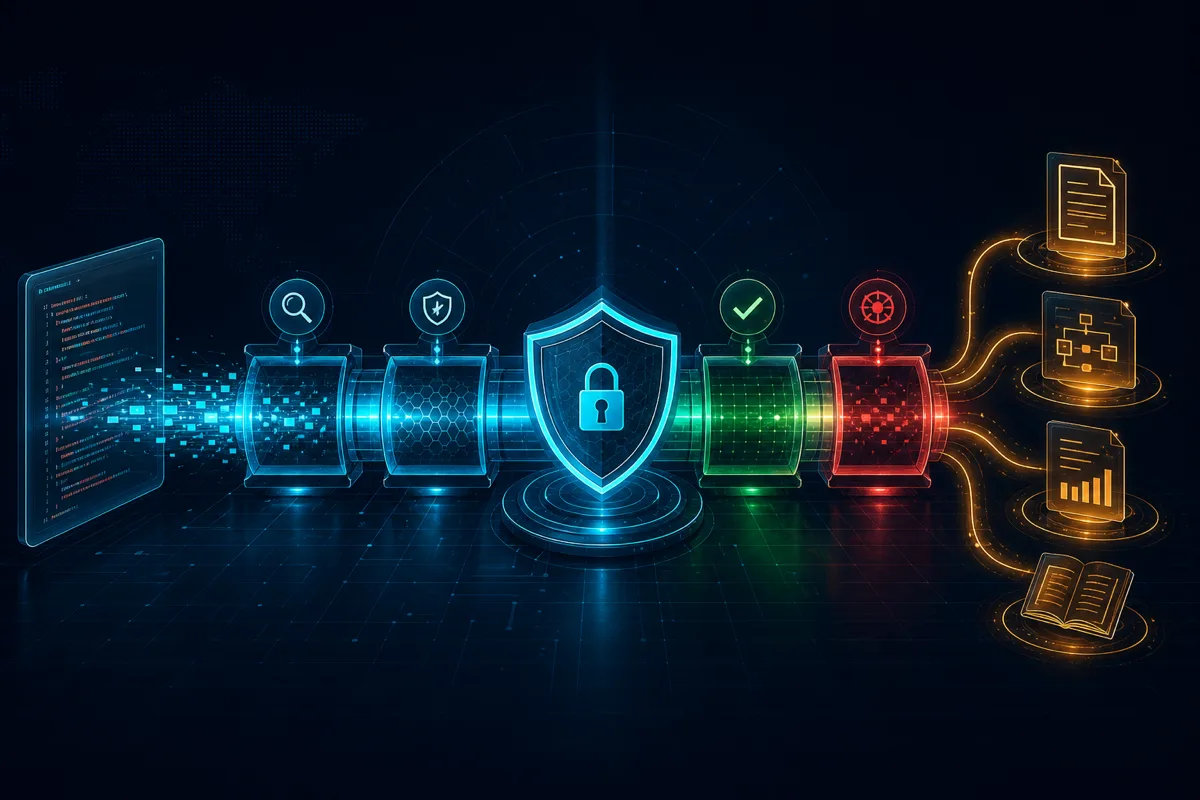
A cloud engineering subcontractor changes this equation by making ATO evidence a byproduct of infrastructure automation rather than a separate workstream. When authorization artifacts are generated from the same code that provisions and operates the system, the evidence is always current, always consistent, and always traceable.
This article focuses on Risk Management Framework (RMF) Steps 4 through 6 — Assess, Authorize, and Monitor — and what a cloud engineering sub automates at each stage to compress the authorization schedule.
The Documentation Trap
Before addressing what automation enables, it is worth understanding what it replaces.
On a typical program, ATO preparation involves:
- Manually authored SSP — security engineers write control implementation descriptions by interviewing developers and system administrators, then transcribing those conversations into a 200-plus page document.
- Point-in-time evidence collection — screenshots of configurations, exports from security tools, and spreadsheets summarizing scan results, all gathered in the weeks before an assessment.
- Manual cross-referencing — each control in the SSP must trace to evidence. This mapping is maintained in spreadsheets or GRC tools that are updated manually and often lag behind system changes.
- Siloed remediation — when the assessment team identifies findings, remediation happens outside the development pipeline. A security engineer files a ticket, a developer eventually addresses it, and someone verifies the fix — a cycle that can take weeks per finding.
This manual approach produces a documentation package that is expensive to create, immediately stale, and painful to maintain. It also creates a bottleneck: the program cannot proceed to production until the package is complete, and completing it competes with development work for the same engineering resources.
RMF Step 4: Assess — Automated Evidence Generation
RMF Step 4 is the security assessment. The assessment team (whether internal or a Third Party Assessment Organization) evaluates whether the system's security controls are implemented correctly, operating as intended, and producing the desired outcome.
What the Assessor Needs
For each applicable control, the assessor needs evidence that the control is implemented. This evidence takes different forms depending on the control family:
- Access Control (AC) — identity provider configurations, role definitions, MFA enforcement policies.
- Audit and Accountability (AU) — logging configurations, log retention policies, log aggregation architecture.
- Configuration Management (CM) — baseline configurations, change management processes, configuration drift detection.
- System and Communications Protection (SC) — encryption configurations, network segmentation, TLS certificate management.
What a Cloud Engineering Sub Automates
A cloud sub operating infrastructure-as-code generates this evidence as a natural output of its engineering work:
SSP sections from Terraform state. When infrastructure is defined in Terraform, the state file is a machine-readable record of every resource, its configuration, and its current state. A cloud sub can generate control implementation narratives directly from Terraform modules — the access control description comes from the IAM module, the encryption description comes from the KMS module, the network segmentation description comes from the VPC module. These narratives are generated from code, not interviews, which means they are accurate and reproducible.
Configuration evidence from policy-as-code. Tools like AWS Config Rules, Open Policy Agent, and Checkov evaluate infrastructure configurations against defined policies continuously. The output — compliance reports showing which resources pass and which fail — serves directly as assessment evidence for CM and SC control families. A cloud sub that implements policy-as-code generates this evidence on every pipeline run.
Access control evidence from identity-as-code. When IAM roles, policies, and group memberships are defined in code and provisioned through automation, the code itself is the evidence. The assessor can review the Terraform module that defines role-based access control rather than requesting screenshots of the AWS console. Code is more auditable than screenshots because it shows intent, not just current state.
RMF Step 5: Authorize — Compressing the Decision Timeline
RMF Step 5 is the authorization decision. The Authorizing Official (AO) reviews the security assessment results, the Plan of Action and Milestones (POA&M), and the system's residual risk to decide whether to grant an ATO.
Why Authorization Decisions Stall
AOs delay decisions when:
- The evidence package is incomplete or inconsistent.
- The POA&M contains too many open findings without credible remediation timelines.
- The risk picture is unclear because evidence is point-in-time rather than continuous.
How Automation Compresses This
A cloud sub that integrates security evidence into the CI/CD pipeline addresses all three blockers:
Complete, consistent packages. When evidence is generated from code and pipeline outputs, completeness is verifiable. A script can check that every applicable control has corresponding evidence artifacts. Gaps are identified during development, not during assessment.
Smaller POA&Ms. When security scanning runs on every commit — SAST, DAST, container image scanning, infrastructure configuration checks — findings are identified and remediated during development. By the time the assessment occurs, the backlog of findings is smaller because the pipeline has been catching and resolving issues continuously. Fewer open findings mean a cleaner POA&M and a faster authorization decision.
Continuous risk visibility. When the AO can see real-time compliance dashboards rather than a static PDF, the risk picture is current. Dashboards showing continuous ATO metrics — percentage of controls with passing evidence, trend of open findings, time-to-remediation averages — give the AO confidence that the system's security posture is monitored, not assumed.
Artifact Traceability
The authorization package must demonstrate traceability from controls to implementation to evidence. A cloud sub structures this traceability through automation:
- Control → code: Each security control maps to one or more Terraform modules or pipeline stages.
- Code → artifact: Each module or stage produces evidence artifacts (state files, scan reports, compliance checks) as part of its execution.
- Artifact → assessment: Evidence artifacts are indexed and linked to specific controls in the SSP or GRC tool.
This chain of traceability is built once and maintained automatically. When the system changes, the evidence regenerates to reflect the current configuration.
RMF Step 6: Monitor — Continuous Authorization Support
RMF Step 6 is ongoing monitoring. After the ATO is granted, the system must demonstrate continuous compliance with its security controls. This is where most programs struggle — the team that built the ATO package moves on, and monitoring degrades to periodic manual reviews.
Continuous Monitoring as Engineering
A cloud engineering sub transforms continuous monitoring from a periodic audit into an engineering function:
AWS Config Rules for configuration monitoring. Config Rules evaluate resource configurations against defined standards on every change. When a security group is modified, an S3 bucket policy changes, or an IAM role is updated, Config Rules immediately evaluate the change against compliance policies. Non-compliant changes trigger alerts and, optionally, automated remediation.
Vulnerability scanning in the pipeline. Container image scanning (ECR scanning, Trivy, or Grype), dependency scanning (OWASP Dependency-Check), and infrastructure scanning (Checkov, tfsec) run on every code commit. Vulnerability reports are generated automatically and feed the POA&M process. Findings do not wait for quarterly scans to be discovered.
ConMon dashboards from real data. Continuous monitoring dashboards should reflect actual system state, not manually updated spreadsheets. A cloud sub builds dashboards from AWS Security Hub, Config, CloudTrail, and GuardDuty data — sources that update in real time as the system operates. These dashboards serve as the ongoing evidence that the system maintains its security posture post-authorization.
Automated POA&M management. When pipeline scanning identifies a new vulnerability, it can automatically create a POA&M entry with the finding details, severity, affected components, and a remediation deadline based on the program's risk tolerance. When remediation is deployed and the subsequent scan passes, the POA&M entry is updated to reflect closure. This automation ensures the POA&M is always current without manual data entry.
What This Means for Program Timelines
Programs that treat ATO as a documentation exercise typically experience:
- 3-6 months of dedicated ATO preparation after development completion.
- Multiple assessment cycles because evidence is incomplete or inconsistent on first review.
- Post-ATO compliance gaps because monitoring is manual and underfunded.
Programs that integrate ATO evidence into engineering typically experience:
- ATO-ready at development completion because evidence was generated alongside the system.
- Single assessment cycle because evidence is complete, current, and traceable.
- Sustained compliance because monitoring is automated and integrated into operations.
The difference is measured in months of schedule and significant cost, which on a government program translates directly to period-of-performance utilization, option year viability, and program reputation.
What Rutagon Automates
Rutagon's cloud engineering practice is built around the principle that authorization is an engineering deliverable, not a documentation project. The technical foundation includes:
- Terraform-based infrastructure where every resource configuration is code-defined and auditable.
- CI/CD pipelines with integrated security scanning that catch findings during development rather than during assessment.
- Policy-as-code enforcement that continuously validates configurations against compliance baselines.
- Evidence generation automation that produces assessment-ready artifacts from pipeline execution.
With SAM registration (CAGE 19ZR7), CMMC Level 1 readiness, and experience supporting FedRAMP-aligned cloud environments, Rutagon brings both the engineering capability and the compliance posture that defense and civilian programs require.
Frequently Asked Questions
How does infrastructure-as-code accelerate the ATO process?
Infrastructure-as-code means every system component — network configurations, access controls, encryption settings, logging architectures — is defined in versioned, reviewable code. This code serves dual duty: it provisions the system and it documents how the system is configured. Assessment teams can review Terraform modules instead of requesting screenshots or interviewing administrators. Evidence is generated from the code itself, ensuring it is always consistent with the deployed system.
Which RMF steps benefit most from a cloud engineering sub?
Steps 4 through 6 see the greatest impact. Step 4 (Assess) benefits from automated evidence generation that ensures completeness and currency. Step 5 (Authorize) benefits from smaller POA&Ms and continuous risk visibility that accelerate the AO's decision. Step 6 (Monitor) benefits from automated configuration monitoring, pipeline-integrated vulnerability scanning, and real-time compliance dashboards that sustain the authorization without manual upkeep.
Can automated ATO evidence replace the System Security Plan?
Automation does not eliminate the SSP, but it transforms how the SSP is produced and maintained. Control implementation descriptions can be generated from infrastructure code, ensuring accuracy. Evidence references link to pipeline artifacts rather than static documents. The SSP becomes a living document that updates as the system evolves, rather than a point-in-time snapshot that immediately begins to decay.
What tools does a cloud sub typically use for ATO automation?
The toolchain varies by program, but common components include Terraform for infrastructure provisioning and state-based evidence, AWS Config Rules for continuous configuration compliance, Security Hub for aggregated findings, pipeline-integrated scanners (Checkov, tfsec, Trivy) for pre-deployment checks, and CloudWatch or equivalent for operational monitoring. The specific tools matter less than the principle: evidence is a pipeline output, not a manual collection.
How does continuous monitoring differ from periodic security assessments?
Periodic assessments evaluate the system at a point in time — quarterly vulnerability scans, annual penetration tests, scheduled configuration reviews. Continuous monitoring evaluates the system on every change and at regular automated intervals. Configuration drift is detected in minutes rather than months. Vulnerabilities are identified on commit rather than on the next scheduled scan. This shift from periodic to continuous means the system's security posture is known, not assumed, at any given moment.