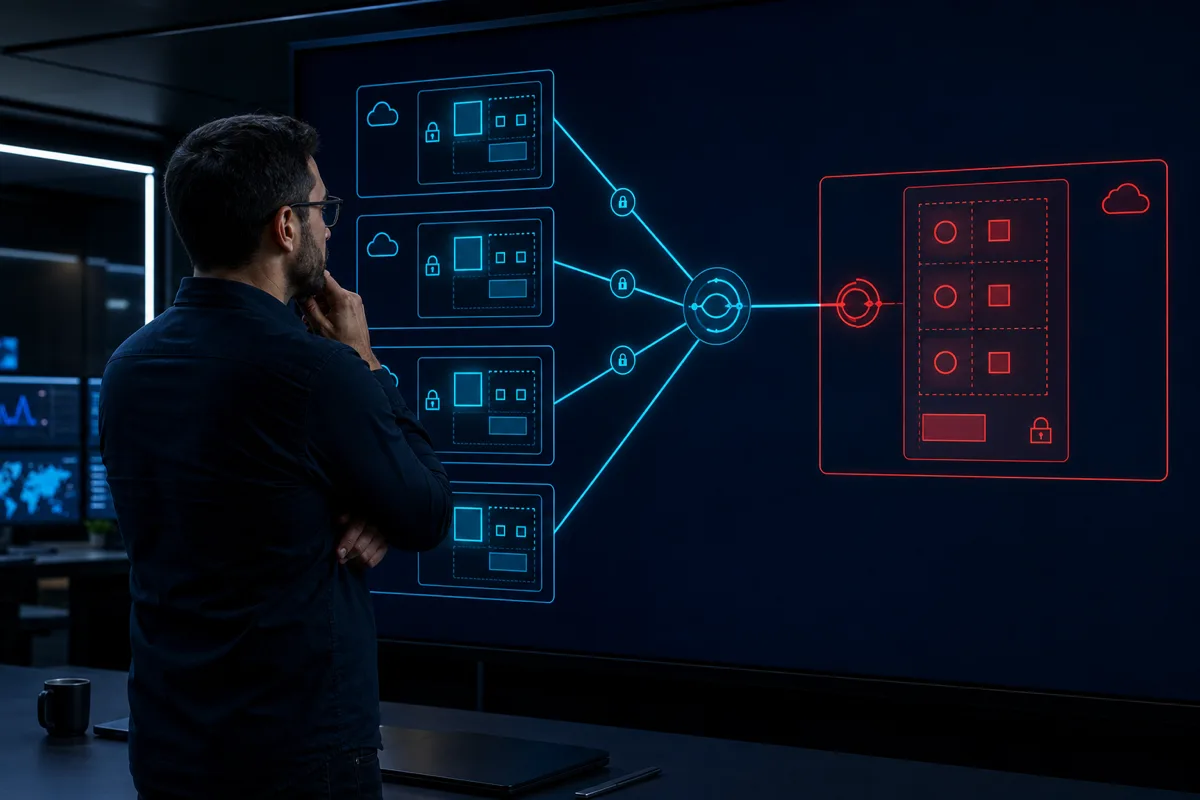
Public service endpoints are convenient until security questionnaires, data gravity, or NAT bills force a harder question: how do consumers reach this API without the public internet? This AWS PrivateLink architecture guide captures patterns Rutagon ships in production — interface endpoints, endpoint services, and multi-account boundaries — without turning your network into an unowned mesh of peering spaghetti.
Buyer Pain: Private Connectivity Without Peering Chaos
Triggers for PrivateLink projects:
- SaaS or internal platforms must stay off public ingress
- NAT Gateway costs spike from AWS API and partner traffic
- VPC peering / TGW meshes become political and operationally expensive
- Security wants private connectivity with clear producer/consumer roles
Related: AWS NAT gateway cost reduction, AWS landing zone setup, AWS VPC security groups best practices, security automation, AWS cloud infrastructure.
AWS PrivateLink Architecture Guide: Producer/Consumer Contracts
Provider VPC
  NLB / GWLB fronting service
        │
        ▼
Endpoint Service (PrivateLink)
        │
        ▼  (approval / principal allow)
Consumer VPC Interface Endpoint
        │
        ▼
Private DNS / app connection strings
We write the contract: ports, health checks, approval workflow, DNS names, and who pays for interface endpoint hours.
Consumer Patterns
- One endpoint per AZ subnet set with correct SGs
- Private DNS enabled when you control the service name story
- Security groups that allow only required consumer CIDRs/SG sources
- Cost allocation tags so endpoint hours hit the right team
resource "aws_vpc_endpoint" "payments_api" {
  vpc_id              = var.vpc_id
  service_name        = var.endpoint_service_name
  vpc_endpoint_type   = "Interface"
  subnet_ids          = var.private_subnet_ids
  security_group_ids  = [aws_security_group.payments_vpce.id]
  private_dns_enabled = var.private_dns_enabled
  tags = merge(var.tags, { service = "payments-api" })
}
Provider Patterns
- NLB as PrivateLink target with healthy target groups
- Endpoint service acceptance: auto-accept only for trusted org principals; manual for partners
- Separate services for prod vs non-prod to avoid cross-env blast radius
- Observation: connection counts, rejected principals, target health
Official PrivateLink concepts are documented by AWS; we implement account-specific controls on top — see AWS PrivateLink documentation on docs.aws.amazon.com.
Multi-Account Reality
In Organizations landing zones, we often place shared services in a network or platform account and expose them via endpoint services to workload accounts. That beats transitive peering nightmares. Tie-in: AWS Organizations multi-account setup and Terraform infrastructure as code consultant.
Production Lessons
Lesson 1 — DNS is half the project. Wrong private DNS settings produce “it works in curl from bastion but not from ECS” tickets for days.
Lesson 2 — Endpoint hours add up. Consolidate thoughtfully; do not spawn duplicates per microservice without a cost model.
Lesson 3 — SG dual control. Provider and consumer SGs both matter; debug both sides.
Lesson 4 — Document break-glass public paths. If a temporary public endpoint exists, give it an expiry.
Ready to implement an AWS PrivateLink architecture that security and FinOps both accept? Talk to Rutagon — contact@rutagon.com or 907-841-8407.
Delivery Cadence With Rutagon
We run these builds as time-boxed delivery, not open-ended advisory:
- Discovery — baselines, owners, constraints, success metrics
- Thin slice — one production path that proves the architecture
- Hardening — observability, access control, failure modes
- Operate — runbooks, dashboards, and a named handoff
Clients keep source, IaC, and operational docs. The goal is a system your team can run — with optional ongoing help if you want a fractional or managed follow-on.
Anti-Patterns We Refuse
- Big-bang rewrites without a strangler seam
- “AI will figure it out” without validators and human gates
- Cost cuts that delete observability or break RTO
- Security theater that claims certifications you do not hold
- Undocumented break-glass paths that become permanent
If a proposed shortcut fails those tests, we say no and offer a safer sequence.
How We Measure Done
Done means the agreed metric moved — latency, cycle time, dollars, or readiness — and the operating model exists. A demo without owners, alerts, and a rollback story is not done.
Why Teams Hire Rutagon for Aws Private Link Architecture Guide
Buyers hire us because we ship the working path in their stack — AWS accounts, repos, identity providers, ERPs, and CRMs they already run — with production lessons included. We are not a slide shop. Commercial CTOs and founders get architecture decisions, code, and an operating cadence. Defense-adjacent private companies get the same delivery discipline with security boundaries treated as design inputs, not paperwork afterthoughts.
Internal links stay on topic: pair this build with related FinOps consulting services or fractional CTO services when leadership bandwidth is the bottleneck, and with AWS cloud infrastructure when landing zones and networking are in scope.
Observability for Private Paths
Private connectivity fails quietly. We add:
- NLB target health alarms
- Endpoint-level connection metrics where available
- Synthetic checks from consumer subnets to provider ports
- Runbook steps for DNS cache and SG mismatches
When PrivateLink replaces a public endpoint, keep the old path dark but recoverable for a short window with an explicit kill date.
Cost Conversation With Finance
Interface endpoint hours are visible and attributable. We present a before/after of NAT bytes vs endpoint hours so FinOps sees the trade, not a surprise new line item. Tags on endpoints are mandatory in the Terraform modules we leave behind.
Frequently Asked Questions
When should we use PrivateLink vs VPC peering?
PrivateLink shines for producer/consumer service exposure with controlled principals. Peering/TGW suits broader network reachability. Many estates use both deliberately.
Does PrivateLink replace NAT Gateways?
It replaces NAT for traffic that can move to endpoints/PrivateLink. True public internet egress may still need NAT or a proxy.
Who pays for what?
Consumers typically pay interface endpoint hours and data processing; providers pay load balancer and service infrastructure. We make that explicit in designs.
Can partners in other orgs connect?
Yes, with endpoint service allowlisting and acceptance workflows. Treat partner onboarding as a product process, not a one-off ticket.
How do you test before cutover?
Connectivity tests from each consumer subnet, DNS resolution checks, failure injection on targets, and load tests against NLB — all before retiring the old path.