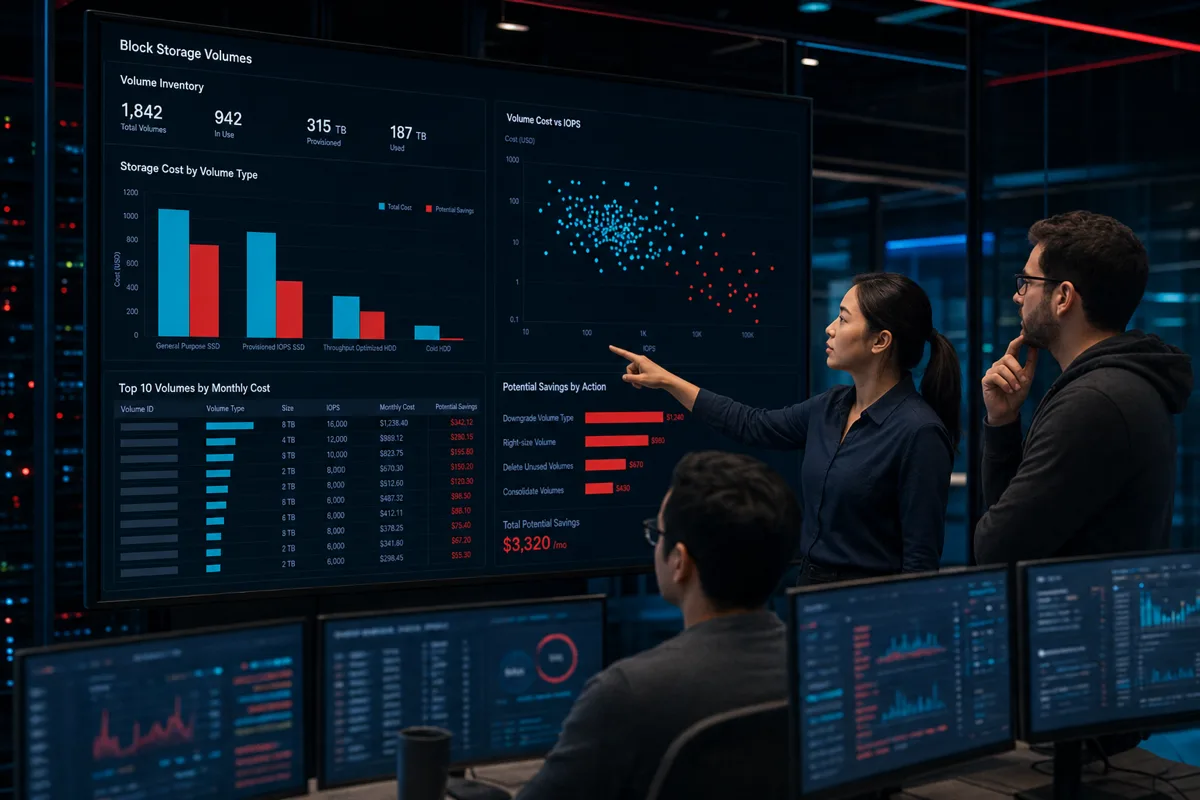
gp2 volumes linger because “they work” and nobody owns storage unit economics. AWS EBS gp3 migration savings show up fast when you inventory, rightsize IOPS/throughput, and cut over with a performance safety net — which is exactly how Rutagon runs these FinOps deliveries for commercial AWS estates.
Buyer Pain: Storage Lines That Never Get a Owner
Typical findings:
- Hundreds of gp2 volumes from early defaults
- Over-provisioned gp3 IOPS “just in case” after one incident
- Unattached volumes still billing
- Snapshots without retention policy
- No baseline of actual IOPS/throughput before changing type
Context for the broader bill: reduce AWS bill cost optimization, AWS cost monitoring setup, and FinOps consulting services. Capability: AWS cloud infrastructure.
AWS EBS gp3 Migration Savings: Inventory → Rightsize → Cutover
CUR + Compute Optimizer + CloudWatch
            │
            ▼
Volume inventory (type, size, IOPS, attachment, tags)
            │
            ├── Delete / archive candidates (unattached)
            ├── gp2 → gp3 with measured IOPS/throughput
            └── Snapshot lifecycle policy
            │
            ▼
Post-cutover watch (latency, queue depth) + rollback notes
We treat migration as a change program with owners — not a weekend script surprise.
Rightsizing Math (Illustrative)
gp3 separates size from IOPS/throughput. That is the savings lever:
def gp3_monthly_estimate(size_gb: int, iops: int, throughput_mib: int) -> float:
    """Illustrative only — verify against current AWS pricing for your region."""
    base = size_gb * 0.08  # placeholder coefficient
    iops_extra = max(iops - 3000, 0) * 0.005
    tp_extra = max(throughput_mib - 125, 0) * 0.04
    return base + iops_extra + tp_extra
We never publish fake guaranteed savings percentages. We estimate from your volume list and confirm against Cost Explorer after cutover. Official pricing and ModifyVolume behavior are documented by AWS in the EBS gp3 user guide.
Cutover Patterns That Avoid Regressions
Online modify where supported. Many volumes can change type/IOPS with ModifyVolume while attached — still requires application-aware monitoring.
Batch by risk. Start with non-prod and low-criticality data volumes. Databases get their own maintenance window and query latency watch.
Capture baseline first. CloudWatch volume metrics for a representative period beat gut feel.
Rollback plan. Know whether you reverse modify, restore from snapshot, or fail over. Write it down before you click.
Related performance discipline: AWS Well-Architected review guide and Kubernetes storage cost adjacency in Kubernetes cost optimization guide.
Unattached Volumes and Snapshot Rot
Migration programs often find 10–20% of storage spend is not “gp2 vs gp3” — it is abandoned disks and eternal snapshots. We add:
- Unattached volume report with owner tags (or “untagged = delete candidate after notice”)
- Snapshot retention by environment class
- Mandatory tags on new volumes via policy (IaC + SCPs where appropriate)
Production Lessons
Lesson 1 — Default IOPS copy-paste wastes money. Teams set 16k IOPS everywhere after one outage. We rightsize from p99 usage plus headroom policy.
Lesson 2 — Throughput matters for large sequential workloads. IOPS-only thinking misses log and analytics disks.
Lesson 3 — Tags before deletes. Finance will ask who owned the volume you removed. Attribution first.
Lesson 4 — Revisit quarterly. New services recreate gp2 via old modules. Fix the Terraform modules, not only the live volumes — see Terraform infrastructure as code consultant.
Ready to capture AWS EBS gp3 migration savings without surprise latency? Talk to Rutagon — contact@rutagon.com or 907-841-8407.
Worked Example Engagement Shape
A typical Rutagon delivery week-plan looks like:
- Inventory export — all volumes with type, size, IOPS, throughput, attachment, tags, last CloudWatch activity
- Savings model — gp2→gp3 candidates ranked by monthly delta; flag io* volumes separately
- Module fix — Terraform/CloudFormation defaults stop minting gp2
- Pilot cutover — non-prod + low-risk prod data volumes
- Database wave — planned windows with latency dashboards
- Cleanup — unattached volumes and snapshot retention
- Guardrails — budgets + weekly drift report for volume types
CloudWatch Signals We Watch Post-Cutover
- VolumeQueueLength
- VolumeTotalReadTime / WriteTime
- Application p95/p99 latency for services pinned to the volume
- Error rates on dependent jobs
If queue depth climbs after an IOPS downsize, we roll IOPS up immediately and document the new floor. Savings that create silent latency debt get reversed — credibility matters more than a one-week Cost Explorer dip.
Coordination With Compute Optimizer
AWS Compute Optimizer recommendations are an input, not an autopilot. We reconcile Optimizer suggestions against application owners who know batch windows and month-end spikes Optimizer may under-represent. Human confirmation remains on the critical path for stateful systems.
Communication Plan
We notify volume owners before cutover with expected window, rollback path, and the metrics we will watch. Silence is how rumors of “FinOps broke prod” start. A short owner map — even if imperfect — beats a global email that everyone ignores.
Validation Before Cutover
For each volume class we sampled CloudWatch VolumeReadOps and VolumeWriteOps, then ran a canary migration on non-critical volumes first. Applications that needed provisioned IOPS stayed on io2; everything else moved to gp3 with explicit IOPS and throughput set in Terraform. Finance saw the savings in the next CUR export without a performance incident.
Frequently Asked Questions
Are AWS EBS gp3 migration savings guaranteed?
No honest partner guarantees a fixed percent without your inventory. We estimate from volume types/sizes/IOPS and validate after cutover against Cost Explorer.
Can we modify volumes without downtime?
Often yes for type/IOPS changes, depending on volume state and AWS constraints — but application impact must still be monitored. Critical databases deserve planned windows.
What about io1/io2 volumes?
Those are a different performance tier. We evaluate whether gp3 meets the measured need before any migration; some workloads should stay on provisioned IOPS SSD families.
Will snapshots convert automatically?
Snapshot strategy is separate from volume type. We review retention and cost in the same engagement because snapshot rot often rivals volume waste.
How do you prevent gp2 from coming back?
Module defaults, CI policy checks, and account governance. Migrating live volumes without fixing IaC is temporary relief.