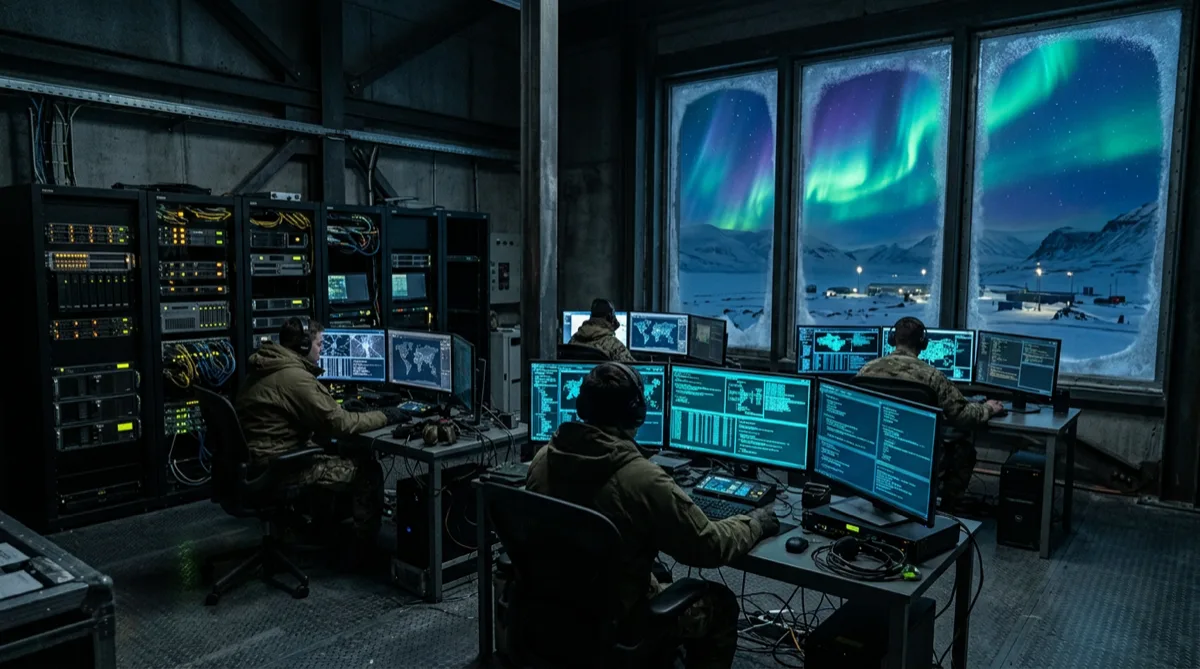
Arctic and high-latitude military operations face a software challenge that most commercial cloud architecture wasn't designed to solve: intermittent connectivity, extreme thermal environments, and mission requirements that can't pause for a network handshake.
A Kubernetes pod that tries to pull its configuration from a cloud control plane won't work in a remote Arctic forward operating location where the satellite link is congested, delayed, or periodically unavailable. Systems designed for the cloud need to be re-architected for the edge — and the edge in Alaska is genuinely hostile to conventional assumptions.
Alaska sits at the strategic tip of the Arctic domain. JBER, Eielson Air Force Base, Clear Space Force Station, and Fort Wainwright are all within the state. The infrastructure and software that supports operations at these installations, and at even more remote sites, must handle the reality of Arctic edge conditions.
The DDIL Environment
DDIL — Disconnected, Degraded, Intermittent, and Limited (connectivity) — is the operational concept that drives edge computing requirements in military contexts.
In an Arctic DDIL environment:
- Disconnected: No connectivity to cloud infrastructure for periods ranging from minutes to hours or longer
- Degraded: Available bandwidth is a fraction of what cloud-native applications assume (SATCOM latency, weather impacts)
- Intermittent: Connection windows are predictable but not continuous
- Limited: Available bandwidth may be measured in kilobits rather than megabits
Software that works in DDIL conditions requires architectural decisions made at design time, not retrofitted. The fundamental question is: what does this system need to do autonomously, and what can it defer until connectivity is restored?
The Edge-First Architecture Pattern
Rutagon's approach to DDIL-ready systems follows an edge-first architecture pattern: the edge node operates autonomously during disconnection and synchronizes with the cloud node when connectivity is available.
Local State and Processing
Applications that must function in DDIL conditions maintain local state. Rather than making synchronous calls to a cloud database, the edge application works from a local database replica:
# Kubernetes StatefulSet: local SQLite/PostgreSQL for edge state
apiVersion: apps/v1
kind: StatefulSet
metadata:
  name: edge-data-service
spec:
  replicas: 1  # Edge nodes are single-instance
  template:
    spec:
      containers:
      - name: data-service
        image: registry.edge.mil/data-service:v2.1.3
        env:
        - name: DATABASE_URL
          value: "postgresql://localhost:5432/edge_db"
        - name: SYNC_MODE
          value: "offline-first"
        volumeMounts:
        - name: edge-data
          mountPath: /var/data
  volumeClaimTemplates:
  - metadata:
      name: edge-data
    spec:
      storageClassName: local-ssd
      resources:
        requests:
          storage: 50Gi
The local data store is the primary truth for edge operations. Cloud sync is a background process that resolves conflicts and propagates updates when connectivity is available.
Sync Protocol: Offline-First with Conflict Resolution
Cloud synchronization for DDIL systems requires conflict resolution logic. When an edge node comes back online with changes made during disconnection, and the cloud state has also advanced:
def sync_edge_to_cloud(edge_records, cloud_records, conflict_strategy="edge-wins-on-fresh"):
    """
    Sync edge records to cloud with configurable conflict resolution.

    Strategy options:
    - edge-wins-on-fresh: Edge record wins if it's more recent
    - cloud-wins: Cloud state always takes precedence
    - merge: Attempt to merge non-conflicting fields
    - flag-for-review: Flag conflicts for human review
    """
    conflicts = []
    synced = []

    for edge_record in edge_records:
        cloud_record = cloud_records.get(edge_record.id)

        if cloud_record is None:
            # New edge record — push to cloud
            synced.append(push_to_cloud(edge_record))
        elif edge_record.updated_at > cloud_record.updated_at:
            # Edge is newer — resolve by strategy
            if conflict_strategy == "edge-wins-on-fresh":
                synced.append(push_to_cloud(edge_record))
            else:
                conflicts.append((edge_record, cloud_record))
        else:
            # Cloud is newer — pull update to edge
            synced.append(pull_to_edge(cloud_record))

    return synced, conflicts
The right conflict strategy depends on the operational context. For sensor data ingestion, edge-wins is typically appropriate — the edge data is authoritative. For configuration updates pushed from command, cloud-wins ensures the latest operator intent takes effect.
Health-Monitoring in Air-Gapped Conditions
Edge nodes need local health monitoring that doesn't depend on a cloud-hosted observability platform. In a fully disconnected state:
# Prometheus and Grafana running locally on the edge node
# Metrics retained locally; shipping to central observability when connected
apiVersion: v1
kind: ConfigMap
metadata:
  name: prometheus-config
data:
  prometheus.yml: |
    global:
      scrape_interval: 15s
      external_labels:
        edge_site: '${SITE_ID}'
        environment: 'tactical'

    scrape_configs:
    - job_name: 'edge-services'
      static_configs:
      - targets: ['localhost:8080', 'localhost:8081']

    remote_write:
    - url: "${CLOUD_PROMETHEUS_URL}"
      queue_config:
        capacity: 10000
        max_shards: 200
      # Queues when disconnected, flushes on reconnect
The remote_write queue buffers metrics during disconnection and transmits the full history when the connection is restored, giving operators full visibility into what happened during the offline period.
Thermal and Power Considerations
Arctic edge hardware faces environmental conditions that cloud architects never need to consider:
- Temperature range: From -40°F in Alaskan Interior winters to heat stress in constrained shelters in summer
- Power availability: Generator or grid power; must support graceful shutdown on power loss
- Humidity: Wide humidity ranges between seasons; condensation risk
Software architecture for Arctic edge must account for hardware failure modes:
- Graceful shutdown handling: Application state flushed to disk on SIGTERM
- Power loss recovery: Persistent volume data must survive unexpected power cycles without corruption
- Thermal throttling: Applications must degrade gracefully when the hardware throttles under thermal stress
Alaska as the Test and Deployment Environment
Alaska's position in the Arctic makes it both a strategic deployment environment and a natural test environment for Arctic edge computing. The state's diverse conditions — from coastal Kodiak to the Fairbanks Interior to the North Slope — replicate the range of Arctic operational environments that defense systems must serve.
Rutagon's presence in Alaska provides a unique vantage point for this work. Systems developed for Alaska's military installations have direct applicability to Arctic operations across the high-latitude domain.
See our related analysis on cloud infrastructure for Alaska military installations and edge computing for defense systems.
Contact Rutagon to discuss Arctic edge requirements →
Frequently Asked Questions
What is DDIL and why does it matter for military edge computing?
DDIL stands for Disconnected, Degraded, Intermittent, and Limited — the connectivity characteristics of forward military operating locations, including Arctic sites. DDIL-aware software architecture is designed to operate autonomously during connectivity gaps, buffer data for synchronization when connectivity is restored, and gracefully handle partial connectivity rather than failing completely. Conventional cloud-native applications that assume reliable connectivity fail in DDIL environments.
What is edge-first architecture for military systems?
Edge-first architecture places the primary operational logic and data at the edge node rather than the cloud. The edge node maintains a local data store, processes requests locally, and operates fully independently during disconnection periods. Cloud connectivity enables synchronization, configuration updates, telemetry aggregation, and command and control communications — but the edge node doesn't require the cloud to fulfill its operational mission.
What conflict resolution strategies are used for DDIL synchronization?
Common conflict resolution strategies for DDIL sync include: edge-wins-on-fresh (more recent edge record takes precedence — appropriate for sensor/observation data), cloud-wins (cloud state always prevails — appropriate for operator configuration updates), merge (attempt to combine non-conflicting fields from both versions), and flag-for-review (human-in-the-loop resolution for high-stakes conflicts). The correct strategy depends on the data type and the operational trust hierarchy.
What Kubernetes configurations matter most for Arctic edge deployments?
Key Kubernetes configurations for Arctic edge deployments: StatefulSets with local persistent storage (not cloud-dependent PVCs), pod disruption budgets that allow zero-downtime during planned maintenance windows, graceful shutdown hooks (preStop) to flush state before container termination, resource limits that account for thermal throttling (reduced CPU availability during thermal events), and DaemonSet-based monitoring that survives cluster turbulence.
Why is Alaska strategically significant for Arctic defense technology?
Alaska is home to multiple major defense installations — JBER, Eielson AFB, Clear Space Force Station, Fort Wainwright — as well as the FAA's Alaska Region (which controls US airspace for the Arctic approaches), NOAA's Arctic research infrastructure, and the northernmost US border with the Arctic Ocean. Technology developed, tested, and deployed in Alaska's operational conditions has direct applicability to the entire Arctic domain — including allied partner operations in the High North.