Companies that engage a fractional vCISO to guide their compliance program often hit the same moment several months in: the vCISO has correctly identified that access reviews are manual, standing credentials are everywhere, and evidence collection is a spreadsheet exercise — and now someone needs to actually build the fix. A vCISO's engagement model is built around strategy, risk assessment, and program oversight, not writing the connectors, pipelines, and automation that turn "we know what's wrong" into "it's fixed."
What a vCISO Engagement Typically Covers
A fractional or virtual CISO brings security leadership to companies that need the function but not a full-time executive — setting security strategy, running risk assessments, interfacing with the board or auditors, choosing which frameworks to pursue, and often owning the relationship with the audit firm itself. This is genuinely valuable, senior-level judgment work, and it's usually priced and scoped as an advisory/leadership engagement rather than a hands-on build.
What a vCISO Engagement Typically Doesn't Cover
Most vCISO engagements are explicitly not scoped to include hands-on engineering — writing the Lambda functions that automate credential rotation, building the connector layer that closes access review gaps for custom internal tools, or standing up evidence pipelines that survive auditor sampling. This isn't a knock on the vCISO model; it's a scope boundary, similar to how a CFO sets financial strategy without personally building the accounting system.
Where the Gap Shows Up in Practice
The pattern we see most often: a vCISO's risk assessment or gap analysis correctly identifies findings like "access reviews are manual and inconsistent" or "standing service account passwords exist across multiple systems," and the remediation plan gets handed to internal engineering — which is already stretched thin on product work and doesn't have bandwidth (or sometimes the specific IAM/identity federation expertise) to build the fix on the timeline the audit clock demands.
Why a Boutique Engineering Partner Fits This Specific Gap
The work a vCISO identifies as needed — access review automation, credential elimination, compliance evidence pipelines — is genuinely specialized engineering, closer to identity and access infrastructure work than general application development. A boutique firm that specializes in exactly this kind of build can move faster on it than internal engineering picking it up as a side project, without the overhead of hiring a full-time specialist for what's typically a defined, time-bound remediation effort.
How the Two Engagements Work Together
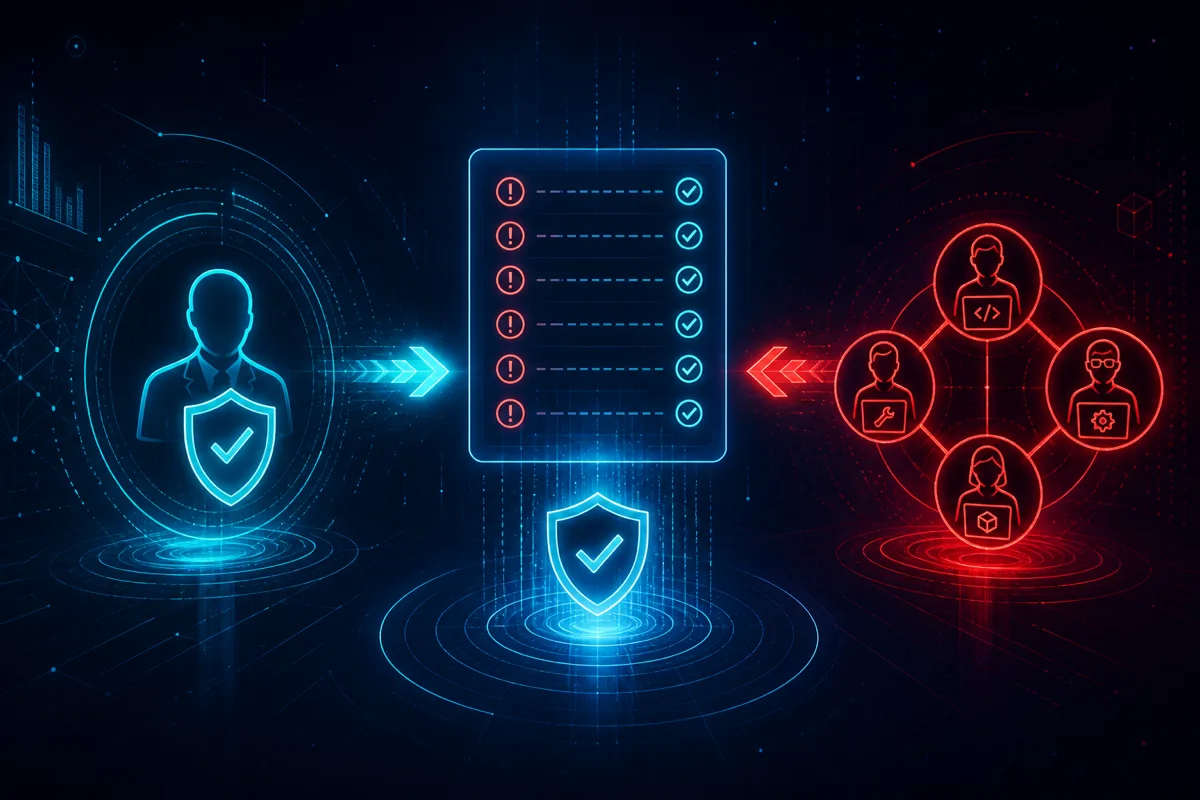
The strongest version of this setup we've seen isn't either/or — it's a vCISO owning the strategic relationship with leadership and the audit firm, identifying and prioritizing findings, while a boutique engineering partner executes the specific technical remediation on a defined timeline, reporting progress back through the vCISO's oversight. The vCISO stays the accountable strategic owner; the engineering partner is the delivery arm for the technical findings that need code, not just policy.
Questions Worth Asking Before Choosing a Path
- Does your vCISO's contract include hands-on build work, or purely advisory/assessment hours? Many are scoped and priced for the latter, which is fine as long as everyone understands where the line is.
- Does your internal engineering team have specific identity federation and access-automation experience, or would this be their first time building this kind of infrastructure? First-time builds on audit-critical infrastructure carry more risk of timeline slippage.
- What's your actual audit deadline, and does internal engineering's current roadmap realistically leave room for a specialized, time-boxed remediation effort alongside product work?
This engagement model complements our security automation capability and the delivery-focused approach in SOC 2 remediation consultant engagements.
Book a technical call to talk through your specific gaps: 907-841-8407 or contact@rutagon.com.
Frequently Asked Questions
Can a boutique engineering firm replace a vCISO entirely?
Generally no — a vCISO's strategic, risk-assessment, and audit-relationship role is a different skill set than hands-on engineering delivery; the two are complementary, not substitutes for each other.
How is a compliance remediation engagement typically scoped and priced?
It's usually structured as a defined-scope project (fixed-price or capped-hours) tied to specific findings — access review automation, credential elimination, evidence pipeline build — rather than an open-ended retainer, since the work has a clear technical endpoint.
What if we don't have a vCISO at all — can we still engage a boutique firm directly?
Yes — many companies without a dedicated GRC or security hire engage directly for specific technical remediation, especially if they already know their access/credential/evidence gaps from a SOC 2 readiness assessment or auditor findings letter.
How long does a typical access/credential/evidence remediation engagement take?
It depends heavily on scope and system count, but a focused 90-day engagement covering the highest-priority findings is a common structure for mid-market companies working against an audit deadline.
Does hiring a boutique firm mean we don't need internal engineering involved at all?
No — internal engineering involvement (system access, architecture context, eventual ownership of the deployed automation) is typically still needed; the boutique firm's role is accelerating the build, not operating entirely independent of your existing team.