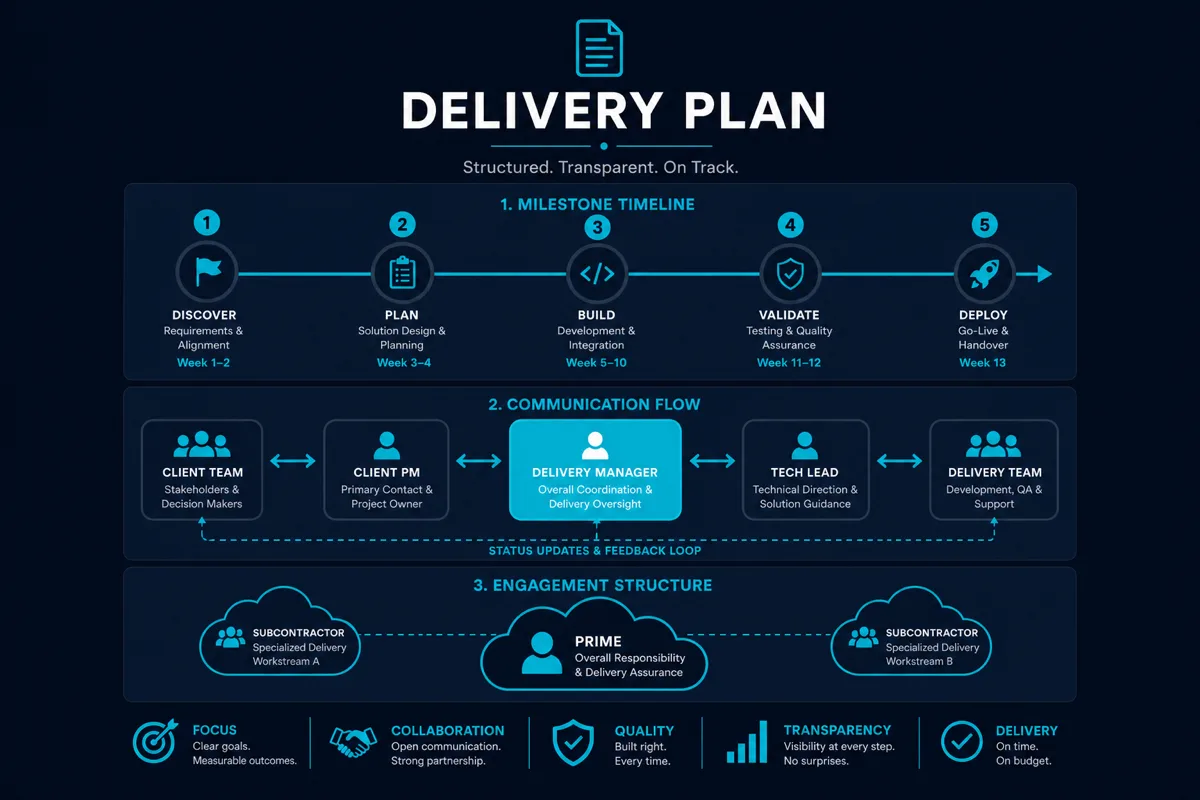
Federal prime contractors are accountable to their customers for subcontractor performance. When a cloud engineering subcontractor is delivering critical infrastructure, DevSecOps pipelines, or ATO evidence components, sub performance directly impacts the prime's CPARS ratings and program outcomes. A clear subcontractor management plan eliminates ambiguity before it creates program risk.
Here's what an effective subcontractor management plan covers for cloud engineering programs — and what Rutagon provides by default in teaming arrangements.
What a Cloud Sub Management Plan Must Address
Scope definition: The most common source of prime-sub friction is ambiguous scope. A cloud sub management plan should define: - Which system components or services the sub owns - Which environments the sub is responsible for (dev, staging, production) - What "done" looks like for each deliverable (deployed, tested, STIG-compliant, with ATO evidence artifact) - What is explicitly out of scope (application code, if cloud infra only; networking above the sub's layer, etc.)
Delivery cadence: How often does the sub report progress? A sprint-based cadence (bi-weekly sprint reviews) is the standard for cloud engineering delivery. Milestone-based delivery (less frequent, tied to major system events like ATO submission or environment go-live) is appropriate for infrastructure-focused scopes. Either way, the prime needs a defined mechanism to verify delivery without micromanaging.
ATO evidence handoff: If the sub is generating ATO evidence artifacts (scan reports, configuration baselines, SSP sections, ConMon dashboard components), the plan should specify artifact format, storage location, naming convention, and handoff timing. ISSO/ISSM can't assemble an ATO package from mixed-format evidence scattered across sub inboxes.
Clearance and access requirements: For programs involving classified or CUI data, the sub management plan must document clearance levels required for personnel, access request process for government systems and networks, and handling procedures for any CUI the sub touches. Personnel clearance requests take weeks to months — establishing requirements upfront prevents last-minute scrambles before kick-off.
Communication and escalation paths: Who is the prime's single point of contact for the sub? Who on the sub side is the prime's contact? What is the escalation path if the sub is blocked by an impediment outside their control (firewall change request delayed, cloud account access not provisioned)?
Rutagon's Default Delivery Standards
Rutagon establishes the following by default in teaming arrangements, independent of what the prime requires:
Bi-weekly sprint delivery: Every two weeks, Rutagon demonstrates working deliverables to the prime's technical lead or program manager. Demos are live — working deployed systems, pipeline runs, monitoring dashboards — not slide decks.
ATO evidence generation: Every infrastructure deployment generates a compliance evidence package: Terraform plan output, STIG scan results (Trivy, SCAP), container signatures (Cosign), and deployment logs. Evidence is stored in the agreed artifact repository with consistent naming and tagged to the deployment event.
Weekly written status: A brief weekly status document covering: what was delivered this week, what's planned next week, any impediments requiring prime action, and any risk items. Delivered via the agreed communication channel (JIRA comment, Teams message, email — prime's preference).
Clearance hygiene: All Rutagon personnel accessing controlled environments or handling CUI maintain appropriate handling practices. Rutagon maintains ITAR-aware development processes with US-person-only access to controlled systems.
SAM.gov currency: Rutagon maintains an active SAM.gov registration (UEI: FB2FHEJHM493, CAGE: 19ZR7). Primes can verify this at SAM.gov directly.
Sub Performance Metrics That Matter for CPARS
Primes' CPARS ratings include subcontractor performance as a factor. Cloud engineering sub performance should be measured against:
Quality: Are delivered artifacts meeting the agreed acceptance criteria? Are STIG findings at or below the program's threshold? Is technical debt being managed or accumulating?
Schedule: Are sprint commitments being met? Are environment readiness milestones hitting program dates?
Business relations: Is the sub communicating proactively? Are changes in scope being flagged early rather than discovered at billing? Are invoices accurate and on schedule?
Management: Is the sub team stable (low turnover)? Are subcontract management processes (clearance requests, access requests, change orders) handled with low friction?
A sub that delivers technically but creates management burden for the prime damages the overall prime performance narrative, even if the technical work is excellent.
Explore teaming with Rutagon → rutagon.com/contact
Frequently Asked Questions
How does Rutagon handle change orders on cloud subcontracts?
Scope changes are documented through a written change request — describing the additional work, estimated hours/cost, and schedule impact — prior to beginning out-of-scope work. Rutagon does not begin work on scope additions until the prime has acknowledged the change request in writing. This protects both parties: the prime knows costs before they're committed, and Rutagon has documented authorization for additional work.
What access does Rutagon require in a cloud engineering sub role?
Minimum access requirements depend on scope. For GovCloud environment delivery: AWS IAM roles with least-privilege access to the environment, GitLab/repository access for CI/CD configuration, and access to the compliance scanning toolchain. For ATO support roles: read access to the system boundary documentation and ATO tracking system. Rutagon does not require broad elevated access — permissions are scoped to the specific delivery work.
How are Rutagon personnel vetted for defense programs?
For programs requiring cleared personnel: Rutagon coordinates with the prime's facility security officer (FSO) and government security officer (GSO) through the standard visitor access request and clearance verification process. Specific clearance levels for Rutagon personnel are disclosed in the sub management plan negotiation, not in public content. For CUI-handling programs that don't require clearances, Rutagon personnel complete CUI awareness training as required by the program.
What happens if a Rutagon team member leaves during a program?
Personnel continuity is addressed in the sub management plan. Rutagon's practice: all work is documented (runbooks, infrastructure documentation, architecture decision records) so that knowledge transfer to a replacement resource is bounded. For cleared personnel, transition planning follows program security protocols. Rutagon notifies the prime of personnel changes at least 2 weeks in advance where possible.
How does a prime include Rutagon in their SB subcontracting plan?
The prime includes Rutagon in their SB subcontracting plan documentation with: company name, CAGE code (19ZR7), SAM.gov UEI (FB2FHEJHM493), SB size status, NAICS code(s) applicable to the work scope, and estimated subcontract value. ISR (Individual Subcontract Report) and SSR (Summary Subcontract Report) reporting processes are coordinated with Rutagon to ensure accurate data.