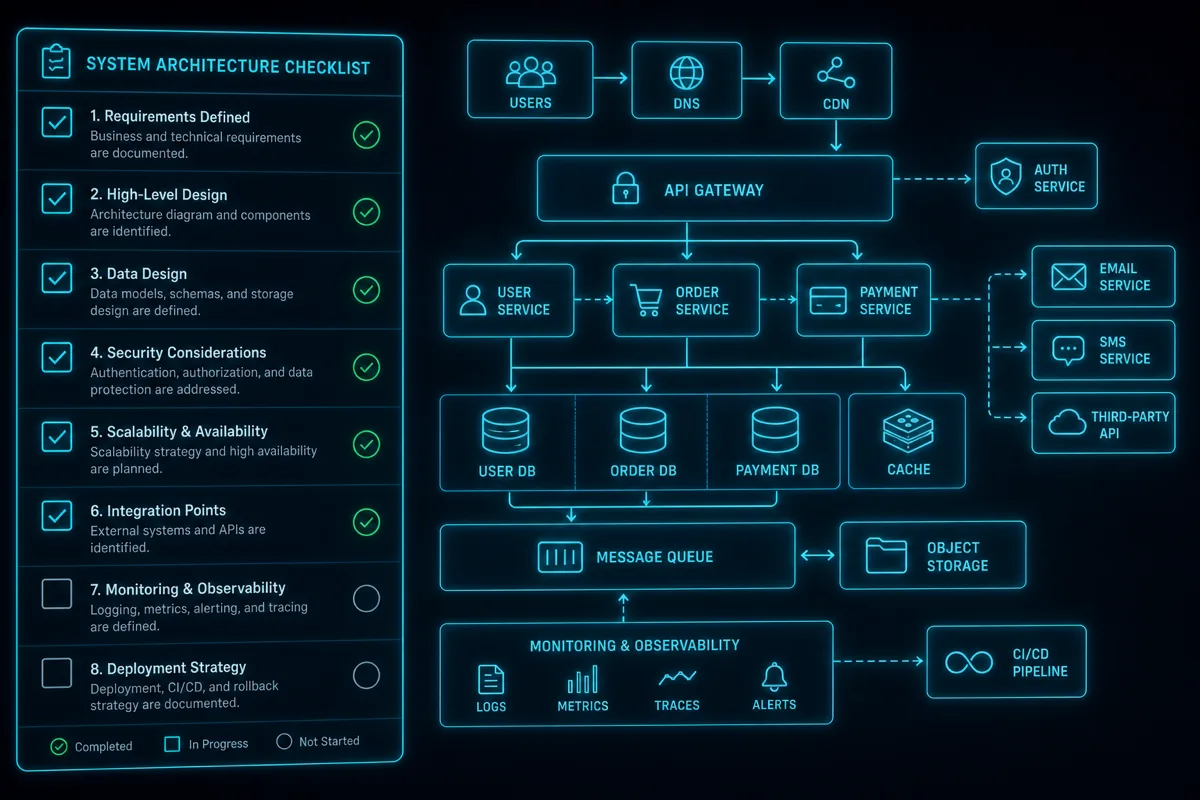
Before we take on any fractional CTO or rescue engagement, we run a structured technical audit — not a vague "code review," but a repeatable framework that surfaces the specific risks a founder needs to understand before deciding whether to salvage, refactor, or rebuild. Here's the framework itself.
Why a Structured Audit, Not a Gut-Check
Founders evaluating a struggling codebase often get one of two unhelpful reactions from engineers: either "this is fine, just needs some cleanup" (from someone who doesn't want to deliver bad news) or "rewrite it all" (from someone defaulting to the answer that's easiest to estimate). Neither is grounded in evidence. A structured audit produces a defensible, specific answer.
The Six Audit Dimensions
1. Architecture Coherence
Does the system have a discernible architecture, or has it accreted feature by feature with no consistent pattern? We map the actual data flow and compare it against what the team believes the architecture to be — the gap between the two is often the first real finding.
2. Test Coverage and Confidence
Raw coverage percentage matters less than whether tests exist for the system's critical paths — payment processing, auth, data integrity. We look for evidence the team can deploy without manual regression testing, not just a coverage badge.
3. Infrastructure and Deployment Risk
Can the team deploy safely and roll back quickly? We check for manual deployment steps, missing infrastructure-as-code, undocumented production configuration, and single points of failure in the deployment pipeline itself.
4. Security Posture
A focused review of authentication, authorization, secrets management, and dependency vulnerabilities — not a full penetration test, but enough to flag anything that represents immediate exposure (hardcoded credentials, unpatched critical CVEs, missing access controls).
5. Technical Debt Inventory
We catalog debt by category — deferred refactors, outdated dependencies, workarounds shipped under deadline pressure — and estimate the cost of each in terms of ongoing velocity drag, not just abstract "cleanliness."
6. Team and Process Health
Technical problems are often downstream of process gaps: no code review requirement, no staging environment, no incident postmortem practice. We interview the engineering team to understand where process, not just code, is contributing to instability.
The Deliverable: A Decision Framework, Not Just a Report
Every audit ends with three explicit options, each with a cost and timeline estimate:
- Salvage — targeted fixes to the highest-risk areas, keeping the existing system largely intact
- Refactor — incremental architectural improvement while the system stays in production
- Rebuild — starting over on critical components, justified only when the existing system's problems are structural, not fixable through iteration
We've recommended salvage more often than rebuild — a full rewrite is expensive, slow, and carries its own risk of repeating the same mistakes. But when the audit surfaces genuinely structural problems (like a data model that can't support the product's next 12 months of requirements), we say so directly.
Why This Matters Before a Fundraise
Technical due diligence from an investor follows a similar pattern to what we audit internally. Running this audit before a fundraise — rather than being surprised by it during one — gives founders time to fix the highest-impact issues or at minimum have a credible, evidence-based answer when investors ask about technical risk.
Results
For a recent engagement, this framework identified that a startup's "we need a full rewrite" instinct was wrong — the core data model was sound, but deployment risk and test coverage gaps around payment processing were the actual sources of their production incidents. A targeted 6-week engagement addressing those two dimensions specifically resolved the instability without the cost or risk of a rebuild.
Considering a technical audit before your next raise or major hire? Book a project diagnostic — 907-841-8407 or contact@rutagon.com.
Frequently Asked Questions
How long does a startup technical audit take?
A focused audit across all six dimensions typically takes 1-2 weeks for a mid-size codebase, longer for larger or more fragmented systems with multiple services.
Does a technical audit require full access to our codebase and infrastructure?
Yes, meaningful findings require read access to the codebase, deployment pipeline, and infrastructure configuration. We work under NDA and scope access to what's needed for the audit.
Will the audit tell us whether we need to rebuild our product?
The audit is specifically designed to answer that question with evidence rather than assumption — we've found that most codebases don't need a full rebuild, but some genuinely do, and the audit distinguishes between the two.
Can this audit help us prepare for investor technical due diligence?
Yes. Running this audit proactively before a fundraise lets founders address the highest-impact issues in advance and speak credibly to technical risk during due diligence conversations.
Do you only audit codebases you plan to work on afterward?
No, though many audits do lead into a rescue or fractional CTO engagement. The audit itself is a standalone deliverable that gives founders an independent, evidence-based technical assessment regardless of what they decide to do next.