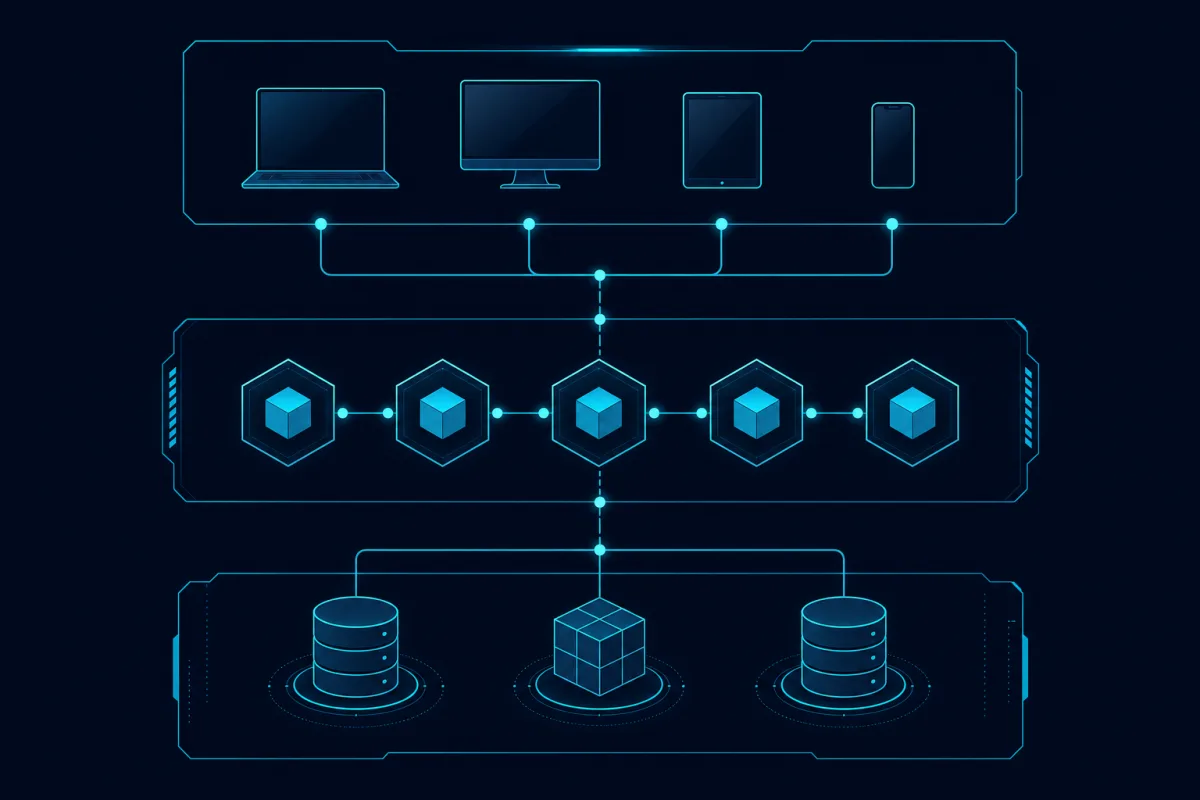
Startups choose cloud architecture patterns based on the problems they actually have, not the ones they might have at Series C. The three patterns that appear most often are 3-tier, event-driven, and CQRS. Each has a sweet spot and a set of over-engineering traps that waste engineering time and cloud spend.
The decision is not which pattern is "best." It is which pattern matches the current growth stage, team size, and risk tolerance.
3-Tier: Simple, Fast to Ship
The classic 3-tier (web, app, data) is the default for early-stage startups. A load balancer, a fleet of stateless application servers, and a managed database. Deployment is straightforward, debugging is local, and the cloud bill stays predictable.
The pattern wins when the domain is simple, the team is small, and the priority is shipping features faster than competitors. Most startups stay in 3-tier through product-market fit and into the first scaling phase.
The trap is staying in 3-tier past the point where the monolith becomes the bottleneck. When every deploy touches 40 services and the database is the single point of contention, the pattern has outlived its usefulness.
Event-Driven: Async Workflows, Independent Scale
Event-driven architecture decouples services through an event bus. A service publishes an event, downstream services react without direct calls. The pattern shines when workflows are naturally asynchronous and when different parts of the system have different scaling needs.
A common startup use case is order processing. The checkout service publishes "order.created", the inventory service reserves stock, the payment service authorizes the charge, and the notification service sends the confirmation. Each step can scale independently and fail without blocking the others.
The trap is introducing event-driven complexity before the team has operational maturity. Debugging distributed workflows requires tracing, replay, and clear event schemas. Teams that adopt the pattern too early spend more time on infrastructure than on product.
CQRS: Read/Write Separation for Complex Domains
CQRS separates the write path from the read path. Writes go through a command model that enforces business rules. Reads come from a query model that is optimized for the access patterns. The pattern is useful when the read and write workloads differ significantly or when the domain has complex consistency requirements.
A startup example is a marketplace with heavy search and recommendation reads but relatively simple transaction writes. The write side stays in a normalized relational model. The read side materializes into Elasticsearch or a denormalized view that serves search and feed queries at low latency.
The trap is adopting CQRS for the sake of "scalability" when the actual bottleneck is elsewhere. The added complexity of maintaining two models and keeping them in sync pays off only when the read/write asymmetry is real and persistent.
Migration From Monolith to Distributed
Most startups start with a monolith and extract services as pain points emerge. The extraction order matters. Start with the domain that has the clearest bounded context and the least cross-service chatter. That first extraction proves the operational model without risking the core transaction flow.
The migration path from 3-tier to event-driven often begins with an outbox pattern or change-data-capture from the database. Events are published from the existing monolith before any services are split. That approach lets the team validate the event schema and consumer behavior before the architecture changes.
Cost Considerations at Startup Scale
Distributed patterns increase cloud spend in the short term. More services mean more Lambda invocations, more EventBridge events, more managed queues. The cost is justified when the pattern unlocks faster feature development or higher reliability that directly affects revenue.
The teams that manage cost well measure the incremental spend against the business outcome. A CQRS read model that cuts search latency from 800ms to 80ms and lifts conversion by 3% pays for itself. The same model built for hypothetical scale that never arrives is waste.
Have a startup architecture that is hitting the limits of the current pattern? Talk to Rutagon or call 907-841-8407. We assess your growth stage and map the minimal pattern change in the first call.
FAQ
When should a startup move from 3-tier to event-driven?
The trigger is usually a specific pain point: a workflow that needs to run asynchronously, a service that needs to scale independently, or a team structure that benefits from clear ownership boundaries. The move is justified when the pain is felt, not when a blog post says it is time.
Does CQRS require eventual consistency everywhere?
No. The write side can remain strongly consistent. The read side is eventually consistent by nature. The decision is which parts of the system can tolerate the lag. Search and recommendations usually can. Financial transactions usually cannot.
How do we avoid over-engineering the event schema?
Start with the minimal event that the first consumer needs. Add fields only when a second consumer requires them. Version the schema from day one so that additive changes do not break existing consumers.
Can we mix patterns in the same system?
Yes. A 3-tier core with event-driven edges is common. The checkout flow stays in the monolith while the notification and analytics paths are event-driven. The boundary is drawn where the operational and scaling needs diverge.
What is the operational overhead of each pattern?
3-tier requires standard monitoring and deployment. Event-driven adds tracing, replay, and schema governance. CQRS adds model synchronization and dual deployment pipelines. The overhead is real and should be budgeted in the engineering roadmap.
---
*Cross-reference: See AWS Landing Zone Setup for the account and network foundation that supports any of these patterns at scale.*