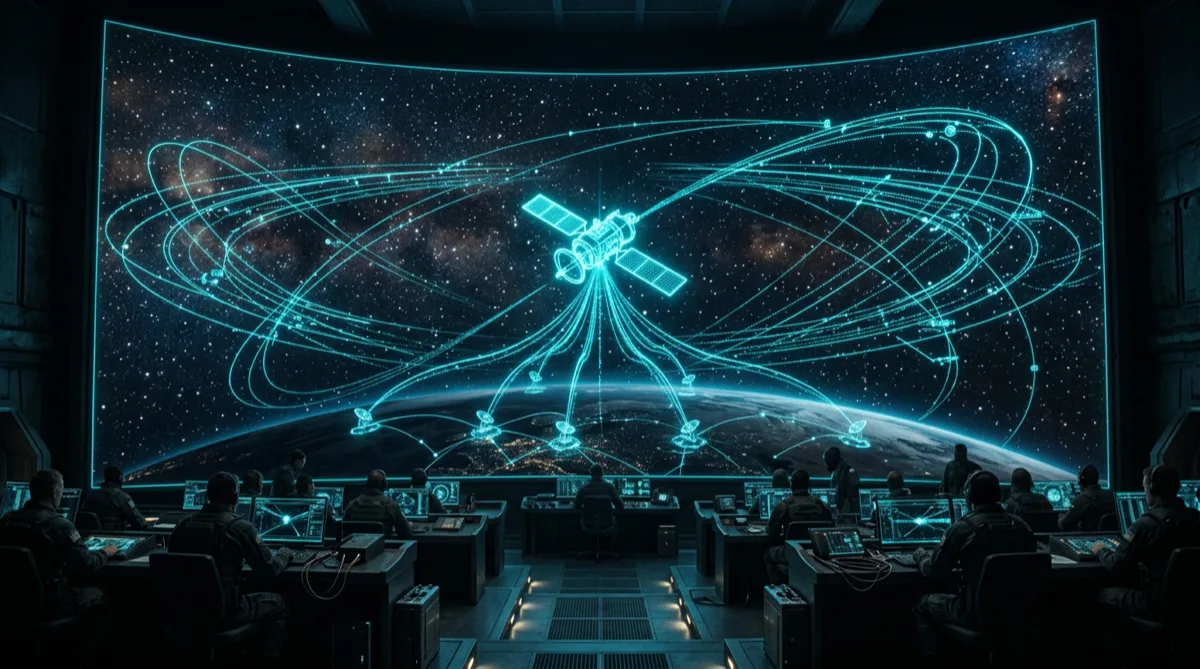
The Space Force's shift from purpose-built, vendor-locked ground systems toward cloud-hosted, software-defined ground infrastructure represents one of the most significant architecture changes in space operations. Ground systems that once required dedicated hardware at fixed locations are increasingly implemented as containerized services deployable to commercial cloud, government cloud, or tactical edge environments.
Here's how cloud-native engineering teams approach ground software architecture for Space Force programs.
The Ground Software Challenge
Traditional satellite ground systems were designed for single-mission, single-orbit, dedicated hardware architectures. A ground station would be purpose-built for a specific satellite constellation — specific telemetry formats, specific command uplinks, specific frequency bands handled by dedicated RF hardware and signal processing pipelines.
The limitations of this approach are well-documented: high maintenance cost, inability to rapidly retask for new missions, single points of failure, and long lead times for capability upgrades.
Cloud-native ground architecture separates the concerns:
- RF layer: Antennas, transceivers, modems — physical hardware that remains satellite-specific
- Signal processing layer: Modem-to-digital conversion, often increasingly done in software-defined radio (SDR)
- Ground software layer: Telemetry processing, command generation, mission management, data storage — fully software, fully portable
It's the ground software layer where cloud-native patterns apply directly.
Telemetry Ingestion Architecture
The telemetry pipeline handles incoming satellite data — typically CCSDS (Consultative Committee for Space Data Systems) formatted telemetry frames coming off the modem in real time.
A cloud-hosted telemetry ingest pipeline:
Modem → UDP/TCP receiver → Kafka/Kinesis stream → Frame processor → Parameter extractor →
  ↓
  Time-series DB (InfluxDB / Amazon Timestream)
  Real-time monitoring dashboard
  Anomaly detection pipeline
  Telemetry archive (S3/GCS)
The Kafka/Kinesis stream in the middle provides critical resilience properties: it decouples the real-time receiver from the downstream processors, allows multiple consumers (monitoring, anomaly detection, archival) to process the same stream independently, and provides replay capability if a downstream processor fails.
# CCSDS telemetry frame processor — simplified example
import struct
from dataclasses import dataclass

@dataclass
class CCSDSPrimaryHeader:
    version: int
    spacecraft_id: int
    virtual_channel_id: int
    packet_sequence_count: int
    packet_data_length: int

def parse_ccsds_header(frame_bytes: bytes) -> CCSDSPrimaryHeader:
    """Parse 6-byte CCSDS primary header"""
    word1, word2, word3 = struct.unpack(">HHH", frame_bytes[:6])
    return CCSDSPrimaryHeader(
        version=(word1 >> 13) & 0x7,
        spacecraft_id=(word1 >> 4) & 0x3FF,
        virtual_channel_id=(word1) & 0xF,
        packet_sequence_count=word2 & 0x3FFF,
        packet_data_length=word3
    )
For Space Force programs, telemetry stores must handle high-frequency ingestion (some satellites produce telemetry at 1–10 Hz per parameter, across thousands of parameters) while supporting historical queries for anomaly investigation. Time-series databases with compression and downsampling are standard.
Command and Control Architecture
The command pipeline flows in reverse — mission users generate commands, commands are validated and queued, uplinked to the satellite during contact windows.
Key architectural properties for cloud-hosted C2:
Command authentication: Commands to defense satellites require authentication to prevent spoofing. Cloud-hosted C2 systems integrate with hardware security modules (HSMs) or AWS CloudHSM for cryptographic command signing. The signing key never leaves the HSM.
Contact window management: Satellites have discrete contact windows — periods when the ground antenna can establish radio contact. The C2 scheduler must sequence commands against contact window predictions, handle late contact establishment, and manage command retransmission if acknowledgment isn't received.
State machine for command lifecycle: Commands transition through states (Generated → Queued → Uplinked → Acknowledged → Completed, or Timeout/Failed). This state machine must be persistent across pod restarts in a Kubernetes environment — use a backing state store (PostgreSQL, DynamoDB) rather than in-memory state.
from enum import Enum
import asyncio
from datetime import datetime, timedelta

class CommandState(Enum):
    GENERATED = "generated"
    APPROVED = "approved"
    QUEUED = "queued"
    UPLINKED = "uplinked"
    ACKNOWLEDGED = "acknowledged"
    COMPLETED = "completed"
    TIMEOUT = "timeout"
    FAILED = "failed"

class CommandManager:
    def __init__(self, db_client, uplink_service):
        self.db = db_client
        self.uplink = uplink_service

    async def submit_command(self, command_id: str, payload: bytes,
                              window_start: datetime, timeout_sec: int = 120):
        """Queue command for uplink during contact window"""
        await self.db.update_command_state(command_id, CommandState.QUEUED)

        # Wait for contact window
        delay = (window_start - datetime.utcnow()).total_seconds()
        if delay > 0:
            await asyncio.sleep(delay)

        # Uplink with timeout
        try:
            await asyncio.wait_for(
                self.uplink.send(command_id, payload),
                timeout=timeout_sec
            )
            await self.db.update_command_state(command_id, CommandState.UPLINKED)
        except asyncio.TimeoutError:
            await self.db.update_command_state(command_id, CommandState.TIMEOUT)
            raise
Resilience and Availability Requirements
Ground software supporting operationally critical satellites has strict availability requirements. Architecture decisions that support high availability:
Multi-region deployment: Critical ground software functions (C2, telemetry store, mission timeline) can be deployed across multiple AWS GovCloud availability zones or, for the most critical programs, multiple regions with automated failover.
Stateless services with persistent backing stores: Ground software services should be stateless where possible — all state lives in the database, all queues are persistent. This allows pod restarts, scaling, and fault recovery without data loss.
Graceful degradation: When components fail, the system should degrade gracefully rather than failing completely. A monitoring dashboard losing its real-time feed should fall back to cached data with a staleness indicator — not crash the operator console.
Chaos engineering: Ground systems benefit from regular failure injection — simulating network partitions, database failovers, and pod terminations to verify that resilience mechanisms actually work. Netflix's chaos engineering principles translate to ground software.
Cloud Hosting vs. Traditional Ground Systems
The operational advantages of cloud-hosted ground software are substantial:
- Elastic scaling: A contact-intensive period (multiple satellites in view simultaneously) can trigger auto-scaling of processing capacity — impossible with fixed hardware
- Geographic flexibility: Satellite contact can be handed off between geographically distributed cloud nodes as the satellite crosses coverage zones
- Software-defined upgrades: A software update to the telemetry processor deploys in minutes via CI/CD — not months of hardware coordination
- Cost structure: Cloud resource costs scale with actual usage; traditional ground hardware has fixed capital costs regardless of utilization
The security constraints — GovCloud requirement, ITAR-compliance for export-controlled systems, network segmentation — are real but manageable with the right architecture. For Space Force programs, AWS GovCloud US provides the authorization baseline; ITAR-controlled data processing requires US-person-only access and appropriate data handling controls.
Discuss your aerospace program with Rutagon →
Frequently Asked Questions
Can commercial cloud be used for Space Force ground systems?
It depends on the classification and sensitivity of the data being processed. Commercial AWS (us-east-1, etc.) may be appropriate for unclassified telemetry and mission planning. Controlled Unclassified Information (CUI) or higher requires FedRAMP High-authorized infrastructure — typically AWS GovCloud or Azure Government. Programs involving classified data require dedicated classified cloud environments. The specific impact level is determined by the program's data classification.
What is CCSDS and why does it matter for ground software?
CCSDS (Consultative Committee for Space Data Systems) is the international standard for spacecraft telemetry and command packet formatting, widely used across civil and military space programs. CCSDS defines packet header formats, frame synchronization, error correction, and protocol layers. Ground software that processes CCSDS-formatted data can potentially support multiple satellite programs without format-specific customization — a significant operational advantage for multi-mission ground systems.
How does Kubernetes handle ground software workloads?
Kubernetes provides the orchestration layer for containerized ground software components. Key features for ground systems: resource guarantees (quality of service classes for time-critical processing), persistent volume claims for stateful services, horizontal pod autoscaling for variable contact-window processing loads, and rolling deployments for zero-downtime software updates. The main challenge is latency-sensitive processing — some telemetry applications have microsecond-level timing requirements that may require bare-metal or specialized hardware rather than containerized environments.
What security controls apply to cloud-hosted C2 systems?
Command and control systems handling satellite commands have stringent security requirements: command authentication (cryptographic verification of command source), encrypted uplink channels, role-based access control limiting who can generate and approve commands, audit logging of every command action, and physical security for HSMs storing signing keys. These requirements layer on top of FedRAMP/IL requirements for the cloud environment. Architecture decisions (HSM integration, command authentication protocols) must be evaluated against ITAR and applicable NIST controls.
What is Rutagon's experience with ground systems software?
Rutagon has developed production systems in the high-availability aerospace web and ground software space, including real-time data visualization, telemetry dashboards, and distributed data processing architectures. Our published capability areas (CAP-03: Space & Aerospace Software, CAP-04: Cloud Infrastructure) reflect production-tested experience with the performance and reliability requirements of aerospace systems. For program-specific capability discussions, contact us at rutagon.com/contact.
Discuss your project with Rutagon
Contact Us →