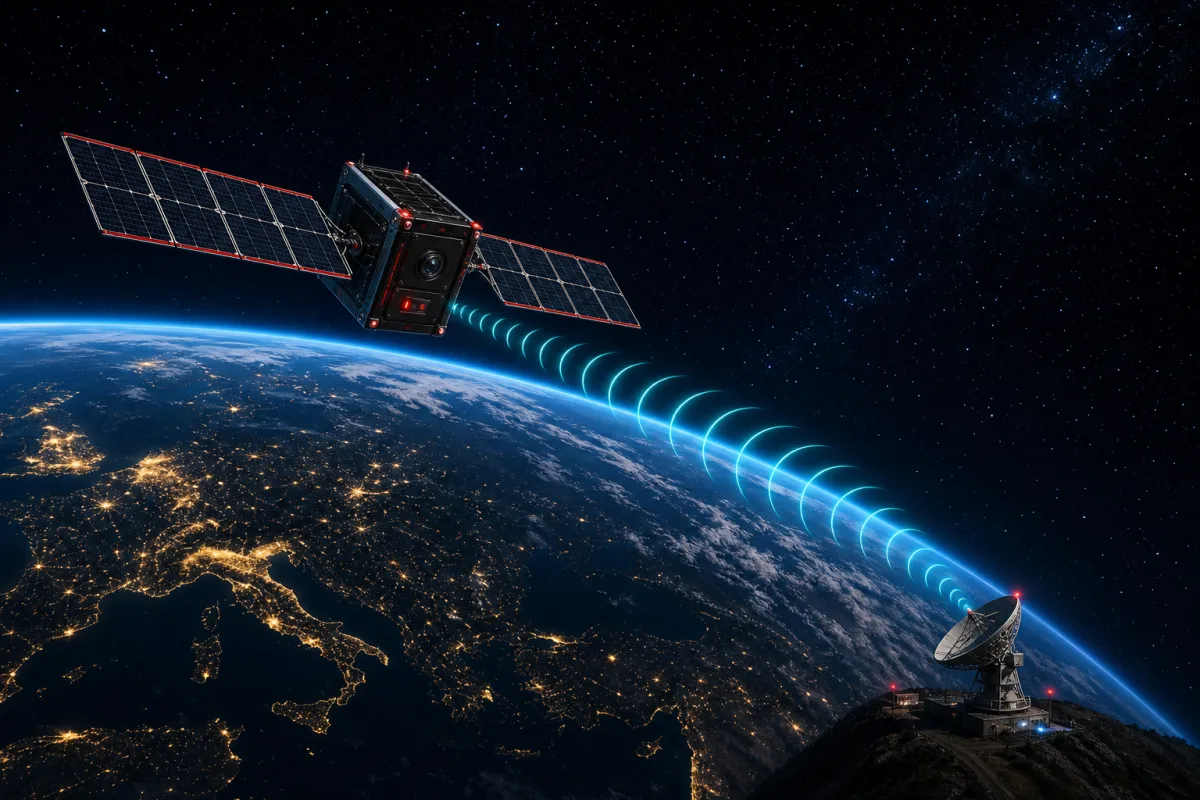
Small satellite programs increasingly run cloud-native ground software rather than traditional monolithic ground stations. This architectural shift creates a subcontracting opportunity structure that didn't exist a decade ago — specialist software firms that deliver ground systems, telemetry processing, and mission data pipelines alongside hardware primes who've built the spacecraft.
Rutagon operates in this space as a small satellite software subcontractor, delivering the ground-side software infrastructure that makes constellation and single-spacecraft missions operational.
The Ground System Software Stack
A complete satellite ground system requires several software layers working together:
Pass scheduling and antenna control: Orbit prediction (using SGP4 propagators), automated antenna scheduling for multiple satellite passes, contact-by-contact link budget calculations. Cloud-native implementations replace dedicated antenna control hardware with software-defined radio interfaces managed through APIs.
Command and Data Handling (C&DH) interface: The software layer that generates, validates, and uplinks telecommand packets per mission CCSDS standards. Includes command queue management, uplink scheduling, and command execution verification from telemetry downlink confirmation.
Telemetry processing pipeline: Real-time decoding of CCSDS telemetry frames, parameter extraction, limit checking, and storage. Cloud-native implementations use event-driven architectures (SNS, Kinesis, or Kafka) to process telemetry streams at high ingestion rates without polling architectures.
Mission data management: Payload data products (imagery, sensor readings, signals collections) require ingestion pipelines, format conversion, metadata tagging, and delivery to end users or mission exploitation systems.
Monitoring and alerting: Spacecraft health monitoring with configurable parameter limits, automated anomaly detection, and multi-channel alerting (dashboard, email, SMS, pager) for out-of-limit conditions.
Cloud-Native vs. Traditional Ground Systems
Traditional ground station software runs on dedicated server infrastructure at fixed sites. Cloud-native ground systems decouple the software from physical infrastructure:
| Dimension | Traditional | Cloud-Native | |---|---|---| | Infrastructure | Physical servers at fixed site | AWS GovCloud/commercial cloud | | Scalability | Fixed capacity | Elastic — scales with contact load | | Redundancy | Site-level DR | Multi-AZ, multi-region by default | | Software deployment | Manual installation | CI/CD pipeline, container-based | | Compliance path | Site accreditation | FedRAMP/IL-based authorization | | Operational cost | High fixed cost | Variable, usage-based |
The satellite command and control cloud-native post covers the microservices decomposition for a complete ground segment in detail.
What Rutagon Delivers as a Ground Software Sub
Rutagon has built ground-side software for production satellite systems — the experience base is real, not theoretical. As a subcontractor to satellite prime integrators, launch companies, and government space programs, we deliver:
Ground Software Development: Python/Go/Rust implementation of C&DH interfaces, telemetry decoders, and command uplink services. CCSDS protocol handling including Space Packet Protocol, TM Space Data Link Protocol, and TC Space Data Link Protocol.
DevSecOps Integration: Ground system software runs in the same kind of CI/CD pipeline we apply to defense cloud programs — automated testing, container hardening, and compliance artifact generation. For programs on government networks, ground software ATOs follow the same cloud-based RMF process as any other government system.
Open-Source Integration and Extension: Many small satellite programs use open-source ground system frameworks (OpenMCT for visualization, Yamcs or Open Space for C&DH). Rutagon implements, extends, and customizes these frameworks rather than reinventing from scratch — faster delivery and better maintainability.
Mission Data Pipelines: Payload data products require data engineering capabilities — ingestion, format conversion (HDF5, CCSDS, custom binary), metadata extraction, and delivery to exploitation systems. We apply AWS GovCloud data lake patterns (see data lake architecture AWS GovCloud) to satellite data management.
Cubesat and Small Satellite Programs Specifically
Cubesat and small satellite programs operate under tighter budgets and faster timelines than traditional large satellite programs. This drives architectural choices:
- Software-defined radio (SDR) ground stations: Rather than dedicated hardware receivers, SDR implementations provide flexibility across frequency bands with software updates
- Shared ground station networks: SatNOGS, AWS Ground Station, Leaf Space, and Atlas Space Operations provide per-pass pricing that eliminates fixed ground station capital costs
- Lean mission control: Automated monitoring and alerting reduce operator staffing requirements — 24/7 automated monitoring with human intervention only on anomalies
For cubesat programs, ground system development timelines are compressed. The cubesat ground software design post covers the architectural patterns that compress development time on small satellite programs.
ITAR Considerations
Space software is inherently ITAR-sensitive. Technical data about satellite command interfaces, orbital parameters, and certain mission data products falls under USML Category XV (Spacecraft). Rutagon operates with ITAR awareness built into development practices:
- US-person-only access to controlled technical data
- Export-controlled data handled in ITAR-compliant environments
- Technical documentation review before sharing with non-US-person subcontractors
- No discussion of specific system performance parameters in public communications
All ground software development at the architectural level uses publicly available information (CCSDS standards, open-source framework documentation, publicly described mission parameters). Controlled technical data stays within appropriate program boundaries.
Frequently Asked Questions
What mission types has Rutagon built ground software for?
We've delivered ground-side software for production programs — not theoretical designs. We don't name specific customers in public materials, but the mission types we've worked include scientific observation, communications, and surveillance. The systems have operated at scale with FAA-comparable traffic loads in the case of our largest production software work.
How do you price ground system software subcontracting?
Ground software development is typically scoped by labor category (software engineer, systems engineer, DevSecOps) and period of performance. For discrete deliverables (telemetry decoder, command uplink service, data pipeline), we scope by component with fixed-price or time-and-materials options depending on requirements stability. Contact us with your requirements for a specific scope and cost estimate.
Can you support programs at Space Force and NRO?
We discuss specific program requirements confidentially with primes. Our capability profile — cloud-native ground systems, DevSecOps, data pipelines — maps well to Space Force programs and the commercial intelligence community. Cleared teaming arrangements for programs with security requirements are handled on a case-by-case basis.
Do you work with commercial launch providers as well as government?
Yes. Cloud-native ground systems are equally relevant for commercial small satellite operators. The technology stack (AWS GovCloud for government, AWS commercial for commercial programs), compliance path, and mission data architecture differ, but the ground software engineering is the same.
How does on-orbit software update architecture work for small satellites?
See on-orbit software update architecture for the detailed technical approach. The short version: dual-bank flash memory, verified boot, signed update packages, and ground-commanded update execution with automated rollback on verification failure. This is standard on modern small satellite platforms and can be implemented at the ground system level (update package generation, signing, uplink scheduling) as part of the C&DH interface we deliver.
If your satellite prime has a program that needs cloud-native ground software, telemetry pipelines, or mission data engineering, contact Rutagon to discuss the scope.