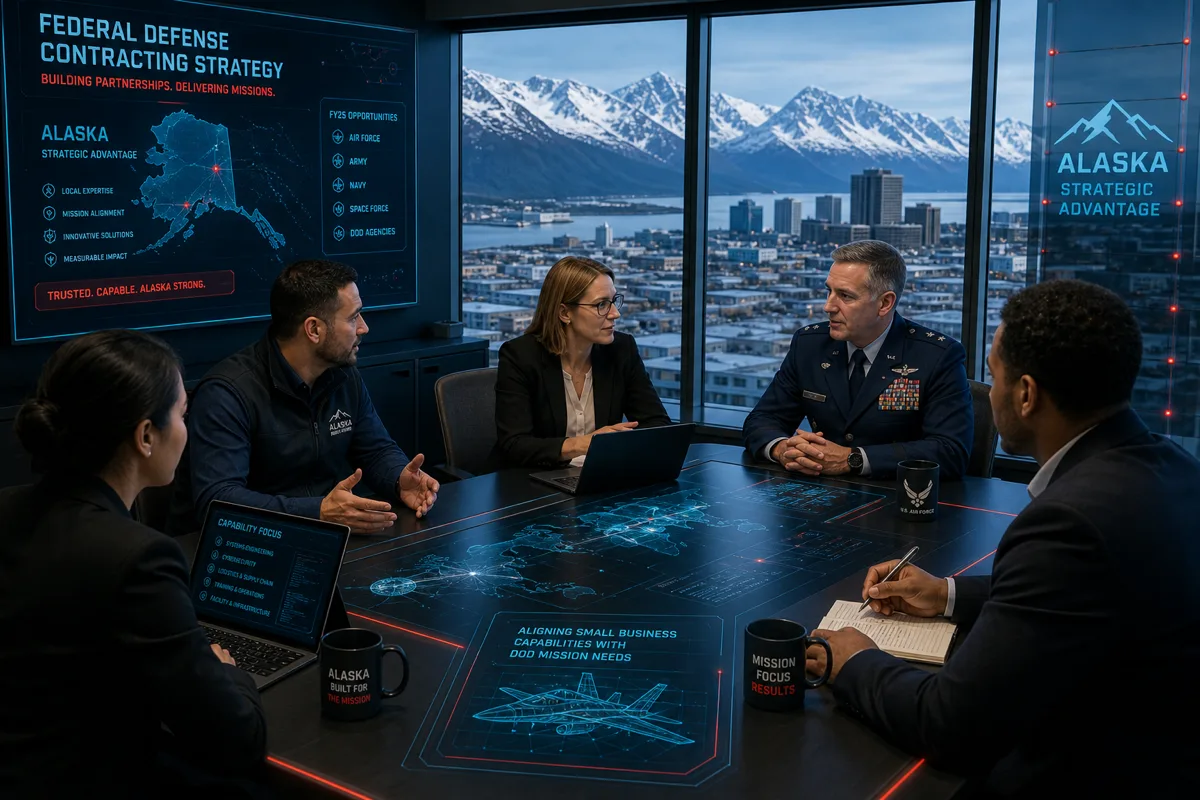
Small businesses in Alaska occupy an interesting position in the federal contracting market: distant from the traditional defense corridors, but operating in a state with a significant defense footprint and growing Pacific security investment. The distance creates challenges. The defense investment creates opportunity. The question is how to bridge the gap effectively.
This article examines the practical mechanics of small business defense contracting for Alaska-based firms — the certifications that matter, the contract vehicles that provide access, and the business development approaches that work despite geographic distance.
Understanding the Small Business Set-Aside System
The federal government has a statutory commitment to award a percentage of all federal prime contract dollars to small businesses. DoD and civilian agencies maintain specific annual small business contracting goals across multiple socioeconomic categories:
Small Business (SB): All businesses that meet SBA size standards for their NAICS code. For most IT services (NAICS 541512, 541519, 541511), the size standard is $34M in average annual receipts.
Service-Disabled Veteran-Owned Small Business (SDVOSB): Small businesses majority-owned and controlled by service-disabled veterans. Separate goals from general SB.
Women-Owned Small Business (WOSB): Small businesses majority-owned by women. WOSB set-aside authority applies in industries where WOSBs are underrepresented.
HUBZone: Small businesses in Historically Underutilized Business Zones — geographic areas with lower income and higher unemployment. Many Alaska communities qualify as HUBZone locations. HUBZone certification provides a 10% price evaluation preference in competitive awards and access to HUBZone-specific set-asides.
8(a) Business Development: The SBA's 8(a) program for socially and economically disadvantaged small businesses. 8(a) participants can receive sole-source awards up to $4.5M (services) and have access to competitive 8(a) set-asides.
Understanding your company's status across these categories — and pursuing applicable certifications — is foundational to small business defense contracting.
HUBZone and Alaska Small Businesses
HUBZone is particularly relevant for Alaska defense businesses. Many Alaska locations — including communities outside Anchorage — qualify as HUBZone locations. A business certified as HUBZone with a principal office and workforce primarily in a HUBZone area:
- Receives a 10% price evaluation preference in full-and-open competitions
- Can compete for HUBZone-specific set-aside opportunities
- Helps large primes meet their HUBZone subcontracting plan commitments (creating subcontracting demand)
The key HUBZone requirements: principal office in a HUBZone, at least 35% of employees residing in a HUBZone. Verify current HUBZone designations at the SBA's mapping tool — designations change based on census data updates.
Important note: Rutagon does not claim any specific certifications — any certification statements should reflect your company's actual certified status.
Essential Contract Vehicles for Alaska Defense IT Small Businesses
GSA MAS 54151S (IT Services): Obtaining your own GSA Multiple Award Schedule IT Services contract provides direct access to civilian and DoD agency task orders without going through a prime. Process takes 6–18 months. Worth the investment for businesses with $500K+ in relevant annual revenue.
GSA STARS III: An IDIQ small business IT contract vehicle for 8(a) and small businesses. Provides task order access similar to CIO-SP4 but with small business-only competition. Useful for businesses with 8(a) status.
AFWERX Phase I SBIR: For technology-focused Alaska businesses, DoD SBIR (Small Business Innovation Research) awards provide non-dilutive funding ($50K–$2M for Phase I/II), government past performance, and visibility to program offices. SBIR solicitations are publicly available on sbir.gov — any small business can compete regardless of location.
Subcontracting under large primes: Large primes with JBER, US Army Alaska, and Alaska Command contracts actively need small business subcontractors to meet their subcontracting plan commitments. Building relationships with the small business specialists at large Alaska prime contractors is a high-yield business development activity.
Business Development for Alaska Defense IT Firms
Local engagement first: The JBER small business office, the Alaska District of the Army Corps of Engineers, and Alaska Command contracting activities are the natural starting points for relationship building. These offices know the local business community and can make introductions.
PTAC (Procurement Technical Assistance Centers): Alaska PTAC provides free technical assistance to Alaska businesses pursuing federal contracts — helping with registrations, proposal writing, and contracting education. This is an underused resource for Alaska defense tech businesses.
AFCEA Alaska Chapter: AFCEA (Armed Forces Communications and Electronics Association) has an Alaska chapter that connects defense IT professionals, military personnel, and contractors. Regular events create relationship-building opportunities with JBER and Alaska Command personnel.
Conference investment: Attending AUSA Winter Symposium (Huntsville), AFCEA TechNet Indo-Pacific (Honolulu), and other Pacific-focused defense conferences is worth the travel investment for Alaska firms pursuing Pacific Command-connected opportunities.
Proposal quality: Geographic disadvantage is overcome by proposal quality. Invest in proposal writing capability — whether through training, hiring a capture professional, or working with a proposal consultant. A technically excellent proposal from an Alaska-based team is evaluated equally to one from a Virginia-based team.
Building Toward Prime Contracts
Most Alaska defense businesses start as subcontractors and grow toward prime contracts. The typical progression:
- Local subcontracting under Alaska-based primes with JBER or Alaska Command contracts
- Government-wide vehicle acquisition (GSA Schedule, SBIR awards)
- National subcontracting opportunities through prime outreach and teaming databases
- Prime contract awards on small business set-asides or full-and-open competitions where past performance and technical capability are established
This takes years, not months. Alaska defense tech businesses that build consistently on this progression create sustainable federal revenue streams that leverage their unique geographic and domain context.
Rutagon is an Alaska-based defense technology firm that develops cloud engineering, DevSecOps, and systems integration capabilities for national security and defense programs.
Related articles: - Building a Defense Tech Business in Alaska - CIO-SP4 Subcontractor Guide - Defense Cloud Contract Performance
Frequently Asked Questions
Can Alaska small businesses compete nationally for defense IT contracts?
Yes. Federal procurement regulations prohibit geographic discrimination — Alaska businesses can compete for any federal contract regardless of location. Government-wide contract vehicles (GSA Schedule, SBIR, CIO-SP4) provide access to nationally competed task orders. The practical challenge is relationship building from a distance, which requires intentional travel and conference investment.
What is HUBZone certification and does it apply to Alaska businesses?
HUBZone (Historically Underutilized Business Zones) certification provides small businesses in qualified areas a 10% price evaluation preference in competitive federal awards and access to HUBZone set-aside contracts. Many Alaska locations qualify as HUBZones. Certification requires that your principal office is in a HUBZone and at least 35% of employees reside in HUBZone areas. Verify current designations and eligibility at the SBA's HUBZone mapping tool.
What is SBIR and how can Alaska tech businesses use it?
SBIR (Small Business Innovation Research) is a federal program that reserves a percentage of agency R&D budgets for small business awards. DoD SBIR solicitations are published on sbir.gov and any qualifying small business can compete — location is irrelevant. Phase I awards ($50K–$250K) fund feasibility studies; Phase II awards (up to $2M) fund prototype development. SBIR provides non-dilutive funding, government past performance, and program office relationships.
How important is PTAC for Alaska defense contracting?
Alaska Procurement Technical Assistance Centers (PTAC) provide free government contracting assistance — help with SAM.gov registration, finding opportunities, reviewing solicitations, and proposal support. For businesses new to federal contracting, PTAC assistance can prevent costly mistakes and accelerate the learning curve. The service is funded by the DoD and delivered through regional centers; Alaska businesses can access it through the University of Alaska Anchorage's PTAC office.
What is the most effective conference for Alaska defense IT businesses to attend?
AFCEA TechNet Indo-Pacific (typically held in Honolulu) is the highest-value conference for Alaska defense IT businesses focused on Pacific Command-connected opportunities. It brings together Indo-Pacific Command leadership, Pacific-focused program offices, and defense industry — with strong Alaska military participation given JBER's role in INDOPACOM. AUSA Annual (Washington DC) provides the broadest Army connection; AFCEA TechNet Augusta connects to Army Cyber Command.