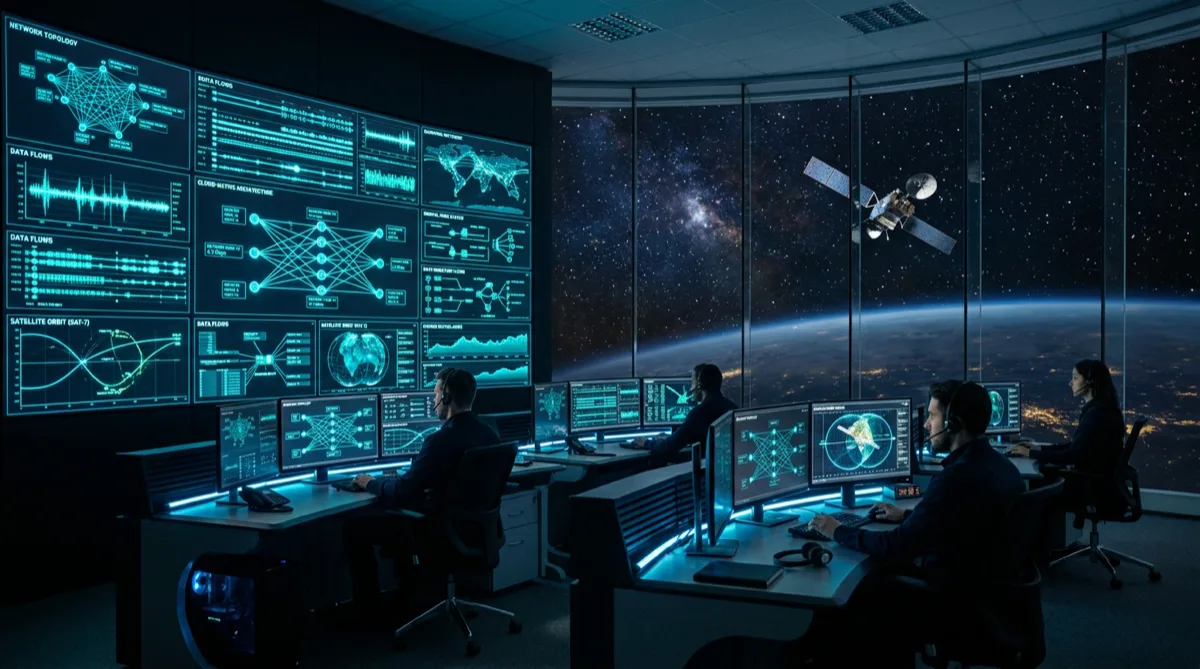
Legacy satellite command and control systems share a common set of problems: they were built for the spacecraft they currently control, they run on aging hardware with long vendor support tails, and they've accumulated years of undocumented configuration that makes change frightening. Operators know that the system works — they're deeply uncertain about what specifically makes it work.
Re-architecting these systems for cloud-native delivery is technically feasible and strategically necessary as on-orbit assets outlive their ground segment support infrastructure. The challenge is doing it without breaking operational continuity.
Here's Rutagon's approach to satellite C2 modernization: what the patterns look like, how containerization applies to ground system architecture, and where the hard problems actually live.
The Anatomy of a Legacy Satellite C2 System
Most legacy satellite C2 systems share a common architecture pattern that was sensible when built and creates problems now:
- Monolithic scheduler: A single application handles contact scheduling, command sequencing, and uplink timing. Any modification risks breaking all three functions simultaneously.
- Tight hardware coupling: The C2 software is compiled against specific SDR (software-defined radio) hardware APIs or proprietary RF front-ends. Hardware changes require software re-certification.
- Static configuration: Spacecraft parameter tables, command dictionaries, and telemetry decoding configurations live in flat files managed manually. Version control is an afterthought.
- Single-site deployment: The system runs on a specific rack of servers at a specific ground station. Scalability is a physical hardware problem.
These characteristics made the original systems reliable — a tightly coupled, single-purpose system has fewer failure modes than a distributed one. But they make evolution expensive and adaptation slow.
The Strangler Fig Pattern for C2 Modernization
Rutagon applies the strangler fig modernization pattern to ground system work. Named after the tropical fig that grows around a host tree and eventually replaces it, the pattern involves building new capabilities alongside the legacy system until the legacy functions can be retired incrementally:
Phase 1: Wrap and Observe
- Build an API gateway layer in front of the legacy monolith
- Capture and log all command and telemetry traffic through this layer
- Begin building a ground truth data model of how the system actually behaves (not how documentation says it behaves)
Phase 2: Decompose and Parallel-Run
- Extract discrete functions (telemetry ingestion, command scheduling, contact management) as separate containerized services
- Run new and legacy services in parallel, comparing outputs
- Validate new services against legacy behavior before cutover
Phase 3: Replace and Retire
- Incrementally route traffic from legacy functions to new microservices as validation completes
- Maintain legacy as failback for a defined period
- Retire legacy functions as new services achieve operational maturity
This approach minimizes operational risk because the legacy system remains authoritative until the replacement is proven.
The Cloud-Native Ground System Architecture
A modernized satellite ground system implemented in cloud-native patterns:
Telemetry Ingestion Service
Telemetry arrives from the spacecraft via ground station RF front-ends as raw binary frames. The ingestion service deframes, decommutates, and routes telemetry to consuming services:
# Telemetry ingestion microservice
from dataclasses import dataclass
from typing import Optional
import struct

@dataclass
class TelemetryFrame:
    spacecraft_id: str
    timestamp: float
    frame_sequence: int
    raw_data: bytes

class TelemetryIngestor:
    def __init__(self, frame_sync: bytes = b'\x1A\xCF\xFC\x1D'):
        self.frame_sync = frame_sync
        self.decoders =   # Spacecraft-specific decoder registry

    def ingest(self, raw_stream: bytes) -> list[TelemetryFrame]:
        """
        Synchronize on frame headers, deframe, route to spacecraft-specific decoder.
        ITAR note: No specific spacecraft parameter values in this implementation.
        """
        frames = []
        offset = raw_stream.find(self.frame_sync)

        while offset != -1:
            frame_data = self._extract_frame(raw_stream, offset)
            if frame_data:
                sc_id = self._identify_spacecraft(frame_data)
                frames.append(TelemetryFrame(
                    spacecraft_id=sc_id,
                    timestamp=self._extract_timestamp(frame_data),
                    frame_sequence=self._extract_sequence(frame_data),
                    raw_data=frame_data
                ))
            offset = raw_stream.find(self.frame_sync, offset + 1)

        return frames
This service is stateless — it processes frames as they arrive and publishes to a message bus (Amazon Kinesis or SQS for GovCloud workloads). Consuming services (telemetry archive, real-time display, anomaly detection) subscribe independently.
Contact Schedule Management
The contact scheduler manages antenna pointing, communication windows, and uplink/downlink timing. As a dedicated microservice, it exposes a clean API:
# OpenAPI spec for contact scheduler (abbreviated)
openapi: 3.0.0
info:
  title: Contact Schedule API
  version: 1.0.0
paths:
  /contacts:
    get:
      summary: List upcoming contacts within time window
      parameters:
        - name: spacecraft_id
          in: query
          schema:
            type: string
        - name: window_hours
          in: query
          schema:
            type: integer
            default: 24
    post:
      summary: Schedule a new contact
      requestBody:
        content:
          application/json:
            schema:
              $ref: '#/components/schemas/ContactRequest'
The scheduler is decoupled from the antenna control system — it issues contact commands and monitors execution, but the antenna vendor's hardware abstraction layer handles the physical control. This separation means scheduler software changes don't require antenna system re-certification.
Command History and Audit Trail
Every command uplinked to a spacecraft must be logged with sender identity, timestamp, parameters, and spacecraft acknowledgment. In legacy systems, this is often a flat file or proprietary database with limited query capability. The modernized approach:
-- Command history table: fully queryable, tamper-evident
CREATE TABLE command_history (
    id UUID PRIMARY KEY DEFAULT gen_random_uuid(),
    spacecraft_id VARCHAR(50) NOT NULL,
    command_type VARCHAR(100) NOT NULL,
    operator_id VARCHAR(100) NOT NULL,  -- Federated identity ID, not username
    submitted_at TIMESTAMPTZ NOT NULL DEFAULT NOW(),
    scheduled_for TIMESTAMPTZ,
    uplinked_at TIMESTAMPTZ,
    spacecraft_ack_at TIMESTAMPTZ,
    ack_status VARCHAR(20),  -- SUCCESS, TIMEOUT, REJECTED
    command_hash VARCHAR(64) NOT NULL,  -- SHA-256 of command content
    -- parameters stored as JSONB for flexibility without schema changes
    parameters JSONB
);

CREATE INDEX idx_cmd_spacecraft_time ON command_history(spacecraft_id, submitted_at DESC);
CREATE INDEX idx_cmd_operator ON command_history(operator_id, submitted_at DESC);
This schema supports full audit queries, real-time command status tracking, and anomaly detection (unusual command sequences, unauthorized command types).
Containerization and Kubernetes for Ground Systems
Running ground system services in Kubernetes provides:
- Multi-site resilience: Services can run simultaneously at multiple ground stations, with traffic routing based on contact windows and site availability
- Zero-downtime updates: Rolling deployments allow software updates without service interruption
- Horizontal scaling: During high-activity contact windows, services auto-scale; during quiet periods, they scale down
# Ground system service deployment with anti-affinity for resilience
apiVersion: apps/v1
kind: Deployment
metadata:
  name: telemetry-archive-service
spec:
  replicas: 3
  template:
    spec:
      affinity:
        podAntiAffinity:
          requiredDuringSchedulingIgnoredDuringExecution:
          - topologyKey: kubernetes.io/hostname
            labelSelector:
              matchLabels:
                app: telemetry-archive
      containers:
      - name: telemetry-archive
        image: registry.spacecraft-ops.mil/telemetry-archive:v3.2.1
        resources:
          limits:
            cpu: 2000m
            memory: 4Gi
          requests:
            cpu: 500m
            memory: 1Gi
Three replicas across three different nodes provides resilience against single-node failures without any ground contact window interruption.
See our related work on ground systems software for satellite operations, multi-orbit constellation software, and space and aerospace software capabilities.
Contact Rutagon to discuss your ground system modernization →
Frequently Asked Questions
What is the strangler fig pattern for legacy system modernization?
The strangler fig pattern is a software modernization approach where new functionality is built incrementally around a legacy system, gradually replacing it. Rather than a high-risk "big bang" rewrite, the pattern builds and validates new components alongside the legacy system, routing traffic incrementally to new services as they're proven. The legacy system is retired piece by piece as new components achieve operational maturity. This approach maintains operational continuity while enabling full architectural transformation.
What are the advantages of cloud-native satellite C2 over legacy systems?
Cloud-native ground system architecture provides: horizontal scalability (scale compute with workload, not hardware capacity), multi-site deployment (run at multiple ground stations simultaneously with automatic failover), zero-downtime software updates (rolling deployments for mission-critical services), modern observability (full telemetry on system health, contact performance, and anomalies), and abstraction from hardware vendor lock-in (antenna systems interfaced through APIs rather than tight coupling).
How is containerization applied to satellite ground systems?
Ground system functions are decomposed into discrete containerized microservices: telemetry ingestion, contact scheduling, command management, real-time display, data archive, and anomaly detection. Each service is independently deployable, independently scalable, and independently testable. Kubernetes orchestrates the services, handling health monitoring, restarts, and scheduling across the available nodes.
What are the critical data challenges in satellite C2 modernization?
The hardest data challenges in ground system modernization are: spacecraft command dictionary and parameter table migration (often stored in proprietary formats with undocumented history), telemetry historical archive access (decades of spacecraft telemetry in formats that new systems must still be able to read), and command history audit trail integrity (ensuring the chain of custody for every historical command is preserved and queryable). These data challenges often take longer to solve than the software architecture challenges.
Does Rutagon have experience with satellite ground system modernization?
Yes. Rutagon's production aerospace engineering work includes high-availability systems for aviation and space applications, real-time data visualization and telemetry processing, and cloud-native architectures for mission-critical operations. Ground system modernization applies the same containerization, API design, and cloud-native patterns used in these production systems to the specific constraints of satellite C2. Discuss your program requirements with Rutagon.