Why Defense Primes Need Alaska-Based Small Business Subs
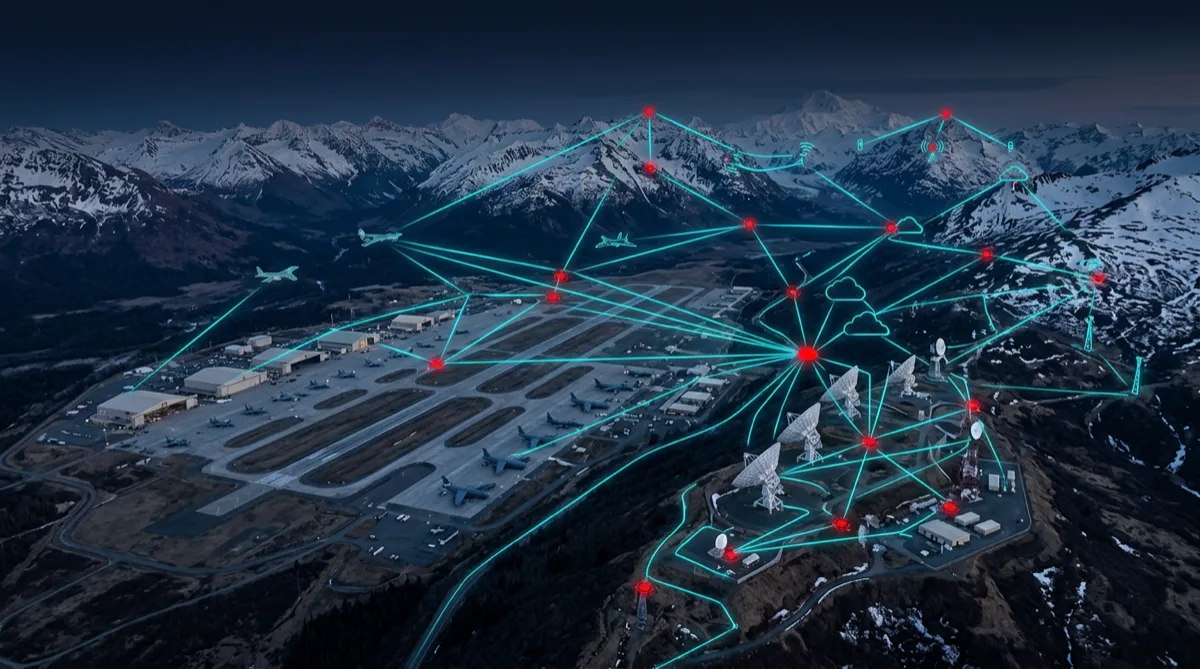
Alaska is not peripheral to the defense of the United States. It is the northern edge of North America, home to the largest combined military base on the continent, positioned directly across the polar flight corridor from potential adversary forces, and housing the only operational ground-based midcourse defense interceptors in the Western Hemisphere at Fort Greely.
For defense primes building teams for Alaska-connected federal programs — whether the customer is JBER, Eielson AFB, Clear Space Force Station, the Missile Defense Agency, or any of the dozens of federal agencies operating across the state — having an Alaska-based small business subcontractor on the team is not a checkbox. It's a genuine competitive advantage.
Alaska's Defense Infrastructure, in Scale
Understanding why Alaska matters to defense primes requires understanding what's actually there:
Joint Base Elmendorf-Richardson (JBER): The largest combined base in North America by acreage. Home to the 3rd Wing (Air Force), 25th Infantry Division elements (Army), and multiple joint commands. Supports a fighter-to-bomber spectrum of missions and serves as a strategic hub for Pacific and Arctic operations.
Eielson AFB: The Air Force's designated Arctic combat training center. Hosts F-35A operations under the 354th Fighter Wing. Participates in Red Flag-Alaska exercises that bring allied nations to train in high-latitude, contested air environments.
Clear Space Force Station: One of the Ground-Based Electro-Optical Deep Space Surveillance (GEODSS) and BMEWS (Ballistic Missile Early Warning System) sites. Monitors polar trajectories and provides early warning data for missile defense systems.
Fort Greely: Home to the Ground-Based Midcourse Defense (GMD) system — the only operational missile defense interceptors in North America. The 49th Missile Defense Battalion operates here.
Fort Wainwright: Home to the 1-25 ABCT (Arctic Brigade Combat Team). Adjacent to Fairbanks, serving as the Army's primary Arctic ground combat element.
UAF Geophysical Institute: Operates more than a dozen instrument arrays across Alaska monitoring space weather, ionospheric conditions, seismic activity, and atmospheric chemistry — all relevant to Arctic domain awareness.
Programs touching any of these installations have Alaska-specific operational requirements that no Lower 48 generalist sub can address with the same credibility.
What an Alaska-Based Sub Brings to a Prime's Proposal
Geographic credibility with contracting officers. A CO reviewing proposals for an Alaska-based program notices when every team member is headquartered in Virginia or Maryland. It's not a disqualifier, but it's a question: does this team actually understand the operating environment they're proposing to support? An Alaska-based sub on the team resolves that question directly.
Local industry knowledge and relationships. Rutagon's Wasilla principal office puts the company in the Mat-Su Borough — the fastest-growing area of Alaska by population, with strong connections to the Anchorage metro, JBER, and the state's growing defense technology ecosystem. Local relationships with Alaska state agencies, tribal entities, and the Alaska defense contractor community are not available from a DC office.
Alaska location advantage. Rutagon's Wasilla principal office is located in a confirmed Indian Land HUBZone (permanent designation through 2028). This geographic presence satisfies prime contractors' need for genuine Alaska-based small business subcontractors — not a paper address, but an entity operating in the region the designation was created to support.
Arctic and austere environment understanding. Software and infrastructure in Alaska operate under conditions that don't exist in the continental US: extreme temperature ranges (−40°F to 90°F at JBER), high-latitude ionospheric interference that affects communications and GPS, disconnected and intermittently connected network environments in rural installations, and physical infrastructure constraints that require edge computing approaches rather than cloud-first assumptions.
Rutagon's work on Arctic edge computing architecture — documented at Arctic Edge Computing for Military Systems — addresses the software design patterns that Alaska military environments actually require.
How Alaska ANCs Fit the Picture
Alaska Native Corporations add another dimension. As discussed in Subcontracting IT with Alaska ANCs, ANC-owned 8(a) firms can win sole-source contracts of any dollar value. When a national prime is building a team to bid alongside or support an ANC, having an Alaska-based sub who has existing relationships with Doyon, Goldbelt, NANA, or Chenega is a meaningful differentiator.
These relationships aren't formal — they're contextual. Alaska is a small business community by total size even if large by geography. Contractors who operate here build reputations that travel through the community. A national prime coming in cold doesn't have that context; a local sub can provide it.
What Rutagon Brings Specifically
Rutagon is an Alaska-based cloud engineering and DevSecOps firm focused on defense and federal IT programs. The company's capabilities are documented at rutagon.com/government:
- Cloud-native architecture: AWS-primary, Terraform IaC, OIDC-federated CI/CD, zero long-lived credentials
- DevSecOps: SAST/DAST pipeline integration, container vulnerability scanning (Trivy), policy-as-code (Checkov, OPA), continuous ATO evidence generation
- Government compliance: CMMC Level 1 (self-assessed), DFARS 252.204-7012 posture, NIST 800-171 control mapping
- SAM.gov: Active as of March 17, 2026 — UEI: FB2FHEJHM493, CAGE: 19ZR7
- HUBZone: Application pending (Q2 2026), principal office Wasilla, AK (Indian Land designation)
For primes building proposals for Alaska-connected defense or federal programs, Rutagon represents a sub that combines genuine technical delivery capability with authentic local presence — not a Lower 48 firm with an Alaska mailing address.
Explore teaming with Rutagon → rutagon.com/contact
Frequently Asked Questions
Why is Alaska strategically important to US defense?
Alaska is positioned at the top of the Pacific polar corridor — the shortest route between North America and potential adversary launch sites. It hosts the only operational ground-based missile defense interceptors in North America (Fort Greely), the largest combined military base on the continent (JBER), the Air Force's Arctic combat training center (Eielson AFB), and a BMEWS early warning site (Clear SFS). Alaska is not strategically peripheral — it is on the front line of Arctic and Indo-Pacific defense.
What is a HUBZone and why does it matter in Alaska?
A HUBZone (Historically Underutilized Business Zone) is an area designated by the SBA where businesses receive contracting preferences: set-aside contracts, 10% price evaluation preference in full-and-open competitions, and sole-source eligibility up to $4.5M. Alaska has significant HUBZone-designated areas including Indian Lands. A HUBZone sub in Alaska brings genuine local presence rather than a nominal address used to capture a preference.
How does an Alaska-based sub improve a prime's proposal for Alaska programs?
A prime with an Alaska-based sub can credibly claim local knowledge, community relationships, and operational familiarity with Alaska's environment. Contracting officers for Alaska-based programs specifically notice whether proposed teams have genuine Alaska connections. An Alaska sub who operates in the state year-round and understands Arctic environment constraints is a tangible proposal asset.
What are the unique software challenges for Alaska military installations?
Alaska military installations operate under conditions that include extreme temperature variation, high-latitude ionospheric effects on GPS and communications, intermittent or disconnected network connectivity at rural sites, and physical infrastructure constraints requiring edge computing over cloud-first approaches. Software designed for continental US operations often requires significant rearchitecting for reliable Alaska performance.
Can Rutagon provide a capability brief for proposal preparation?
Yes. Rutagon's capability statement (v4, including CAGE code 19ZR7 and active SAM.gov registration) is available at rutagon.com/government. For proposal-specific capability documentation, teaming letter language, or technical approach content related to cloud engineering and DevSecOps delivery, contact rutagon.com/contact.