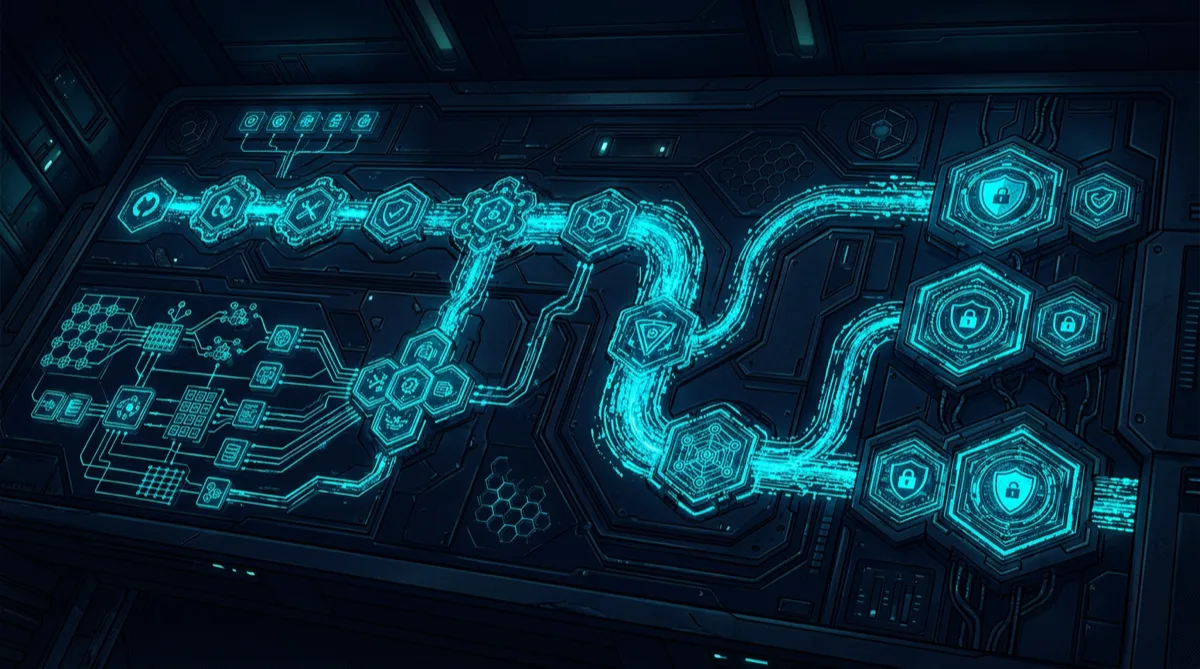
Platform engineering has emerged as one of the most impactful investments a software delivery organization can make — and federal development teams have more to gain from it than almost any commercial counterpart. Federal programs carry compliance overhead (ATO requirements, continuous monitoring, change management) that multiplies the cost of every manual process and slows down teams that haven't automated it away.
An internal developer platform (IDP) in a federal environment does more than standardize developer workflows. Done right, it's the mechanism that makes ATO compliance a byproduct of delivery rather than a tax on it.
What Platform Engineering Is (and Isn't)
Platform engineering is the practice of building and operating an internal product — the developer platform — that makes other engineering teams faster and more effective. The platform team is an internal service provider; application teams are the customers.
This is distinct from simply having a CI/CD pipeline or a Kubernetes cluster. A developer platform has:
- Self-service infrastructure provisioning: Developers request environments, databases, and services through a catalog interface — not by filing tickets
- Paved paths for common patterns: Opinionated, pre-approved templates for microservices, data pipelines, and batch jobs that meet compliance requirements by default
- Integrated compliance automation: Security scanning, policy enforcement, and evidence generation happen in the platform — not as separate team responsibilities
- Observable and supported: The platform team supports the developer experience with SLAs, documentation, and developer self-service tooling
In federal environments, the key difference from commercial IDPs is that the platform must manage compliance as a first-class concern.
The Federal Context: ATO as a Platform Problem
The fundamental challenge for federal development teams is that ATO compliance requirements create overhead that scales with team size and change velocity. Every change must be assessed against the authorization boundary; significant changes require updated documentation and potentially re-authorization.
Teams that manage compliance manually — updating SSP sections by hand, running scans manually, collecting evidence ad hoc — create a compliance debt that grows with program velocity. When the annual assessment arrives, the documentation is out of date, findings are unaddressed, and the team scrambles.
Platform engineering solves this by making compliance automation infrastructure:
Evidence generation in CI/CD: Every pipeline run produces artifacts — SBOM, container scan results, SAST results, infrastructure conformance check output — that become ConMon evidence. No manual collection required.
Change management integration: IaC changes go through an approval workflow that gates on policy checks before production deployment. The approval record is the change management evidence.
Configuration management automation: The platform enforces configuration standards (via AWS Config rules, OPA admission controllers) and automatically remediates drift — or creates ConMon findings when drift is detected.
The goal is a state where the compliance documentation is the system — not a document about the system. When the annual assessor asks "how do you manage access control?", the answer is git log --oneline iam/ plus an IAM Access Analyzer report, not a manually maintained spreadsheet.
Internal Developer Platform Architecture for Federal
Portal Layer (Backstage)
Backstage (CNCF project, incubated at Spotify) is the dominant open-source developer portal framework. It provides:
- Software catalog: Inventory of all services, APIs, and infrastructure with ownership metadata
- Service templates: Self-service scaffolding for new services with pre-configured CI/CD, observability, and compliance gates
- TechDocs: Auto-generated documentation co-located with the code it describes
For federal environments, Backstage runs on-premise or in GovCloud. Template scaffolding can enforce naming conventions, tagging standards, and account-level controls that are required by the program's ATO.
CI/CD Layer (GitLab / GitHub Actions + Tekton)
The paved-path CI/CD pipeline for federal programs typically implements:
Code Commit → Static Analysis (SAST) → Dependency Scan →
Container Build → Container Scan → Image Signing →
Policy Check (OPA) → Deploy to Dev → Integration Test →
SBOM Export → Evidence Archive → Promote to Stage →
Manual Gate (for prod) → Deploy to Prod
Key federal-specific pipeline gates:
# GitLab CI example — federal compliance gates
stages:
  - scan
  - build
  - compliance-check
  - deploy

container-scan:
  stage: scan
  image: aquasec/trivy:latest
  script:
    - trivy image --exit-code 1 --severity CRITICAL,HIGH $IMAGE_NAME
  artifacts:
    reports:
      container_scanning: trivy-report.json

sbom-generate:
  stage: compliance-check
  script:
    - syft $IMAGE_NAME -o cyclonedx-json > sbom-${CI_COMMIT_SHA}.json
    - aws s3 cp sbom-${CI_COMMIT_SHA}.json s3://${EVIDENCE_BUCKET}/sbom/

opa-policy-check:
  stage: compliance-check
  script:
    - conftest test --policy policy/ k8s/manifests/
Infrastructure Layer (Terraform + Service Catalog)
Self-service infrastructure is provided through approved Terraform modules published in an internal registry. Application teams select from catalog offerings (PostgreSQL RDS, Redis Elasticache, ECS Service, Lambda function) that are pre-configured for compliance:
- KMS encryption enabled by default
- CloudTrail logging enabled
- Required tags (Environment, Owner, DataClassification) enforced at module level
- SCPs in the account prevent creation of non-compliant resources
A developer who needs a PostgreSQL database doesn't write Terraform from scratch — they instantiate the federal-postgresql module and get a compliant, monitored, backed-up database that satisfies the ATO database requirements automatically.
Compliance Automation Layer
The compliance layer runs continuously and feeds the ConMon program:
- AWS Config rules: Enforce and report on configuration standards
- GuardDuty + Security Hub: Aggregate threat findings into the SIEM
- OPA Admission Controller: Block non-compliant Kubernetes deployments at the API server
- Scheduled SBOM refresh: Regenerate SBOMs for all production images on a weekly schedule
- Monthly evidence export: Automated report generation pulling CloudTrail, Config, GuardDuty findings into ConMon report template
Rutagon's Platform Engineering Approach
Rutagon builds developer platforms for federal programs where the tension between delivery velocity and compliance requirements is real. Production internal platforms have supported content delivery systems at scale with integrated compliance automation — the patterns translate directly to federal environments where compliance is mandatory rather than aspirational.
Rutagon Cloud Infrastructure Capabilities →
DevSecOps and Compliance CI/CD Architecture →
Frequently Asked Questions
What is the ROI of investing in platform engineering for federal programs?
The ROI is in reduced compliance overhead, faster developer onboarding, and higher deployment frequency. Programs that build IDPs report 40–60% reduction in time spent on compliance documentation (because automation generates it) and significant reduction in developer friction from ticket-based infrastructure provisioning. In federal programs with long ATO timelines, any investment that accelerates ATO evidence generation has measurable ROI.
How does an IDP handle significant change management for ATO purposes?
The IDP's CI/CD pipeline is the change management system. IaC changes go through pull request review (producing a documented approval record), automated policy checks (producing compliance scan results), and a manual production approval gate (producing an authorized change record). These pipeline artifacts satisfy CM-3 (Configuration Change Control) requirements with full audit traceability — every change has an approver, timestamp, and automated compliance check result.
Can Backstage work in an air-gapped federal environment?
Yes. Backstage is a Node.js application that can run in any environment with access to a database (PostgreSQL) and the internal tools it integrates with (GitLab/GitHub, Kubernetes, AWS). In an air-gapped environment, Backstage connects to internal services only — no external API calls. The plugin ecosystem must be evaluated carefully; plugins that phone home to external services need modification or replacement with internal alternatives.
What's the difference between DevSecOps and platform engineering?
DevSecOps is a cultural and process philosophy — integrating security into every phase of development. Platform engineering is an organizational pattern — building an internal product that enables DevSecOps practices at scale. A platform engineering team builds the tools that make DevSecOps practices the path of least resistance for application developers. DevSecOps without platform engineering relies on every team independently implementing good practices; platform engineering makes good practices the default.
How does platform engineering accelerate the ATO process specifically?
Platform engineering accelerates ATO by producing ATO evidence as a byproduct of normal development activity. Pipeline scan results, infrastructure conformance checks, SBOM generation, and access control reports exist because the platform generates them continuously — not because someone ran scans before an assessment. When the 3PAO or agency assessor requests evidence, the evidence is current, complete, and consistent rather than retrospectively assembled.