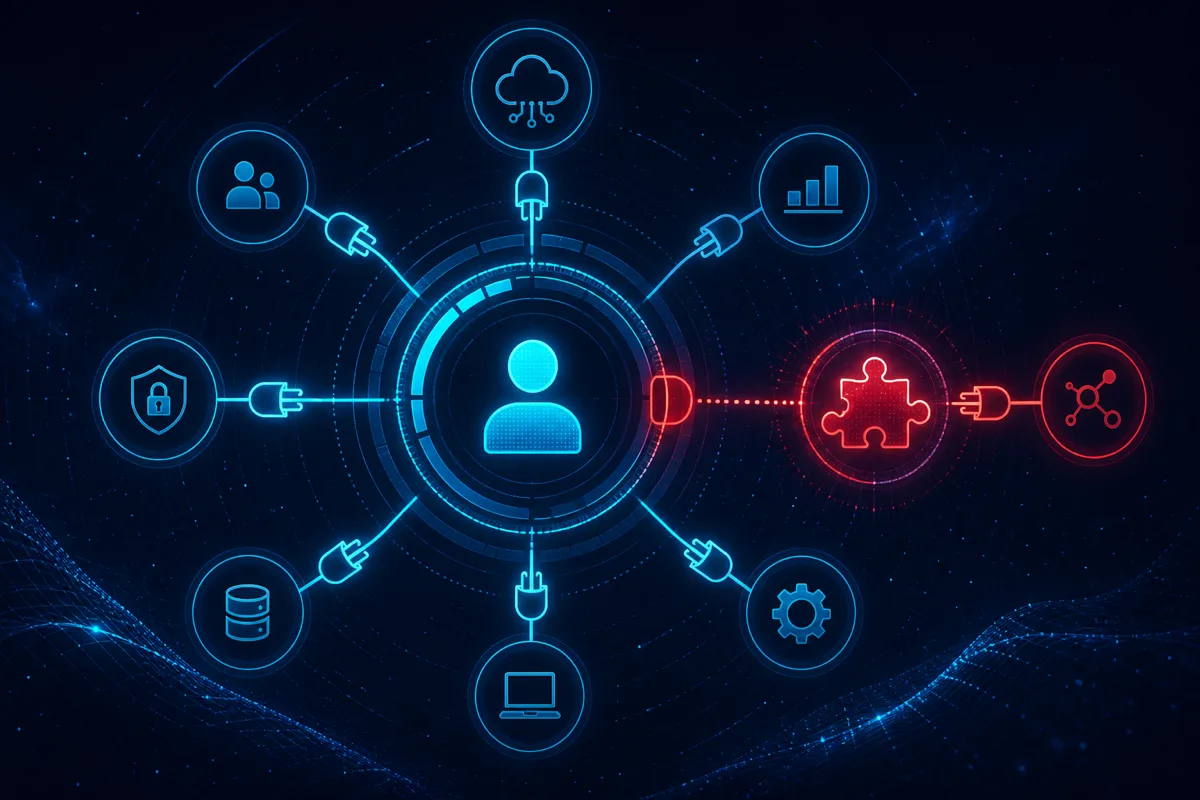
Okta's lifecycle management engine is genuinely good at what it's built for: apps that speak SCIM or have a native Okta integration get automatic provisioning and deprovisioning the moment an HR event fires. The gap that keeps showing up in SOC 2 audits isn't in that layer — it's in the internal tools, homegrown admin panels, and legacy systems that were never built to speak SCIM in the first place. Those accounts get created manually during onboarding and, more often than auditors would like, forgotten during offboarding.
Where the Okta Coverage Model Breaks Down
Okta's Lifecycle Management product provisions and deprovisions accounts through three mechanisms: native SaaS app integrations (Salesforce, Slack, Google Workspace), SCIM 2.0 for apps that implement the protocol, and SWA (Secure Web Authentication) for apps that only support shared credentials. The problem is that a meaningful share of the systems auditors sample during a SOC 2 review — a custom admin dashboard, an internal ticketing tool, a homegrown deployment console — fall into none of these categories. They authenticate independently, often against a local user table, with no API surface Okta can reach.
The Connector Pattern We Build
Rather than treat these systems as permanently manual, we build a lightweight connector layer that bridges Okta's lifecycle events to the target system's actual data model:
# Okta System Log webhook receiver -> internal app provisioning
@app.route("/webhooks/okta/lifecycle", methods=["POST"])
def handle_lifecycle_event(request):
    event = verify_okta_signature(request)
    if event["eventType"] == "user.lifecycle.deactivate":
        okta_user_id = event["target"][0]["id"]
        internal_user = user_map.lookup_by_okta_id(okta_user_id)
        if internal_user:
            internal_app_client.disable_account(internal_user.id)
            audit_log.record(
                action="deprovision",
                source="okta_webhook",
                target_system="internal_app",
                target_user=internal_user.id,
            )
The architecture has three parts:
- Event capture via Okta's System Log API or event hooks, filtered to lifecycle events (activate, deactivate, suspend).
- Identity mapping, since the internal system almost never uses Okta's user ID as its primary key — we maintain a mapping table (or derive it from a shared attribute like email) that's itself part of the audit evidence.
- Idempotent disable calls against the target system's own API or database, with a retry queue for systems that are occasionally unreachable, so a deprovisioning event never silently fails.
Why "We'll Handle It Manually" Fails Audits
Manual deprovisioning for non-SCIM systems tends to work fine for the first few months after a process is documented, then degrades as team turnover and urgency erode the checklist discipline. When an auditor samples terminated employees and checks whether every system was disabled within the SLA window, the custom apps are disproportionately where the exceptions show up — not because anyone was careless, but because there was no system forcing the action.
A connector-based approach turns this into an engineering guarantee rather than a process hope: the disable action fires from the same event that disables Okta itself, with a logged record either way.
Handling Systems With No API at All
Some internal tools genuinely have no API surface — a legacy admin panel with only a database connection, for instance. In these cases, we build a narrower "database-direct" connector that updates the user's status column via a service account with least-privilege write access scoped only to that table, still triggered by the same Okta lifecycle webhook, still logged to the same audit trail. It's a smaller, uglier integration than a proper API call, but it closes the same gap.
What This Looks Like for an Auditor
The evidence artifact that matters isn't the connector code — it's the audit log showing that for every termination event in the sample period, every mapped system (SCIM-native and custom alike) shows a disable action within the same time window, with no manual step in between. That's the difference between "we have a documented offboarding checklist" and "we have engineering enforcement of the offboarding checklist."
This connector pattern is part of our broader security automation capability, and pairs well with the identity work covered in user access review automation.
Talk to us about your credential elimination pilot: 907-841-8407 or contact@rutagon.com.
See what an Access & Credential Governance Diagnostic finds in your environment →
Frequently Asked Questions
Does this replace Okta's native Lifecycle Management product?
No — it extends it. Okta still owns the event source and native SaaS integrations; the connector layer only closes the gap for systems Okta can't natively reach.
What if our internal tool doesn't have any API at all?
We build a narrower database-direct connector scoped to a least-privilege service account that can only update the status field needed for deprovisioning, still triggered by the same lifecycle event and logged the same way.
How do you handle identity mapping when the internal system doesn't use email as a key?
We build a mapping table populated during onboarding (or backfilled once for existing accounts) that ties the Okta user ID to the internal system's primary key, and that mapping itself becomes part of the audit evidence.
Does this work with identity providers other than Okta?
Yes — the same webhook/event-driven pattern applies to Azure AD/Entra ID, Google Workspace, and other IdPs that expose lifecycle events; the connector logic on the target-system side is what actually changes per integration.
How long does a typical connector engagement take?
It depends on the number of non-SCIM systems and their API maturity, but a focused engagement covering a handful of custom internal tools is typically scoped in weeks, not quarters.