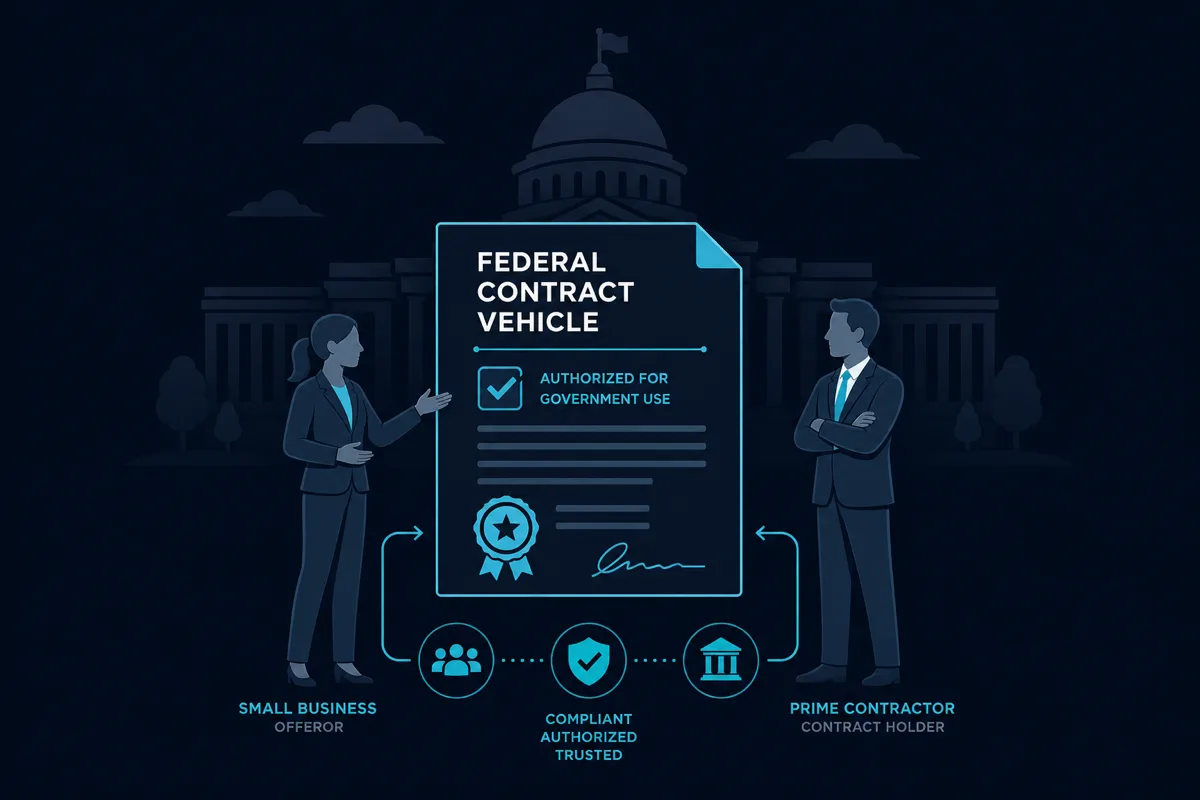
OASIS+ (One Acquisition Solution for Integrated Services Plus) replaced GSA's OASIS IDIQ vehicle as the primary mechanism for professional services delivery across civilian and defense agencies. For primes holding OASIS+ ceiling contracts, the task order execution model creates specific requirements for subcontractors — particularly cloud engineering subs who need to deliver quickly against complex technical requirements.
Here's what primes should expect from a cloud engineering subcontractor on OASIS+ task orders, and what Rutagon specifically delivers in this role.
OASIS+: The Execution Context
OASIS+ is structured around small business and other-than-small-business pools, with task orders competed within pools or awarded on a sole-source basis for small business set-asides. The key dynamics that affect sub delivery:
Task order response speed: OASIS+ task order proposals often have short proposal windows (7-30 days). Primes need subs who can prepare technical volume inputs and staffing plans on compressed schedules without degrading quality.
Technical evaluation criteria: OASIS+ task orders evaluate technical approach, staffing qualifications, and past performance. Cloud engineering subs need documented past performance on comparable cloud and DevSecOps work — not just a capability statement.
Small business subcontracting goals: Primes on contracts over $750,000 are required to have subcontracting plans with SBA goals. An OASIS+ prime with active small business subs documented in task order proposals advances their SBA goal metrics more cleanly.
Delivery model integration: Unlike subcontracts structured as staff augmentation, effective cloud engineering delivery on OASIS+ should be outcomes-based — sprint delivery, ATO evidence milestones, and measurable system improvements. Primes want subs who can articulate measurable deliverables, not just bill hours.
What Rutagon Delivers on OASIS+ Task Orders
Cloud infrastructure delivery: Rutagon's core delivery is cloud-native infrastructure — IaC-driven environments on AWS GovCloud (and cloud-agnostic via Terraform), pre-configured with NIST 800-53 controls, FedRAMP/CMMC baseline configurations, and ATO evidence collection automated into the deployment pipeline. For OASIS+ task orders requiring rapid cloud environment standup, Rutagon's pre-built government baseline modules compress timeline from months to weeks.
DevSecOps pipeline implementation: Programs without mature CI/CD pipelines are common on OASIS+ service areas. Rutagon delivers production-ready DevSecOps pipeline implementations — SAST/DAST integrated, container scanning, STIG compliance gates, and ATO evidence bundles generated on every deployment. These aren't templates — they're based on the same pipeline patterns running in Rutagon's production SaaS platform.
ATO acceleration support: Many OASIS+ task orders involve programs with ATO obligations that are behind schedule. Rutagon's cloud engineers have direct experience with RMF Steps 4-6 — security control implementation, continuous monitoring infrastructure, and ConMon dashboard deployment. A cloud sub who can accelerate a stalled ATO process delivers significant value to a prime's program.
Technical volume inputs: For task order proposal support, Rutagon provides technical input documents — architecture diagrams, SOW technical approach sections, staffing CVs — within the prime's proposal schedule. Our SAM.gov registration (UEI: FB2FHEJHM493, CAGE: 19ZR7) is current and documented for teaming agreement execution.
OASIS+ Service Areas Where Cloud Engineering Subs Add Most Value
OASIS+ spans multiple service areas; cloud engineering subs are most relevant to:
SA 1 — Management and Advisory: Cloud strategy, architecture reviews, digital transformation planning SA 3 — Engineering Services: Cloud infrastructure engineering, systems integration, DevSecOps implementation SA 5 — IT Services: Cloud migration, managed cloud operations, security engineering
For OASIS+ task orders in these service areas requiring cloud-native delivery, a specialized cloud engineering sub with documented past performance outperforms a general IT staff augmentation model.
Building the Teaming Arrangement
Effective subcontracting on OASIS+ programs requires a signed teaming agreement that specifies: - Scope of sub delivery (specific work areas, not open-ended) - Delivery model (sprint-based, milestone-based, or time-and-materials with a defined outcome) - ATO evidence responsibilities (which party owns each artifact type) - Clearance requirements (Rutagon operates with ITAR-aware processes; program clearance requirements are scoped by task order)
Teaming arrangements established early — before task order pursuit rather than after award — allow subs to meaningfully contribute to the technical approach and staffing plan, improving proposal quality.
Ready to explore teaming on OASIS+ task orders? → rutagon.com/contact
Frequently Asked Questions
Does Rutagon hold its own OASIS+ vehicle?
Rutagon is a small business sub available for prime-led OASIS+ task orders. We don't hold a prime OASIS+ ceiling contract. The subcontracting relationship is: prime holds the OASIS+ ceiling, Rutagon delivers specific cloud engineering work scopes under the prime's task order award. This structure allows primes to access Rutagon's technical capabilities while maintaining prime contractual accountability.
What documentation does Rutagon provide for OASIS+ teaming agreements?
Active SAM.gov registration documentation (UEI, CAGE), capability statement, past performance summaries, and staffing CVs for relevant technical roles. Rutagon can produce teaming agreement language drafts for review by prime contracts teams, and supports SB subcontracting plan documentation requirements including estimated subcontract value and work scope descriptions.
How quickly can Rutagon respond to a task order proposal request?
For task orders in cloud infrastructure, DevSecOps, and IT modernization service areas, Rutagon can produce technical volume inputs within 5-10 business days depending on proposal complexity. Early engagement (2-3 weeks before proposal submission) allows full technical volume development. Emergency requests on shorter timelines are handled on a case-by-case basis.
What OASIS+ task order sizes does Rutagon typically support?
Rutagon is best suited for task orders in the $500,000-$5M range where a focused, senior-heavy team delivers specific technical outcomes. Very large task orders requiring broad staffing may be better served by larger sub teams. Rutagon's value is technical depth and delivery speed — not headcount — which aligns well with focused task orders with specific cloud or DevSecOps deliverables.
Can Rutagon support OASIS+ task orders across civilian and defense agencies?
Yes — our technical capabilities are applicable to both civilian agency (HHS, DHS, VA, State) and defense (DoD components, combatant commands) OASIS+ task orders. The primary differentiator by agency is the IL environment (civilian agencies typically use FedRAMP Moderate; defense programs may require IL4/IL5) and the compliance framework (FedRAMP vs. CMMC). Rutagon's cloud infrastructure baseline supports both compliance paths.