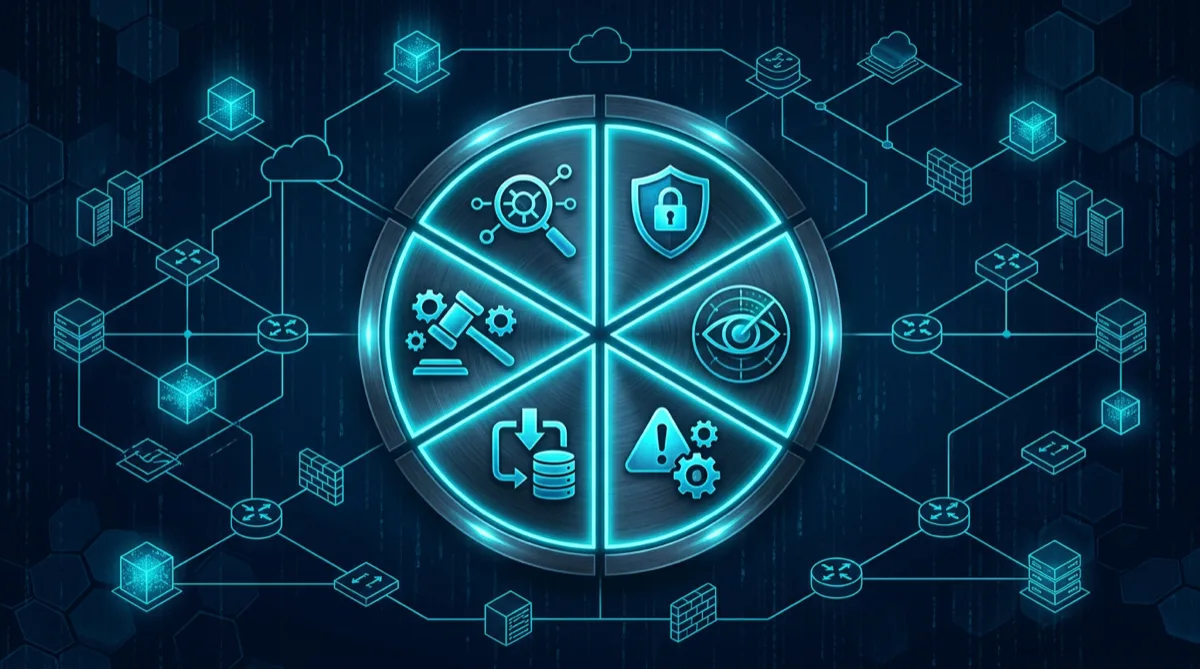
NIST released Cybersecurity Framework 2.0 in February 2024 — the first major revision since the framework's original 2014 release. CSF 2.0 expands the framework's scope from critical infrastructure to all organizations, adds a significant new function, and provides explicit guidance on using CSF alongside other NIST frameworks including SP 800-53 and SP 800-171.
For federal cloud programs, CSF 2.0 introduces architecture and governance changes that affect how programs approach FedRAMP authorization, CMMC compliance, and continuous monitoring. This article covers the key changes and how they map to practical cloud implementation decisions.
What Changed in CSF 2.0
The New GOVERN Function
CSF 1.1 had five functions: Identify, Protect, Detect, Respond, Recover (IPDRR). CSF 2.0 adds a sixth: Govern.
The Govern function is not a new category of technical controls — it's an umbrella function for the organizational context that makes cybersecurity programs work: policy, roles and responsibilities, risk strategy, supply chain risk management, and oversight.
The Govern function contains six categories:
- GV.OC — Organizational Context (mission, stakeholders, legal requirements)
- GV.RM — Risk Management Strategy
- GV.RR — Roles, Responsibilities, and Authorities
- GV.PO — Policy
- GV.OV — Oversight
- GV.SC — Cybersecurity Supply Chain Risk Management
For government cloud programs, the Govern function creates a natural mapping to ATO governance artifacts. The System Security Plan (SSP) corresponds to GV.PO (Policy). The Authorizing Official's role maps to GV.RR. The continuous monitoring program maps to GV.OV.
Expanded Scope
CSF 1.1 was specifically designed for critical infrastructure sectors. CSF 2.0 explicitly addresses all organizations, including small businesses, academic institutions, and government agencies. The framework implementation guidance now includes organization-specific profiles and tiers that are more explicitly applicable to federal programs.
Supply Chain Risk Management Elevated
CSF 2.0 gives SCRM its own function category (GV.SC) rather than burying it in the Identify function. This elevation reflects the post-SolarWinds, post-Log4Shell threat landscape where supply chain compromise is a primary attack vector.
For cloud programs, GV.SC maps directly to NIST SP 800-161r1 (SCRM) controls and CMMC Level 2 requirements around supplier risk. Software Bill of Materials (SBOM) generation, third-party assessment requirements, and container image signing practices are all GV.SC implementations.
Mapping CSF 2.0 to AWS GovCloud Controls
The CSF 2.0 framework is intentionally implementation-agnostic — it doesn't specify AWS services. But the cloud implementations of each function category map clearly to AWS GovCloud capabilities:
GOVERN
| CSF 2.0 Category | AWS GovCloud Implementation |
|---|---|
| GV.RM — Risk Management Strategy | AWS Security Hub with NIST 800-53 standard enabled; findings feed risk register |
| GV.SC — Supply Chain Risk | ECR image scanning; Cosign image signing; SBOM generation in CI/CD |
| GV.OV — Oversight | AWS Config rules; CloudTrail organizational trail; GuardDuty aggregated to SIEM |
IDENTIFY
| CSF 2.0 Category | AWS GovCloud Implementation |
|---|---|
| ID.AM — Asset Management | AWS Config inventory; Systems Manager inventory; resource tagging strategy |
| ID.RA — Risk Assessment | Security Hub findings; Inspector vulnerability scan results |
| ID.IM — Improvement | ConMon reports; POA&M tracking |
PROTECT
| CSF 2.0 Category | AWS GovCloud Implementation |
|---|---|
| PR.AA — Identity Management | IAM Identity Center; IAM permission boundaries; SCPs for preventive controls |
| PR.DS — Data Security | KMS encryption for S3, RDS, EBS; Macie for PII detection |
| PR.PS — Platform Security | Systems Manager Patch Manager; AWS Backup; Config conformance packs |
DETECT
| CSF 2.0 Category | AWS GovCloud Implementation |
|---|---|
| DE.AE — Adverse Event Analysis | GuardDuty threat detection; Security Hub aggregation; CloudWatch anomaly detection |
| DE.CM — Monitoring | VPC Flow Logs; CloudTrail; Config rule evaluation; CloudWatch metrics |
RESPOND / RECOVER
| CSF 2.0 Category | AWS GovCloud Implementation |
|---|---|
| RS.MA — Incident Management | Security Hub findings workflow; SNS/EventBridge automation |
| RC.RP — Incident Recovery | AWS Backup restore testing; DR runbooks in Systems Manager |
CSF 2.0 and FedRAMP Alignment
CSF 2.0 is not a FedRAMP requirement — FedRAMP still requires NIST SP 800-53 control implementation. However, CSF 2.0 provides a useful risk-based framework for organizing how an organization thinks about its FedRAMP program.
The CSF Profile concept (defining current and target states against the framework) is a practical tool for communicating ATO readiness to non-technical stakeholders (AOs, program managers, agency leadership). Rather than presenting 300+ 800-53 controls, a CSF Profile summary shows where the program is against each function category.
FedRAMP continuous monitoring alignment:
The Govern GV.OV (Oversight) category provides a clear framework for organizing ConMon activities:
- Monthly vulnerability scanning → GV.OV evidence
- Annual security assessment → GV.OV + GV.RM evidence
- Significant change process → GV.RR evidence (who has authority to approve changes)
- POA&M management → GV.OV + ID.IM evidence
CSF 2.0 and CMMC Alignment
CMMC Level 2 maps directly to NIST SP 800-171 (110 controls). CSF 2.0's relationship to CMMC is through the shared NIST 800-53 lineage — most 800-171 controls map to 800-53 controls, which map to CSF categories.
The most direct CMMC-to-CSF 2.0 alignment is in the Govern function. CMMC Level 2 requires a system security plan, incident response plan, and configuration management plan — these are all GV.PO artifacts.
For contractors handling CUI on cloud systems, implementing CSF 2.0's Govern function rigorously produces the documentation artifacts that feed both FedRAMP authorization (if using a FedRAMP-authorized cloud) and CMMC assessment.
Implementation Approach
For a federal cloud program starting fresh with CSF 2.0 as the organizing framework:
- Establish the Organizational Profile: Document GV.OC (mission, stakeholders, legal requirements) — this is the foundation everything else references.
- Define the Current Profile: Assess where each CSF function category stands today. This is your gap analysis.
- Define the Target Profile: Based on regulatory requirements (FISMA impact level, FedRAMP tier, CMMC level), define where each category needs to be.
- Build the Implementation Roadmap: Prioritize gaps by risk — IDENTIFY and GOVERN gaps first, then PROTECT, then DETECT and RESPOND.
- Map to AWS GovCloud controls: For each CSF category gap, identify the specific AWS service or configuration that addresses it.
Rutagon Cloud Security Architecture →
Cloud Security Posture Management in GovCloud →
Frequently Asked Questions
Does CSF 2.0 replace NIST SP 800-53?
No. CSF 2.0 is a risk management framework — it provides the "what to achieve" at an organizational level. NIST SP 800-53 is a security controls catalog — it provides the "how to implement" at the technical level. CSF 2.0 explicitly references 800-53 as one of the informative references that informs CSF implementation. Federal agencies still use 800-53 as the basis for ATO, FedRAMP, and FISMA compliance.
Is CSF 2.0 required for federal agencies?
Federal agencies are required to implement NIST cybersecurity standards under FISMA and OMB guidance. OMB Memorandum M-24-04 references CSF 2.0 as guidance for agency risk management. While CSF 2.0 is not itself a compliance mandate in the same way 800-53 is, agencies that use CSF 2.0 as an organizational framework are aligning with OMB direction.
How does the Govern function differ from the Identify function in CSF 1.1?
The Identify function in CSF 1.1 included risk assessment, asset management, and business environment — what the organization is protecting and why. The new Govern function in CSF 2.0 pulls out the organizational context, risk management strategy, and governance structure into a separate function that explicitly sits above and informs all other functions. It's the "why we do what we do" and "who decides what" layer.
What AWS Config rules map to CSF 2.0 PROTECT controls?
AWS Config Conformance Packs provide pre-built collections of Config rules mapped to NIST 800-53. The Operational-Best-Practices-for-NIST-800-53-rev-5 conformance pack covers most of the PROTECT function categories. For CSF 2.0 specifically, the mapping is indirect — CSF 2.0 → 800-53 control families → Config rules. NIST publishes the CSF-to-800-53 mapping at csrc.nist.gov.
How does Rutagon apply CSF 2.0 in cloud program delivery?
Rutagon uses CSF 2.0 as the organizing framework for communicating security posture to program stakeholders who need a risk-level view rather than a controls-level view. During cloud program assessment and architecture, we map the target state to CSF function categories to identify governance and technical gaps, then translate those to specific 800-53 controls and AWS service implementations. This bridges the gap between business risk language and technical implementation.