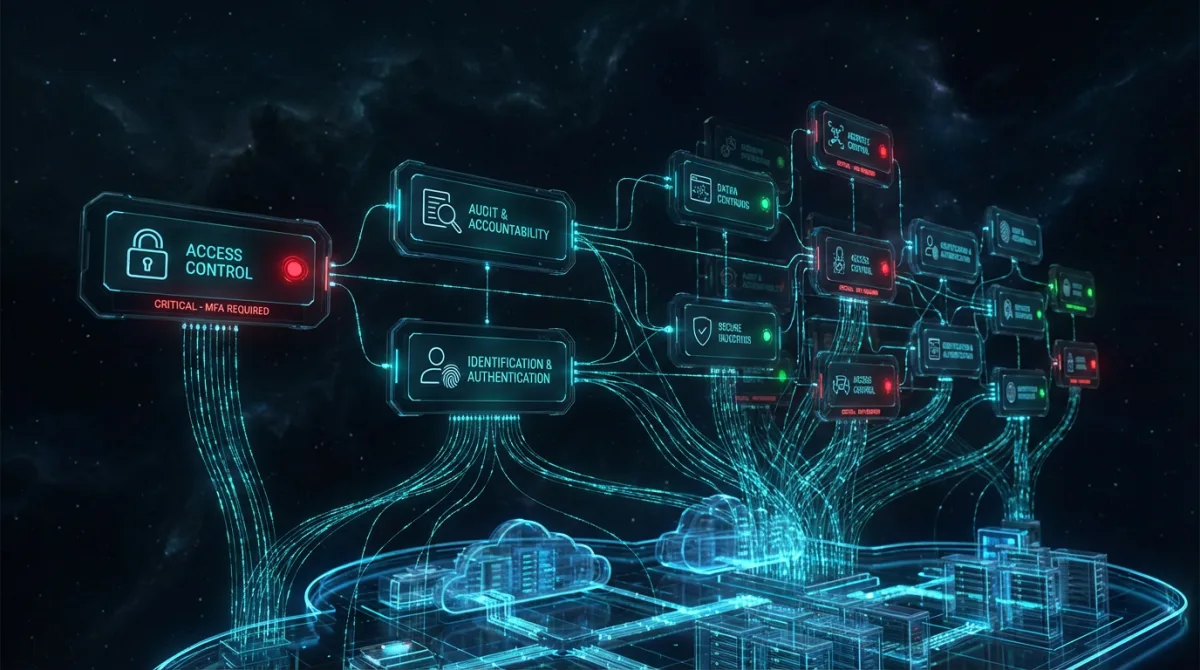
# NIST 800-171 Cloud Implementation Patterns for CUI Protection
Implementing NIST 800-171 in the cloud is not a checklist exercise. It's an architecture problem. Every control family maps to specific AWS services, configurations, and operational practices — and getting the mapping wrong means you're compliant on paper but vulnerable in practice.
We've built cloud systems that handle Controlled Unclassified Information (CUI) in AWS, and the gap between reading the 800-171 requirements and actually implementing them in a cloud-native way is significant. This article covers the patterns that work in production.
Understanding NIST 800-171 in Context
NIST Special Publication 800-171 defines 110 security requirements across 14 control families for protecting CUI in nonfederal systems. If you're a defense contractor handling CUI — and most are — compliance is contractual, not optional. DFARS clause 252.204-7012 mandates it.
With CMMC 2.0 now in effect, these controls are also the foundation of Level 2 certification. The organizations that treat CMMC security architecture as a design discipline rather than a documentation exercise are the ones that pass assessments without scrambling.
The 14 families are:
- Access Control (AC)
- Awareness and Training (AT)
- Audit and Accountability (AU)
- Configuration Management (CM)
- Identification and Authentication (IA)
- Incident Response (IR)
- Maintenance (MA)
- Media Protection (MP)
- Personnel Security (PS)
- Physical Protection (PE)
- Risk Assessment (RA)
- Security Assessment (CA)
- System and Communications Protection (SC)
- System and Information Integrity (SI)
Of these, AC, AU, CM, IA, SC, and SI have the heaviest cloud implementation requirements. Let's focus there.
Access Control: The Foundation
Access Control has 22 requirements — the largest family. In AWS, this maps to IAM policies, SCPs, VPC configurations, and session management.
Principle of Least Privilege (AC 3.1.5)
Every IAM role, policy, and permission boundary must enforce least privilege. In practice, this means:
{
  "Version": "2012-10-17",
  "Statement": [
    {
      "Sid": "RestrictCUIBucketAccess",
      "Effect": "Allow",
      "Action": [
        "s3:GetObject",
        "s3:PutObject"
      ],
      "Resource": "arn:aws-us-gov:s3:::cui-documents/*",
      "Condition": {
        "StringEquals": {
          "s3:x-amz-server-side-encryption": "aws:kms",
          "aws:PrincipalOrgID": "o-organization-id"
        },
        "IpAddress": {
          "aws:SourceIp": ["10.0.0.0/8"]
        }
      }
    }
  ]
}
This policy grants S3 access only for KMS-encrypted objects, from within the organization, and from internal network ranges. Every condition narrows the blast radius.
Session Controls (AC 3.1.10, 3.1.11)
CUI systems require session lock after inactivity and session termination after defined conditions. For web applications, implement server-side session management with short-lived tokens:
SESSION_CONFIG = {
    'idle_timeout_minutes': 15,
    'absolute_timeout_minutes': 480,
    'concurrent_sessions_per_user': 1,
    'require_re_auth_for_sensitive': True,
}
Enforce these at the application layer and validate server-side. Client-side timeouts alone don't satisfy the control — a modified client can bypass them.
Remote Access (AC 3.1.12)
All remote access to CUI systems must be monitored and controlled. In AWS, this means no direct SSH or RDP to instances. Use Systems Manager Session Manager, which provides:
- No inbound ports required
- Full session logging to CloudWatch and S3
- IAM-based access control
- Automatic session recording for audit
Audit and Accountability: Everything Gets Logged
The AU family requires comprehensive audit logging with protection against tampering. AWS CloudTrail is the foundation, but it's not sufficient alone.
What to Log (AU 3.3.1)
Every action on CUI must generate an audit record containing: who, what, when, where, and outcome. CloudTrail covers AWS API calls. Application-level access to CUI requires custom audit logging:
interface AuditRecord {
  timestamp: string;
  actor: {
    userId: string;
    role: string;
    sourceIp: string;
    sessionId: string;
  };
  action: string;
  resource: {
    type: string;
    identifier: string;
    classification: 'CUI' | 'PUBLIC';
  };
  outcome: 'SUCCESS' | 'FAILURE';
  details: Record<string, unknown>;
}

function logAuditEvent(record: AuditRecord): void {
  const immutableRecord = {
    ...record,
    integrity: computeHMAC(JSON.stringify(record)),
    sequenceNumber: getNextSequence(),
  };

  cloudwatchLogs.putLogEvents({
    logGroupName: '/audit/cui-access',
    logStreamName: `${record.actor.userId}/${new Date().toISOString().split('T')[0]}`,
    logEvents: [{
      timestamp: Date.now(),
      message: JSON.stringify(immutableRecord),
    }],
  });
}
Audit Log Protection (AU 3.3.8)
Audit logs for CUI systems must be protected from unauthorized modification. Ship logs to a dedicated security account with:
- S3 Object Lock in compliance mode (immutable retention)
- Separate AWS account with restricted access
- CloudTrail log file integrity validation enabled
- KMS encryption with a key the workload account cannot delete
This separation of duties ensures that even a compromised workload account cannot tamper with its own audit trail.
Configuration Management: Infrastructure as Code
The CM family requires baseline configurations, change control, and restriction of unnecessary functions. Infrastructure as Code isn't just a best practice here — it's a compliance requirement.
Every resource in a CUI environment should be defined in Terraform or CloudFormation. No console changes. No manual configuration. The infrastructure code is the baseline, and any drift is a finding.
resource "aws_config_configuration_recorder" "cui_recorder" {
  name     = "cui-environment-recorder"
  role_arn = aws_iam_role.config_role.arn

  recording_group {
    all_supported                 = true
    include_global_resource_types = true
  }
}

resource "aws_config_config_rule" "encrypted_volumes" {
  name = "encrypted-volumes"
  source {
    owner             = "AWS"
    source_identifier = "ENCRYPTED_VOLUMES"
  }
  depends_on = [aws_config_configuration_recorder.cui_recorder]
}

resource "aws_config_config_rule" "s3_bucket_encryption" {
  name = "s3-bucket-server-side-encryption-enabled"
  source {
    owner             = "AWS"
    source_identifier = "S3_BUCKET_SERVER_SIDE_ENCRYPTION_ENABLED"
  }
}
AWS Config rules provide continuous monitoring against your baseline. When a resource drifts — an unencrypted volume, a public S3 bucket, an overly permissive security group — Config flags it immediately.
System and Communications Protection: Encryption Everywhere
SC controls require encryption of CUI in transit and at rest, boundary protection, and network segmentation.
Encryption at Rest (SC 3.13.16)
Every data store in a CUI environment must use encryption at rest with customer-managed KMS keys. This includes S3, EBS, RDS, DynamoDB, SQS, SNS, CloudWatch Logs, and any other service that stores data.
Use a KMS key policy that restricts usage to specific roles:
{
  "Sid": "AllowCUIEncryption",
  "Effect": "Allow",
  "Principal": {
    "AWS": [
      "arn:aws-us-gov:iam::123456789012:role/cui-application-role",
      "arn:aws-us-gov:iam::123456789012:role/cui-backup-role"
    ]
  },
  "Action": [
    "kms:Encrypt",
    "kms:Decrypt",
    "kms:GenerateDataKey"
  ],
  "Resource": "*",
  "Condition": {
    "StringEquals": {
      "kms:ViaService": [
        "s3.us-gov-west-1.amazonaws.com",
        "rds.us-gov-west-1.amazonaws.com"
      ]
    }
  }
}
Network Segmentation (SC 3.13.1)
CUI systems must operate in isolated network segments. In AWS, this means dedicated VPCs with no peering to non-CUI environments, private subnets with no internet gateway routes, and VPC endpoints for all AWS service access:
- S3 gateway endpoint
- DynamoDB gateway endpoint
- Interface endpoints for KMS, CloudWatch, Systems Manager, STS
- No NAT gateway unless explicitly justified and logged
Identification and Authentication: Zero Trust in Practice
IA controls map directly to our philosophy that eliminating long-lived credentials is the foundation of secure systems. Every authentication event must be validated, logged, and constrained.
Multi-factor authentication is required for all access to CUI systems (IA 3.5.3). In AWS, this means MFA on the root account, MFA for console access via IAM Identity Center, and OIDC federation for programmatic access — no long-lived access keys.
For CI/CD pipelines accessing CUI environments, OIDC-based federation with short-lived role assumptions replaces static credentials entirely. We've implemented this across production environments where every deployment authenticates via identity provider trust, assumes a scoped role, and operates with credentials that expire in minutes.
Continuous Monitoring: Compliance Is Not a Point in Time
The biggest implementation mistake is treating NIST 800-171 as a one-time configuration. Compliance is continuous. Systems drift. New vulnerabilities emerge. People make changes.
Build automated compliance monitoring that:
- Runs AWS Config rules continuously against all 110 requirements
- Aggregates findings in Security Hub with custom insights
- Generates compliance dashboards mapped to control families
- Alerts on any finding that moves a control out of compliance
- Produces evidence packages automatically for assessments
Our security automation capabilities treat compliance as code — assessable, testable, and continuously validated against the control baseline.
For organizations navigating the government compliance landscape, the pattern is clear: automate evidence collection, continuously monitor controls, and treat every configuration as code that can be audited.
Mapping Controls to AWS Services
| Control Family | Primary AWS Services |
|---|---|
| Access Control (AC) | IAM, SCPs, VPC, Security Groups, WAF |
| Audit (AU) | CloudTrail, CloudWatch Logs, S3 Object Lock |
| Config Management (CM) | AWS Config, Systems Manager, CloudFormation |
| Identification (IA) | IAM Identity Center, Cognito, KMS |
| System/Comms Protection (SC) | KMS, VPC, PrivateLink, ACM, WAF |
| System Integrity (SI) | GuardDuty, Inspector, Config Rules |
Frequently Asked Questions
What's the difference between NIST 800-171 and NIST 800-53?
NIST 800-53 is the comprehensive security control catalog used by federal agencies (over 1,000 controls). NIST 800-171 is a derived subset of 110 requirements specifically for protecting CUI in nonfederal systems. If you're a contractor handling CUI, 800-171 is your requirement. The controls map back to moderate-baseline 800-53 controls, so implementing 800-171 well gives you a head start on FedRAMP.
Can you implement NIST 800-171 in commercial AWS or does it require GovCloud?
It depends on the sensitivity of the CUI and your contract requirements. GovCloud provides US-person-only access, ITAR compliance, and FedRAMP High baseline. For most DFARS contracts, GovCloud is the expected choice. Some CUI workloads can operate in commercial regions with appropriate controls, but GovCloud eliminates several control implementation challenges automatically.
How long does NIST 800-171 cloud implementation typically take?
For a greenfield environment with experienced architects, a compliant baseline can be established in 6-8 weeks. Retrofitting an existing environment takes 3-6 months depending on the gap analysis findings. The ongoing operational burden — continuous monitoring, evidence collection, incident response — is permanent. Plan for sustained investment, not a one-time project.
How does NIST 800-171 relate to CMMC 2.0?
CMMC Level 2 maps directly to the 110 NIST 800-171 requirements. The difference is verification: 800-171 is self-assessed under DFARS, while CMMC Level 2 requires third-party assessment by a C3PAO. If you've genuinely implemented 800-171 (not just documented it), CMMC Level 2 assessment should validate what you've already built.
What are the most common NIST 800-171 cloud findings?
Overly permissive IAM policies (AC), missing audit log protection (AU), lack of automated configuration monitoring (CM), long-lived access keys instead of federated authentication (IA), and unencrypted data stores (SC). These five issues appear in nearly every initial assessment we've seen. They're all solvable with proper cloud architecture.
---
Protecting CUI in the cloud requires architecture, not just documentation. Contact Rutagon to discuss your NIST 800-171 cloud implementation strategy.