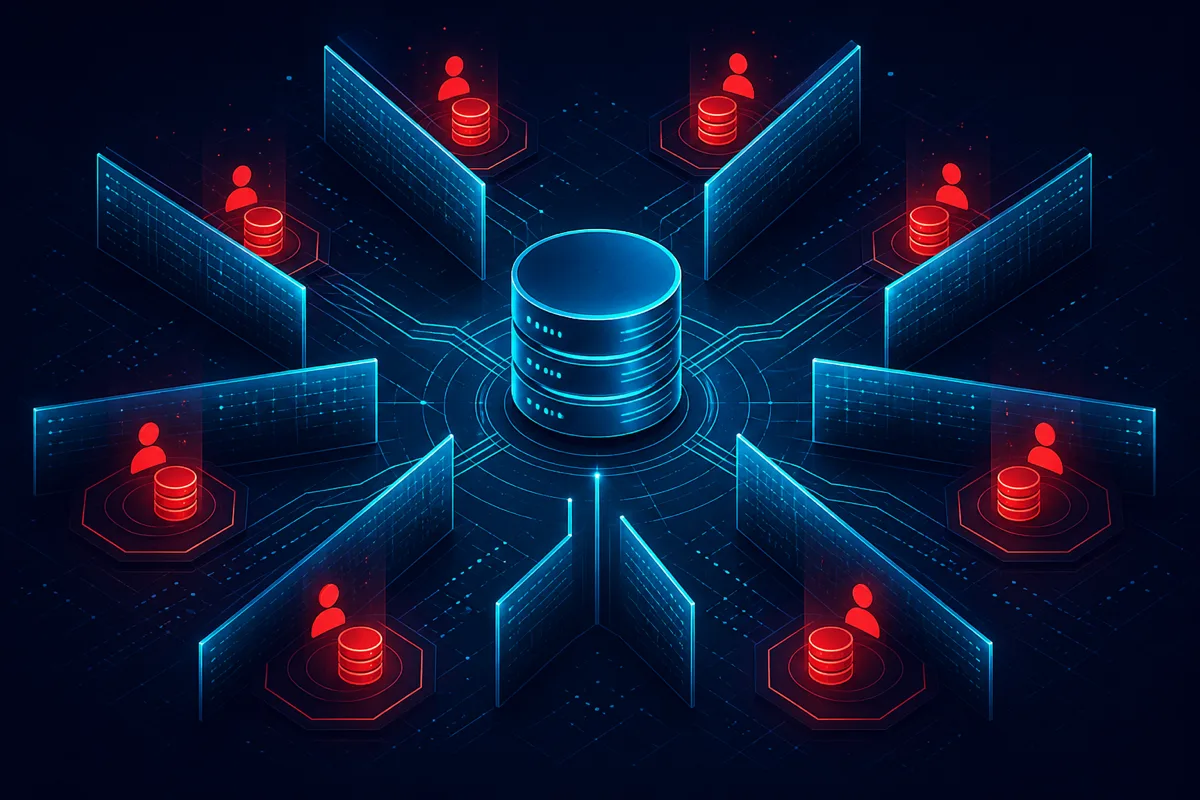
Every SaaS company eventually faces the same architectural decision: how do you store data for many customers in a way that's secure, performant, and doesn't require a database migration every time you land an enterprise customer with strict data isolation requirements? There's no universally correct answer — only tradeoffs that fit different growth stages and customer profiles differently.
Here's how the three main patterns actually work, and where each one breaks down in practice.
Pattern 1: Shared Schema, Shared Database
Every tenant's data lives in the same tables, distinguished by a tenant_id column present on every row. This is the simplest pattern to build and operate initially — one schema, one connection pool, one set of migrations to manage.
Where it works well: Early-stage SaaS with many small tenants, low per-tenant data volume, and no strict regulatory or contractual data isolation requirements. Operational simplicity dominates at this stage — you have one database to back up, monitor, and scale.
Where it breaks down: As you land larger customers, "noisy neighbor" problems emerge — one tenant's heavy query load or large data volume can degrade performance for every other tenant sharing the same database. Enterprise customers with compliance requirements (HIPAA, certain government contracts, data residency rules) often explicitly require assurance that their data is physically isolated, which a shared schema fundamentally can't provide without significant additional controls.
The critical failure mode: A missing or incorrect tenant_id filter in a single query is a cross-tenant data leak — one of the most severe security failures a SaaS product can have. Every single query touching tenant data must be audited for correct tenant scoping, and this risk compounds as your codebase and team grow.
Pattern 2: Siloed (Database-per-Tenant)
Each tenant gets a completely separate database instance (or at minimum, separate schema within a shared instance, depending on how strict your isolation needs to be).
Where it works well: Enterprise-focused SaaS with fewer, larger customers, especially in regulated industries requiring provable data isolation. It also eliminates the noisy-neighbor problem entirely — one tenant's load has zero impact on another's performance.
Where it breaks down: Operational overhead scales linearly with tenant count. Running migrations across hundreds or thousands of separate databases requires robust automation; a failed migration on tenant #847 needs the same detection and remediation rigor as tenant #1. Cost also scales less efficiently — you're paying for database overhead (connections, minimum compute) per tenant rather than sharing infrastructure.
The critical failure mode: Migration drift. If your migration automation isn't bulletproof, tenants can end up on different schema versions, creating a maintenance nightmare where application code has to handle multiple schema states simultaneously.
Pattern 3: Hybrid — Shared Infrastructure, Logical Isolation
A middle path: shared database infrastructure (reducing operational overhead) with schema-level or row-level security providing stronger isolation than a simple shared table with a tenant_id column. PostgreSQL's Row-Level Security (RLS) is a common implementation — the database itself enforces tenant isolation at the query engine level, rather than relying entirely on application code to always filter correctly.
Where it works well: Mid-stage SaaS that has outgrown pure shared-schema risk tolerance but isn't ready for the operational overhead of full database-per-tenant, or companies with a mix of small self-serve tenants and a smaller number of enterprise tenants needing stronger guarantees.
Where it breaks down: RLS and schema-per-tenant hybrids add real complexity to your ORM layer and connection management. Performance tuning becomes more nuanced since you're relying on database-level policy enforcement in addition to standard query optimization, and debugging cross-tenant issues requires understanding an additional layer that pure shared-schema or pure siloed architectures don't have.
Choosing the Right Pattern for Your Stage
Early stage, high tenant count, low individual value: Shared schema, with rigorous automated testing for tenant isolation and a plan to migrate specific high-value tenants to dedicated infrastructure later if needed.
Enterprise-focused, fewer larger tenants, compliance-sensitive: Siloed from the start, accepting the operational overhead as a cost of the isolation and compliance benefits it provides.
Mixed customer base, moderate scale, growing compliance needs: Hybrid approach, often starting with shared schema and RLS, with a path to move specific tenants to dedicated database instances as they grow or require it contractually.
The Migration Path Most Companies Actually Take
Most successful SaaS companies don't pick one pattern permanently — they start with shared schema for speed, then build the ability to "graduate" specific large tenants to isolated infrastructure as a premium tier, without re-architecting the entire system. Designing your data access layer with this eventual migration in mind from day one — consistent tenant scoping patterns, abstracted database connection logic — makes this transition dramatically less painful than retrofitting it after the fact.
Rutagon designs and builds multi-tenant SaaS architectures that scale from early-stage to enterprise without requiring a rewrite. Contact us to discuss your multi-tenant data architecture.
Frequently Asked Questions
Which multi-tenant pattern is most secure?
Database-per-tenant (siloed) provides the strongest isolation guarantee since tenant data is physically separated. Shared schema with Row-Level Security provides strong logical isolation enforced at the database level, which is significantly more robust than relying solely on application-level tenant_id filtering.
Can I migrate from shared schema to database-per-tenant later?
Yes, but it's significantly easier if you design your data access layer with eventual isolation in mind from the start — consistent tenant scoping, abstracted connection logic — rather than retrofitting migration capability after years of ad-hoc query patterns have accumulated.
Does multi-tenant architecture affect performance?
Yes, depending on the pattern. Shared schema architectures risk noisy-neighbor performance issues as tenant data volume grows unevenly. Siloed architectures eliminate this risk but require more careful capacity planning per tenant. Hybrid approaches with RLS add a database-level enforcement layer that requires its own performance tuning.
What is Row-Level Security and how does it help multi-tenancy?
Row-Level Security (RLS) is a database feature, notably in PostgreSQL, that enforces tenant isolation policies directly at the query engine level rather than relying entirely on application code to filter correctly. This significantly reduces the risk of a cross-tenant data leak from a missed application-level filter.
How do I decide which multi-tenant pattern fits my SaaS?
Consider your tenant count and size distribution, compliance requirements, and operational capacity for managing infrastructure. Companies with a large number of small tenants and no strict isolation requirements can usually start with shared schema; regulated or enterprise-focused products often need siloed or hybrid architectures from the start.