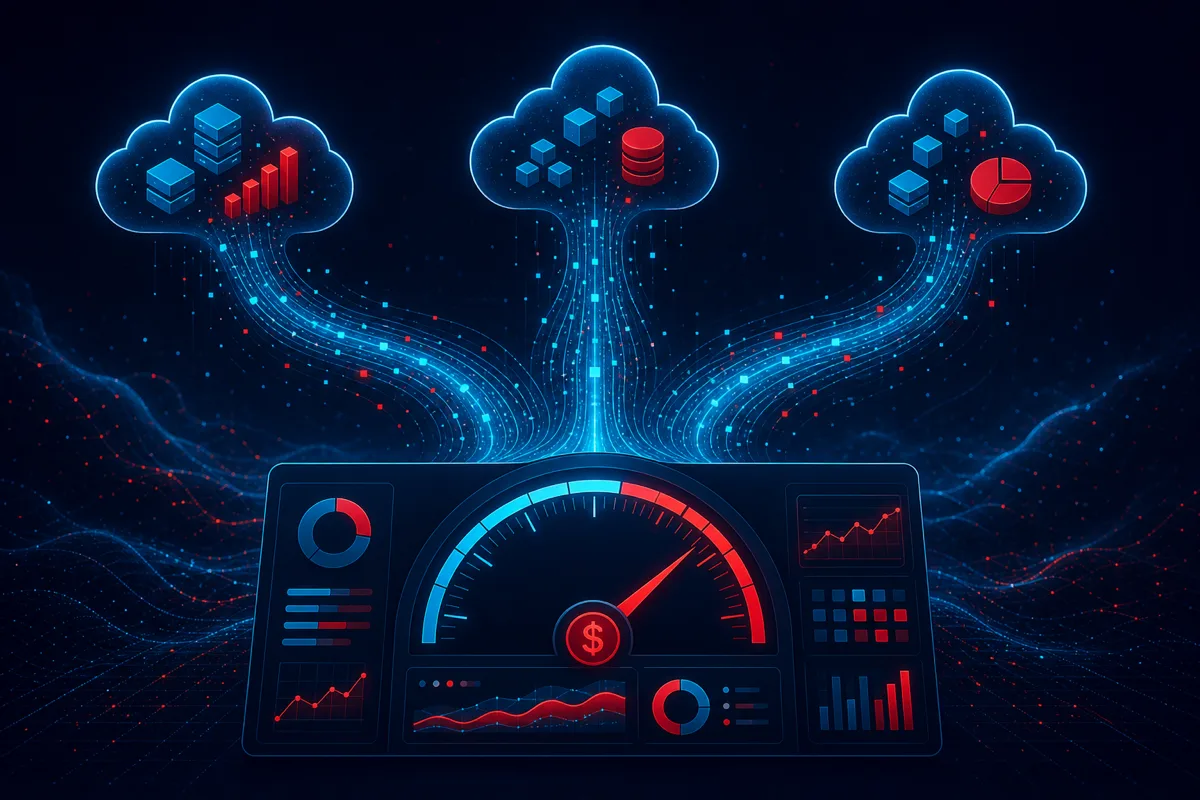
Most startups don't set out to run multi-cloud. It happens gradually — AWS for core infrastructure, GCP because a specific team needed BigQuery, a scattering of SaaS tools each with their own usage-based billing. By the time anyone asks "what's our total infrastructure cost, really?", the answer requires manually pulling numbers from four different billing dashboards and reconciling them in a spreadsheet.
Enterprise FinOps platforms solve this well, but they're built for companies spending millions annually, with pricing that doesn't make sense for a startup spending tens of thousands per month. Here's a practical approach that gets you real visibility without that price tag.
Why This Matters Earlier Than Most Startups Realize
Cost visibility isn't just about cutting costs — it's about being able to answer basic questions that come up constantly: Is this new feature's infrastructure cost sustainable at scale? Which customer segment or product line is actually cost-efficient? Are we tracking toward a cloud spend number that changes our unit economics story to investors? Without consolidated visibility, these questions get answered with guesses instead of data.
The Building Blocks of a Lean Multi-Cloud Cost Stack
Centralize billing exports, not just dashboards. Both AWS (via Cost and Usage Reports to S3) and GCP (via BigQuery billing export) support exporting detailed billing data to a queryable destination. This is the foundation — dashboards alone don't give you the flexibility to build custom cross-provider reports.
Normalize into a common schema. AWS and GCP billing data have different structures, field names, and granularity. Build a lightweight transformation layer (even a scheduled script writing to a shared BigQuery dataset or a simple Postgres database) that maps both into a common schema: service, team/project tag, cost, date, provider.
Tag consistently across providers from day one. This is the single highest-leverage practice and the one most startups skip until it's painful to retrofit. Establish a tagging convention (team, project, environment, cost-center) and enforce it across both AWS and GCP resources — inconsistent or missing tags are what make cross-provider cost allocation genuinely difficult later.
Include SaaS spend in the same view where practical. Usage-based SaaS tools (observability platforms, CI/CD services, data warehouses) often represent a meaningful and growing share of infrastructure-adjacent cost. Where these tools have cost APIs, pull that data into the same consolidated view rather than tracking it separately.
Building the Actual Dashboard
A simple BI tool (Looker Studio, Metabase, or even a well-structured spreadsheet connected to your normalized data) pointed at your unified cost schema gets you most of the value that an expensive FinOps platform provides for a startup's actual needs: total spend trends over time, cost by team/project, cost by provider, and month-over-month anomaly flags for unexpected spikes.
Prioritize these views first: 1. Total spend trend (weekly/monthly) across all providers combined 2. Spend by team or project, to support internal accountability conversations 3. Spend by environment (production vs. staging vs. development) — a surprisingly common source of waste is non-production environments running at production scale 4. Anomaly detection — even a simple week-over-week percentage change threshold catches most unexpected spend spikes before they become a large surprise bill
When to Graduate to a Commercial FinOps Platform
This lean approach scales well until your engineering time spent maintaining the custom pipeline exceeds what a commercial platform would cost, or until you need capabilities a custom build genuinely can't provide efficiently — sophisticated Kubernetes cost allocation, automated rightsizing recommendations integrated directly into workflows, or complex reserved capacity optimization across many accounts. Most startups can run the lean approach well past Series A; enterprise-scale FinOps tooling typically becomes worth the cost once cloud spend reaches a level where even a few percentage points of optimization represent significant absolute dollars.
Common Mistakes in Early Multi-Cloud Cost Tracking
Waiting until cost becomes a problem to start tracking it. Retrofitting tagging conventions and billing exports onto years of untagged resources is dramatically harder than establishing them from the start, even informally.
Building overly complex custom tooling too early. A lean, simple normalized schema and basic dashboard gets 80% of the value with 20% of the effort compared to building a sophisticated internal FinOps platform before you have the cost scale to justify it.
Ignoring SaaS spend until it's a significant line item. Usage-based tools can grow cost unpredictably as usage scales, and by the time someone notices, months of unexamined growth have accumulated.
Rutagon helps startups build lean, practical cost visibility infrastructure that scales with the business. Contact us to discuss a multi-cloud cost visibility approach for your team.
Frequently Asked Questions
Do I need a commercial FinOps platform as a startup?
Not usually, at least not initially. A lean approach combining billing exports, consistent tagging, and a simple BI dashboard covers most startup needs well past Series A, with commercial platforms becoming worth the cost once cloud spend and complexity reach enterprise scale.
How do I combine AWS and GCP billing data into one view?
Export detailed billing data from both providers (AWS Cost and Usage Reports, GCP BigQuery billing export) into a common destination, then build a lightweight transformation layer that normalizes both into a shared schema for unified reporting.
What's the most important practice for multi-cloud cost visibility?
Consistent resource tagging across all providers from the earliest stage possible. Inconsistent or missing tags are the primary reason cross-provider cost allocation becomes difficult to retrofit later.
Should I include SaaS tool spend in my cloud cost tracking?
Yes, where practical. Usage-based SaaS tools can represent a meaningful and growing share of infrastructure-adjacent cost, and tracking them alongside cloud provider spend gives a more complete and accurate cost picture.
What tools can I use to build a startup-friendly cost dashboard?
Simple BI tools like Looker Studio or Metabase, connected to a normalized cost dataset (often in BigQuery or Postgres), can provide most of the visibility a startup needs without the cost of an enterprise FinOps platform.