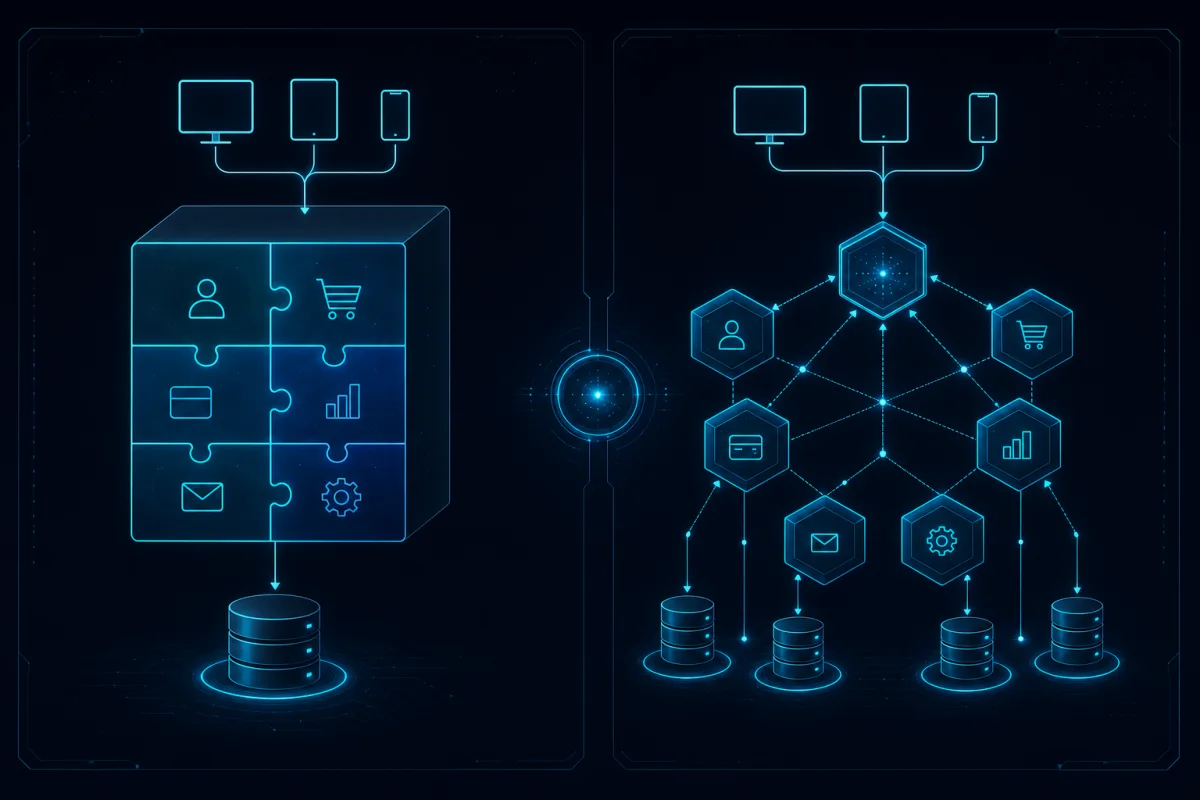
The microservices vs monolith debate is often ideological. The honest decision depends on team size, domain complexity, and scaling requirements. Most early-stage teams over-split and pay the price in operational overhead.
When Monolith Wins
Early-stage startups with <10 engineers and unclear domain boundaries. A well-structured modular monolith delivers faster iteration, simpler debugging, and lower infrastructure cost. Shared database and single deployment pipeline reduce cognitive load.
When Microservices Make Sense
Independent scaling needs, team autonomy across domains, or different deployment cadences. Payment processing that must scale separately from user profiles. Teams >15 engineers with clear bounded contexts benefit from service ownership.
Strangler Fig Migration Pattern
Never rewrite the monolith. Identify a bounded context, extract it behind an API, route traffic gradually, and decommission the old module. This pattern reduces risk compared to big-bang rewrites.
Common Over-Engineering Mistake
Teams split on technical lines (auth service, notification service) instead of business domains. The result is chatty services, distributed transactions, and eventual consistency nightmares. Start with business capabilities.
Modular Monolith as Middle Ground
Keep everything in one repo and deployment but enforce module boundaries with clear interfaces and separate databases per module. This gives 80% of microservices benefits with 20% of the complexity. Many teams never need to split further.
Internal links: see technical due diligence startup and software rescue failing project.
FAQ
How many engineers before microservices become viable?
Roughly 12-15 engineers with clear domain ownership. Below that, the coordination cost exceeds the benefit.
What is the biggest hidden cost of microservices?
Observability, distributed tracing, and service mesh complexity. Plan for 30-50% more operational effort.
Can we start monolith and split later?
Yes. The strangler fig pattern exists for this reason. Most successful microservice architectures began as monoliths.
What if our domain boundaries are unclear?
Stay monolithic. Premature splitting on wrong boundaries creates worse problems than a large monolith.
Is serverless a third option?
Serverless functions work well for event-driven workloads but introduce cold-start and vendor lock-in tradeoffs. Evaluate per use case.
Have a project that needs this? Talk to Rutagon or call 907-841-8407.
Related: buy vs build SaaS decision, custom logistics software.