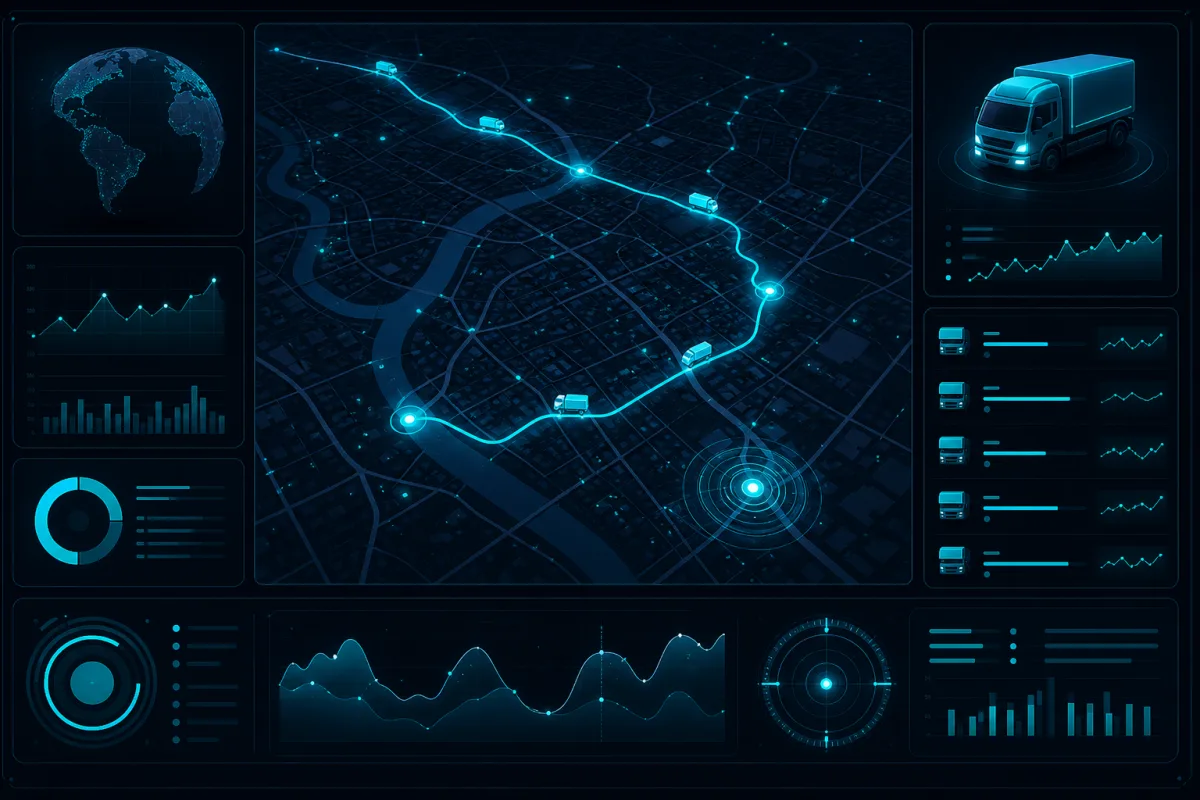
Custom logistics software for field operations is often quoted at enterprise prices. In reality, a focused build delivering sensor data, live maps, and driver apps costs far less than most off-the-shelf platforms — and delivers exactly the workflow you need.
What It Actually Costs
Design and discovery: $25-40k. Core development (real-time tracking, mobile app, operations dashboard): $80-150k. Infrastructure and CI/CD: $15-25k. First-year maintenance and iteration: $30-50k. Total first-year investment: $150-265k. Compare this to $100k+/year SaaS licensing for platforms that still require heavy customization.
Typical Stack
Real-time tracking via MQTT or WebSocket to a geospatial database (PostGIS). Mobile app (React Native or Flutter) with offline-first sync. Operations dashboard (Next.js + Mapbox or Leaflet). Event-driven backend (AWS Lambda, EventBridge, SQS). Sensor ingestion via IoT Core or custom APIs.
Integration with Existing Tools
Most fleets already run QuickBooks, dispatch software, or fuel cards. Build connectors via APIs or file drops. Avoid rip-and-replace. The custom layer sits on top and orchestrates.
Timeline from Kickoff to Production
Week 1-2: discovery and data model. Week 3-8: core features (tracking, alerts, basic dashboard). Week 9-12: mobile app, integrations, hardening. Week 13-16: pilot with one crew, iterate, roll out. 16-week typical timeline for a focused MVP.
Common Scope Creep Traps
"Add routing optimization," "integrate with every telematics provider," "build a customer portal." These are phase-two features. Lock scope to sensor ingestion, live view, and basic alerts for the first release.
ROI vs Off-the-Shelf
A $200k custom build that replaces $120k/year in SaaS fees pays for itself in 20 months. Add the productivity gains from workflow that matches your exact process and the ROI accelerates.
Internal links: see buy vs build SaaS decision and ai powered data pipeline.
FAQ
How do we handle offline field conditions?
Design the mobile app for offline-first with eventual sync. Use local SQLite or Realm and queue operations. Test with airplane mode for 48 hours.
What about data ownership and portability?
All data lives in your account. Export to Parquet or JSON on demand. No vendor lock-in by design.
Can we start with a pilot on one region?
Yes. Deploy to a single crew, measure time saved and data quality, then expand. This de-risks the full rollout.
How do we maintain it with a small team?
Use managed services (RDS, Lambda, App Runner) to minimize ops load. Document everything. Budget 0.5 FTE for ongoing iteration.
What if sensor hardware changes?
Abstract the ingestion layer behind a clean interface. Swap providers without touching the rest of the system.
Have a project that needs this? Talk to Rutagon or call 907-841-8407.
Related: productionize AI prototype to production, aws cloud infrastructure consultant.