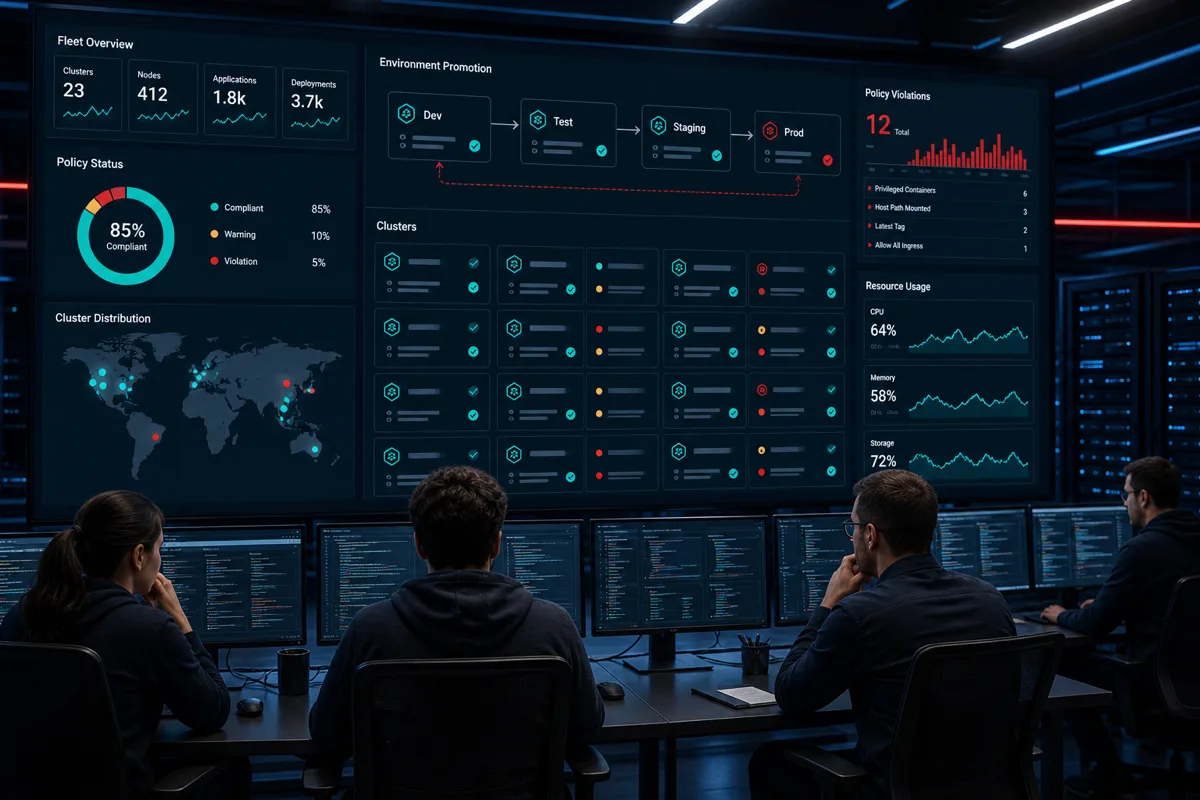
One cluster is a product. Five clusters without a control model is five outages waiting to disagree. Kubernetes multi-cluster management is how Rutagon keeps fleets coherent: GitOps promotion, policy guardrails, and clear environment contracts — without a brittle “one control plane to rule them all” fantasy.
Buyer Pain: Drift Across Environments
What we walk into:
- Prod Helm values diverge from staging “just this once” — forever
- Every cluster has a slightly different ingress/cert/DNS story
- RBAC and network policies were copy-pasted, then edited by hand
- No fleet view of Kubernetes version skew or addon versions
- Platform team spends weeks recreating the same fix N times
Related reading: Kubernetes cost optimization guide, startup cloud architecture patterns, and zero-downtime blue-green deployment AWS. Capabilities: kubernetes-containerization and AWS cloud infrastructure.
Kubernetes Multi-Cluster Management: Fleet Contracts + GitOps
We define a cluster contract (CNI, ingress class, cert issuer, observability agents, node bootstrap) and promote app workloads through environments with the same pipeline shape:
Platform repo (cluster addons + policies)
        │
        ▼
GitOps (per cluster or per fleet hub)
        │
App repo (Helm/Kustomize overlays: dev → stage → prod)
        │
        ▼
Promotion PRs / tags with policy checks
Multi-cluster does not mean one mega-cluster. It means identical contracts and automated drift detection against those contracts.
Reference Pattern: Hub for Policy, Spokes for Workloads
                    ┌─────────────────┐
                    │  Policy / Git   │
                    │  source of truth│
                    └────────┬────────┘
           ┌─────────────────┼─────────────────┐
           ▼                 ▼                 ▼
      cluster-dev       cluster-stage      cluster-prod
      (apps+addons)     (apps+addons)      (apps+addons)
Tools vary (Argo CD ApplicationSets, Flux Kustomizations, EKS constructs) — the architecture pattern stays: declare desired state once, instantiate many.
Policy Guardrails That Matter
We implement policy-as-code for the failures that actually hurt:
- Require resource requests/limits on app namespaces
- Block privileged pods in tenant namespaces
- Enforce image provenance / allowed registries
- Standardize ingress annotations and TLS
# Illustrative constraint shape (engine-agnostic)
apiVersion: constraints.example/v1
kind: RequireRequestsLimits
metadata:
  name: must-set-resources
spec:
  match:
    excludedNamespaces: ["kube-system"]
Exact engine (OPA/Gatekeeper, Kyverno, etc.) is a delivery choice — the product is the rule set and ownership.
Promotion Without Snowflake Clusters
App promotion rules we enforce:
- Same chart/version artifact promoted — not “rebuild in prod”
- Overlay differences limited to config, replicas, and secrets refs
- Manual prod sync only via break-glass with expiry
Secret management stays outside Git (External Secrets / cloud secret stores). Cluster identity uses IRSA/workload identity — no long-lived keys in YAML.
Observability and Cost Across the Fleet
Multi-cluster without fleet metrics recreates blind spots:
- Cluster list with version/addon skew
- Per-cluster burn alerts rolled to a fleet view
- Cost allocation by namespace/team across clusters — see FinOps adjacency in FinOps consulting services
Platform roadmaps often sequence this with startup platform engineering roadmap style milestones.
Production Lessons
Lesson 1 — Don’t centralize blast radius. A shared hub for GitOps is fine; putting all prod workloads on one physical cluster “for simplicity” is not multi-cluster management — it is denial.
Lesson 2 — Addon version skew is an incident generator. Track it like AMI drift.
Lesson 3 — App teams need a paved path. If the only way to get a namespace is a ticket essay, shadow IT clusters appear.
Lesson 4 — Document break-glass. Emergency kubectl access without audit and expiry becomes permanent culture.
Ready to impose Kubernetes multi-cluster management that scales with your fleet? Talk to Rutagon — contact@rutagon.com or 907-841-8407.
Environment Topology We Recommend Early
A pragmatic commercial topology:
- dev — shared or lightly isolated; faster iteration
- stage — prod-like contract; realistic data subset
- prod — regional as needed; strict change controls
Optional sandbox clusters for experiments with aggressive TTL. The mistake is inventing a unique networking snowflake per environment. Contracts stay identical; blast radius and data sensitivity differ.
App Onboarding Checklist
Platform success is measured by how fast a team gets a namespace with paved path CI:
- Namespace + quota + network policy baseline
- Service account + cloud identity binding
- GitOps app skeleton with overlays
- Dashboards and alert routing stubs
- First deploy through the pipeline (not kubectl apply from a laptop)
If step 5 is optional, multi-cluster management becomes theater.
Incident Work Across Clusters
On-call needs a single way to answer: “which cluster am I in, and what shipped?” We standardize:
- Cluster context naming conventions
- Deployment annotations with git SHA
- Fleet status page for addon health
During incidents, naming consistency saves more minutes than a new fancy UI.
Cost Awareness Across Clusters
Each cluster should carry allocation tags/labels that roll into your FinOps views. Idle sandboxes without TTLs become a second NAT Gateway story. Platform sets TTL controllers or scheduled hibernation where the business allows — engineering convenience is not a blank check.
Promotion Path Across Clusters
We promote manifests from a single Git repo: dev → staging → prod, each cluster subscribed to its path. Policy checks (Pod Security, network policy, image provenance) run before apply. When a cluster is unhealthy, traffic shifts via DNS weighted records rather than manual kubectl — the promotion tooling stays the same.
Frequently Asked Questions
What does Kubernetes multi-cluster management include?
Cluster contracts, GitOps instantiation, policy guardrails, promotion paths, fleet observability, and an operating model for version skew — not merely “we have three EKS clusters.”
Should we use a single shared cluster instead?
Sometimes for early startups. Once blast radius, tenancy, or regional needs grow, multi-cluster with a strong contract beats one overloaded cluster with namespace hope.
Do you require a specific GitOps tool?
No. We pick from what your team can operate. The pattern (desired state in Git, reconciled per cluster) matters more than the logo.
How do you handle secrets across clusters?
External secret stores and per-cluster identities. Secrets do not live in Git; references do.
How long to stand up a fleet model?
A contract + two environments GitOps-managed can land quickly. Expanding to many regions/accounts is paced by networking, IAM, and app onboarding — not by YAML volume alone.