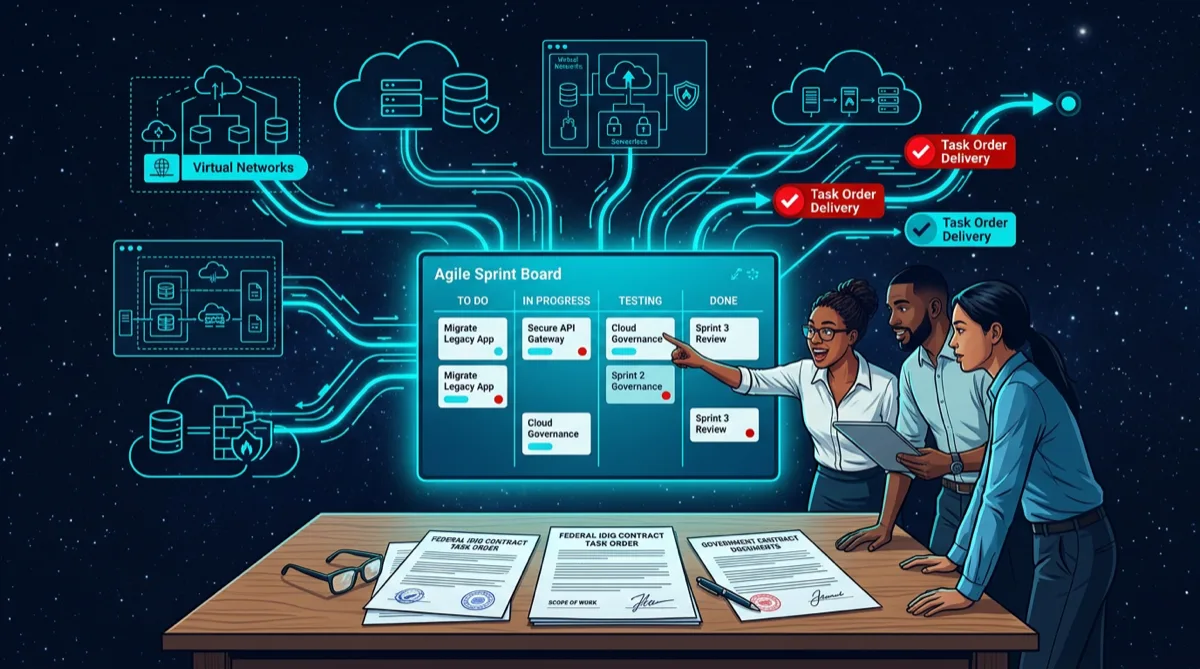
IDIQ (Indefinite Delivery, Indefinite Quantity) contracts are the backbone of federal IT spending. OASIS+, CIO-SP4, SEWP, and dozens of agency-specific IDIQs collectively account for hundreds of billions in annual federal IT awards. For prime contractors holding IDIQ vehicles, the ability to execute task orders — fast and compliantly — depends on having the right subcontractors on their bench.
This covers what cloud engineering subcontractors bring to IDIQ task order delivery, what primes evaluate when selecting subs, and how Rutagon operates as a cloud and DevSecOps sub on federal IDIQ programs.
How IDIQ Task Orders Work for Subcontractors
An IDIQ contract is an umbrella vehicle — it establishes a pre-competed pool of primes eligible to receive task orders. Each task order is a separate statement of work, with its own period of performance, deliverables, and pricing. The prime holds the vehicle and competes for task orders; subcontractors are named at the proposal stage or added through teaming agreements and subcontracts.
For a cloud engineering sub, the typical engagement pattern:
- Pre-proposal: Prime identifies Rutagon as a sub for a specific technical area (AWS infrastructure, DevSecOps, ATO support). A teaming agreement or letter of intent is executed.
- Proposal response: Sub provides a technical write-up, past performance references, key personnel resumes, and rates. Sub is named in the proposal.
- Award: If the prime wins the task order, a subcontract is executed against the existing teaming agreement.
- Execution: Sub delivers against the subcontract statement of work — typically agile sprints, ATO documentation packages, and infrastructure deliverables.
- Option periods: Strong performance on the base period leads to exercised option periods and follow-on task orders.
The sub's role in proposal stage matters: primes increasingly differentiate their proposals using the technical depth and past performance of named subs, particularly in specialized areas like cloud security, IaC, and ATO acceleration.
What Primes Need from Cloud Engineering Subs on IDIQs
The prime's program manager and BD team evaluate cloud subs on different criteria than the CO evaluating the prime. Their concerns are operational:
Can this sub deliver without hand-holding? IDIQ task orders move fast — sometimes from award to first sprint in two to three weeks. A sub that needs extensive onboarding delays the prime's timeline and creates program risk. Rutagon brings pre-built IaC modules, CI/CD pipeline templates, and ATO documentation frameworks that compress the ramp-up period.
Does the sub understand the compliance environment? A sub that doesn't know NIST 800-53 controls, what ConMon evidence looks like, or how an ATO boundary is defined will generate extra work for the prime's compliance team. Rutagon's deliverables generate ATO evidence as a byproduct of standard engineering work — security scanning results, change logs, configuration baselines, and audit trails are produced by the pipeline, not written separately.
Is the sub's documentation deployable? A common complaint from program managers: sub-produced documentation that reads well but can't be used for ATO submissions without rewriting. Rutagon's SSP contributions, system boundary diagrams, and control implementation narratives are written to match NIST 800-53A assessment procedures — they go into the package, not into a revision cycle.
Will the sub protect the prime's past performance? Delivering late or below standard on an IDIQ task order damages the prime's CPARS record, which affects future competition. Primes select subs partly for risk reduction. Rutagon's delivery philosophy — defined sprint cadence, written acceptance criteria, weekly status with blockers documented — gives prime program managers visibility and early warning.
Rutagon's IDIQ Sub Delivery Model
On IDIQ task order engagements, Rutagon operates on a standard delivery framework:
Sprint cadence: Two-week sprints with written sprint plans, daily standups when the program requires them, and written sprint review summaries provided to the prime's PM each cycle. Deliverables are never verbal.
ATO evidence generation: Each sprint produces a defined set of compliance artifacts — pipeline scan results, configuration change logs, signed container manifests, network diagram updates for boundary changes. These are organized in the ATO evidence package folder and handed off at the end of each sprint.
Status reporting: Weekly written status (email or shared document) covering: completed work, next sprint plan, risks and blockers, key decisions needed. PMs get what they need to update their own reporting chain without chasing the sub.
Change management: Scope changes are handled through formal change order requests against the subcontract. Rutagon doesn't absorb undocumented scope without a written change order — this protects both the sub and the prime from schedule and cost overruns.
Key personnel: Named key personnel (e.g., technical lead, DevSecOps engineer) don't get swapped without prime PM agreement. On programs requiring personnel clearance or specific certifications, Rutagon confirms personnel eligibility before naming them in the proposal.
Why Alaska Small Business Status Matters on IDIQs
IDIQ vehicles like OASIS+ have explicit small business set-aside pools — OASIS+ SB, for example, is limited to small business primes competing against each other. Within those pools, primes benefit from small business subs:
- SBA subcontracting goals: Federal contracts over $750K require primes to submit small business subcontracting plans with specific spend goals. A cloud engineering sub with documented CAGE code, active SAM.gov registration, and CMMC Level 1 compliance satisfies these goals with verifiable credentials.
- Alaska HUBZone eligibility: Rutagon is pursuing HUBZone certification (pending 8(a) resolution) at its Wasilla, Alaska address — a designated HUBZone. Alaska-based small businesses bring geographic diversity to team compositions that primes value for certain agency programs, particularly DoD programs with Alaska-based mission partners.
- 8(a) pending: Rutagon's 8(a) application (submitted March 2026) is pending. If certified, 8(a) status opens sole-source pathways for certain task order awards and further strengthens teaming proposals.
Getting on the Prime's Sub Bench
Primes maintain approved sub lists — "bench" entries with vetted past performance, rate cards, and capabilities. Getting on the bench happens through:
- Cold outreach targeting sub-opportunity leads — identifying primes holding relevant IDIQ vehicles and reaching out with specific capability alignment (not generic "we do IT")
- Responding to teaming solicitations — primes issue teaming solicitations before major re-competes; responding positions you for the proposal
- Performing on a task order — the most reliable path to repeat work is delivering well on the first engagement
Prime contractor BD teams and capture managers are the right contacts — not program managers who are deep in execution. Rutagon's outreach strategy targets BD contacts specifically, with capability statements that reference the prime's active IDIQ vehicles and specific task areas where Rutagon's cloud/DevSecOps skills apply.
For prime contractors looking to add a proven cloud engineering sub to their bench for GovCloud, DevSecOps, or ATO-support task orders, contact Rutagon at contact@rutagon.com.
Related Rutagon reading: Federal IT Subcontractor Delivery Model | How Primes Evaluate Cloud IT Subs | CUI-Capable Cloud Engineering Contractor
Frequently Asked Questions
What does a cloud engineering subcontractor do on an IDIQ task order?
A cloud engineering sub delivers defined technical work under a subcontract to the IDIQ prime. Typical work includes: AWS GovCloud infrastructure as code, CI/CD pipeline implementation, ATO documentation packages, security control implementation and evidence generation, system integration, and sprint-based software delivery. The sub operates independently on its defined scope and provides regular deliverables and status to the prime's program manager.
How does Rutagon get named as a sub on IDIQ proposals?
Rutagon executes teaming agreements with primes before proposal submission. The prime names Rutagon as a named subcontractor in the technical approach, past performance section, or management approach. Rutagon provides technical write-ups, key personnel resumes, and past performance references for the proposal. This process starts at the capture stage — typically 30–90 days before proposal submission.
What is the minimum engagement size for Rutagon as a sub?
Rutagon works on task orders with subcontract value of $50,000+, though preferred engagement sizes start at $150,000 for full sprint-cadence delivery. Smaller engagements (staff augmentation, specific deliverable packages) are considered case-by-case based on scope fit and relationship with the prime.
Does Rutagon hold any IDIQ vehicles directly?
Rutagon does not currently hold its own IDIQ vehicle, but is pursuing GSA MAS Schedule (eOffer 9NHJDL9R, pending CO review) which functions similarly as a pre-competed vehicle for federal buyers. GSA MAS award would allow direct task order awards to Rutagon for eligible work, complementing the sub-role on OASIS+, CIO-SP4, and other prime-held vehicles.
What compliance documentation does Rutagon provide as a sub?
Rutagon provides: current CAGE code (19ZR7), active SAM.gov registration, CMMC Level 1 self-assessment documentation (SPRS UID S100050301, valid 2026-2027), AWS Partner Network credentials, and upon request: capability statement, key personnel resumes with clearance eligibility confirmation, and past performance narratives formatted for CPARS/proposal submission.