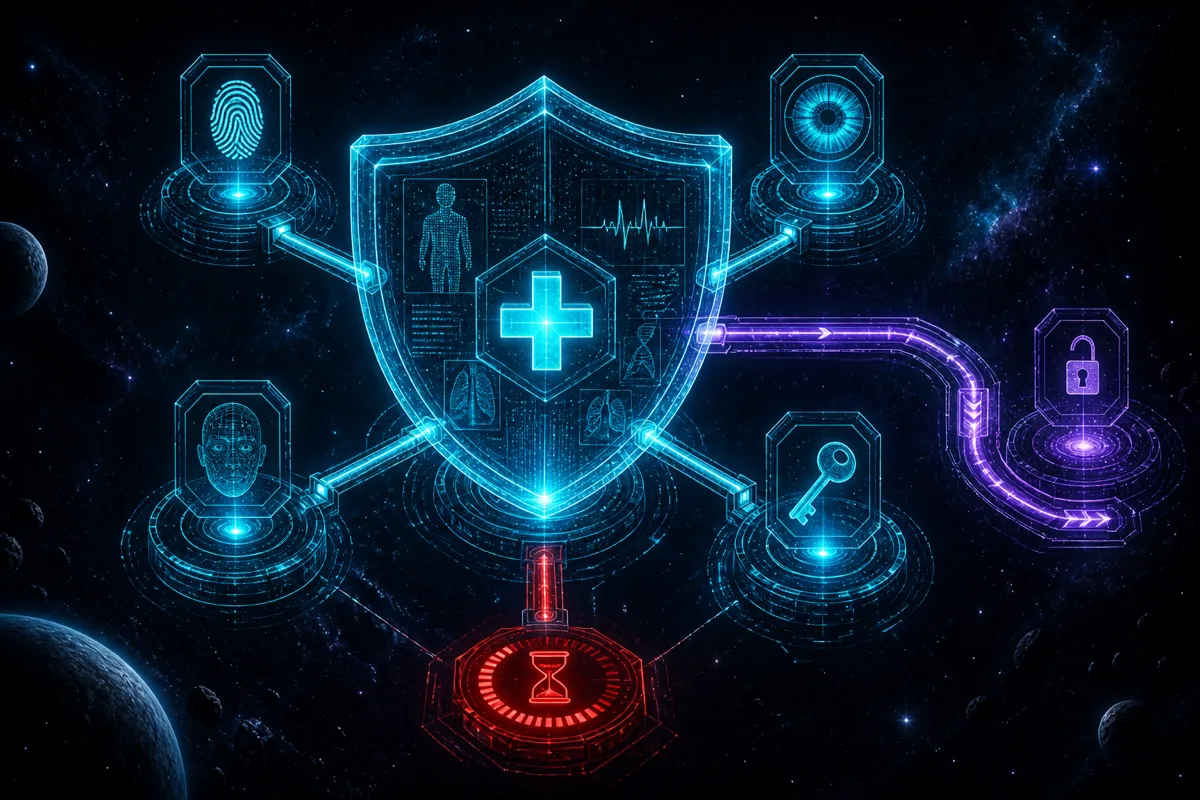
HIPAA's Security Rule access control standard, 45 CFR §164.312(a), reads shorter than it acts — it names four implementation specifications, and most companies building toward HIPAA compliance treat it as a single access-control checkbox rather than four distinct, individually evidenced requirements. Unique user identification is required; the other three (emergency access procedure, automatic logoff, and encryption/decryption) are "addressable," meaning the entity must implement them or document a reasonable equivalent alternative and the justification for it — addressable does not mean optional.
Unique User Identification: The One That's Actually Required
Every person accessing systems that touch electronic protected health information needs a unique identifier — shared logins, generic service accounts used by multiple people, and "the nurse's station computer is logged in as one account all shift" are all direct violations of this specification, not gray areas.
# shared_credential_detector.py — flags any identity pattern suggesting shared access
def detect_shared_credential_usage(login_events: list[dict]) -> list[dict]:
    findings = []
    by_identity = {}
    for event in login_events:
        by_identity.setdefault(event["user_id"], []).append(event)

    for user_id, events in by_identity.items():
        distinct_source_ips = {e["source_ip"] for e in events}
        # Multiple distinct source IPs authenticating as the same identity
        # within a short overlapping window is a strong signal of credential sharing
        overlapping_sessions = [
            e for e in events
            if sum(1 for other in events if other != e
                   and abs((other["timestamp"] - e["timestamp"]).total_seconds()) < 60
                   and other["source_ip"] != e["source_ip"]) > 0
        ]
        if overlapping_sessions:
            findings.append({"user_id": user_id, "concurrent_distinct_ips": len(distinct_source_ips)})
    return findings
This is exactly the kind of detection that's easy to automate and almost never is — most organizations discover credential sharing through an incident or an audit interview, not through monitoring, even though the signal (concurrent sessions from distinct source locations under one identity) is directly observable in authentication logs already being collected.
Emergency Access Procedure: The Addressable Requirement Most Often Missing Entirely
Healthcare systems need a documented procedure for obtaining necessary ePHI access during an emergency — a break-glass path for a clinician who needs immediate record access outside their normal authorization scope during a genuine emergency. This is the specification most commonly missing entirely rather than implemented poorly, because "we'll figure it out if it happens" is how it usually gets handled in practice, which is precisely the undocumented, unaudited path that creates real risk.
# break_glass_access.py — logged, time-boxed emergency override
def grant_emergency_access(requesting_user: str, patient_record_id: str,
                            justification: str, expires_minutes: int = 60):
    grant_record = {
        "requesting_user": requesting_user,
        "patient_record_id": patient_record_id,
        "justification": justification,
        "granted_at": "runtime_timestamp",
        "expires_at": "runtime_timestamp_plus_expiry",
        "requires_post_hoc_review": True,
    }
    # Grant is time-boxed and automatically revoked at expiry — no manual step
    # required to close it, and every emergency grant queues a mandatory
    # supervisor review regardless of whether the access was actually used
    return grant_record
The requires_post_hoc_review flag is the control that makes emergency access defensible rather than a permanent loophole — every use gets reviewed after the fact specifically to confirm it was a genuine emergency, which is both the compliance evidence and the operational check against the path being used as a routine access-request bypass.
Automatic Logoff and Encryption: Configuration, Not Policy
Automatic logoff — terminating an electronic session after a predetermined period of inactivity — and encryption of ePHI at rest and in transit are both largely configuration problems once the architectural decision to implement them is made: session timeout settings on the application and any VPN/remote access tooling, and encryption settings on databases, object storage, and backups. The evidence gap here is usually not "we don't encrypt," it's incomplete coverage — production database encrypted, but a backup snapshot, a database export used for a one-off analysis, or a third-party integration's data-in-transit path left unencrypted because it was outside the scope anyone actually checked.
Frequently Asked Questions
Does "addressable" mean these three specifications are optional?
No — addressable means the entity must implement the specification as written, implement a reasonable and appropriate alternative that achieves the same protective purpose, or document why neither is reasonable given the entity's specific risk analysis. It is not a pass to skip the requirement without documentation.
What counts as a "unique user identifier" for automated systems and integrations?
Service accounts and system-to-system integrations that access ePHI need their own unique, non-shared identity just as human users do — a shared API key used by multiple integrations or a single service account whose credentials are known by an entire team both violate the same principle as a shared human login.
How often should emergency access grants be reviewed?
Every emergency access grant should trigger a review, not just a sample — because these are, by definition, exceptions to normal authorization, and the volume is typically low enough that 100% review is practical, unlike routine access reviews where sampling is standard.
Is encryption at rest required for all ePHI, or only specific systems?
The encryption specification is addressable, but in practice encrypting ePHI at rest and in transit wherever technically feasible is the standard implementation almost every covered entity and business associate adopts, since documenting a reasonable alternative to encryption is a difficult position to defend given how widely available and low-friction encryption is on modern cloud infrastructure.
Does this apply to a company that only occasionally touches ePHI through a business associate relationship?
Yes — HIPAA's Security Rule access control requirements apply to business associates handling ePHI on behalf of a covered entity, not only to the covered entity itself. A vendor with even limited ePHI access through an integration is in scope for these same four specifications for the systems that touch that data.
Rutagon builds access control evidence pipelines mapped to HIPAA §164.312 — unique identification monitoring, break-glass emergency access, and encryption coverage verification.
Ask us what your GRC platform isn't covering → rutagon.com/contact | 907-841-8407 | contact@rutagon.com
Related reading: Compliance Automation for Non-Standard Systems · Multi-Framework Compliance Evidence · Security Automation Capability
External reference: HHS.gov — HIPAA Security Rule, 45 CFR §164.312