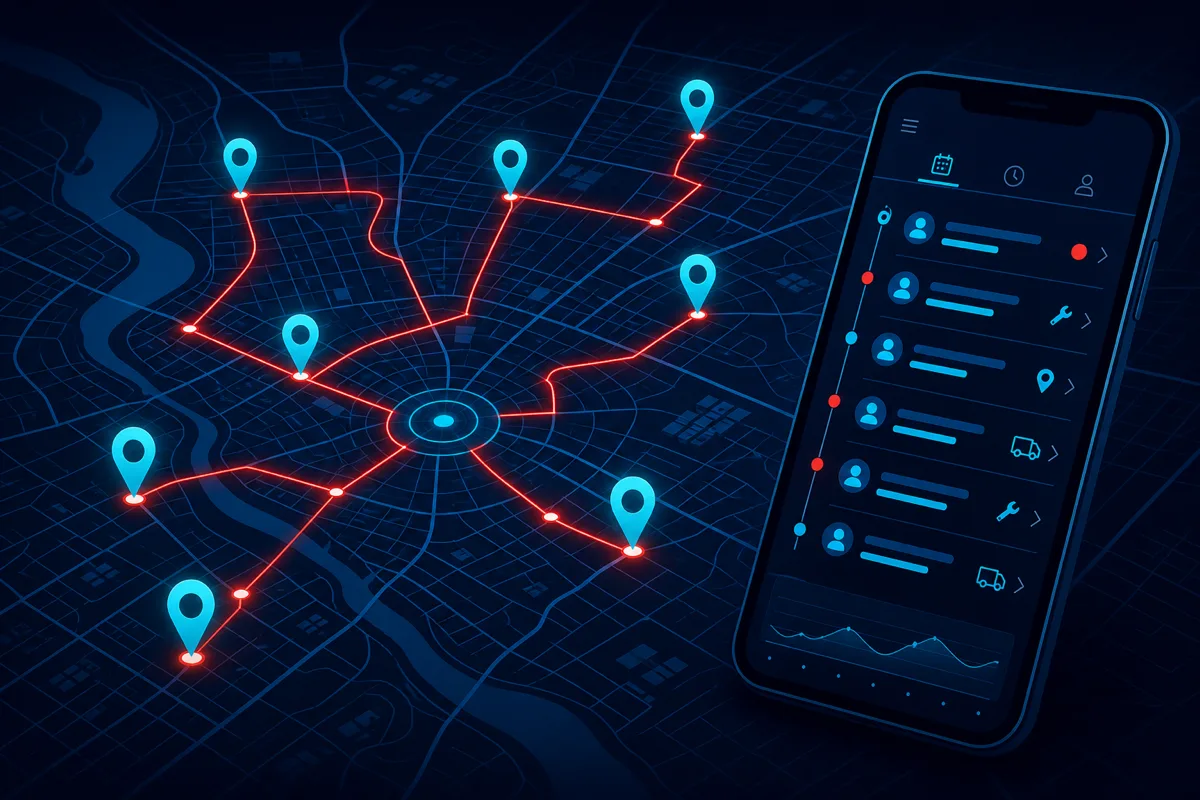
A field service company's growth was outpacing what spreadsheets and phone calls could coordinate. Technicians were double-booked, dispatch decisions were made without visibility into who was actually closest to a new job, and there was no reliable record of what happened at each job site beyond whatever a technician remembered to report afterward. Here's the dispatch and mobile system we built to fix that.
The Core Problem: Coordination Without Real-Time Visibility
The dispatch team was making scheduling and routing decisions based on stale information — a technician's "estimated" location and availability, updated manually or via phone call, rather than actual real-time position and job status. This created constant friction: jobs assigned to technicians who were actually still tied up on a previous job, inefficient routing that ignored technicians who happened to be closer, and no systematic way to handle the inevitable day-of schedule disruptions (a job running long, a technician calling in sick, an emergency job needing immediate dispatch).
System Architecture
Real-time location tracking via the technician mobile app. Technicians use a mobile app (built for both iOS and Android) that shares location updates while on the clock, giving dispatch a live map view of where every technician actually is, not where they were scheduled to be.
Intelligent routing and assignment engine. New jobs get suggested technician assignments based on actual current location, current job status (in-progress, available, estimated completion time), technician skill/certification match for the specific job type, and route efficiency across a technician's remaining scheduled jobs for the day — not just simple proximity, since the closest technician isn't always the most efficient overall assignment once their full day's route is considered.
Dispatcher override and manual control. The routing engine suggests assignments, but dispatchers retain full manual override capability — this was an explicit design requirement, since dispatchers often have contextual knowledge (a difficult customer, a technician's specific strength with a particular equipment type) that the algorithm doesn't capture, and forcing fully automated assignment without override capability would have undermined trust in the system.
Technician mobile app with job details and workflow. Each assigned job includes full details, customer history, required parts or equipment, and a structured workflow for documenting work performed — photos, notes, customer signature capture, and parts used — replacing the previous paper-based or memory-dependent reporting process.
Offline-first mobile architecture. This was one of the most critical technical requirements. Field technicians frequently work in areas with poor or no cellular connectivity — basements, rural service areas, buildings with poor signal penetration. The mobile app needed to function fully offline, queuing all data (job updates, photos, signatures, location pings) locally and syncing automatically once connectivity returns, without data loss or requiring the technician to manually retry failed submissions.
Solving the Offline Sync Problem
Building genuinely reliable offline-first mobile software is harder than it sounds, and this was the highest-risk technical component of the project.
Local-first data model. The app writes every action to local device storage first, treating the sync to the backend as an eventual, best-effort process rather than a required step for the technician's immediate workflow to continue. This means the technician's experience — viewing job details, documenting work, capturing photos — works identically whether connected or not.
Conflict resolution for concurrent updates. If a job's status is updated both from the dispatcher's side and the technician's mobile app while the technician was offline, the sync process needs deterministic conflict resolution rules (generally, the technician's completed-work data takes precedence over dispatcher scheduling changes for the same job, with specific rules defined for each field type) rather than silently overwriting one side's changes.
Sync queue reliability and retry logic. Failed sync attempts (due to intermittent connectivity, not just fully offline periods) needed robust retry logic with exponential backoff, and clear status indicators so technicians and dispatchers both know what has and hasn't successfully synced, rather than assuming sync succeeded silently.
Media handling for photos in low-bandwidth conditions. Photos are compressed and queued for upload separately from the smaller structured job data, so a large photo upload pending on poor connectivity doesn't block critical job status updates from syncing first.
Integration With Existing Business Systems
The dispatch system integrates with the company's existing invoicing and customer management systems, so completed job data (parts used, labor time, customer signature) flows directly into billing without manual re-entry — closing a gap that previously required office staff to manually transcribe technician paper reports into the billing system after the fact.
Results
Since deployment, the company has measurably reduced technician idle time between jobs (through more efficient real-time routing), eliminated the double-booking issues that were common under the previous manual scheduling process, and gained a complete digital record of every job site visit — useful both for billing accuracy and for resolving customer disputes about what work was actually performed.
Rutagon builds custom field service and logistics software, including offline-capable mobile applications for real-world field conditions. Contact us to discuss a field service management project for your operation.
Frequently Asked Questions
Why is offline functionality important for field service mobile apps?
Field technicians frequently work in areas with poor or no cellular connectivity — basements, rural areas, or buildings with poor signal. An offline-first architecture ensures the app functions fully without connectivity, queuing data locally and syncing automatically once connection returns.
Should dispatch routing be fully automated or should dispatchers retain manual control?
We recommend retaining manual override capability alongside automated routing suggestions. Dispatchers often have contextual knowledge — customer relationships, technician-specific strengths — that a routing algorithm doesn't capture, and removing manual control can undermine trust in the system.
How do you handle conflicting updates when a technician is offline?
Deterministic conflict resolution rules need to be defined for each data type before deployment — generally prioritizing the technician's completed-work data over scheduling changes made while they were offline, with specific rules for each field to avoid silently overwriting important updates.
Can field service dispatch software integrate with existing invoicing systems?
Yes, and it should. Integrating completed job data directly into existing invoicing and customer management systems eliminates manual re-entry and closes a common gap where office staff previously had to transcribe technician reports into billing systems by hand.
How long does it take to build custom field service dispatch software?
This depends on the scope of routing intelligence, integration requirements, and offline capability needs, but a focused implementation covering core dispatch, mobile app, and offline sync typically takes several months from architecture through field-tested production rollout.