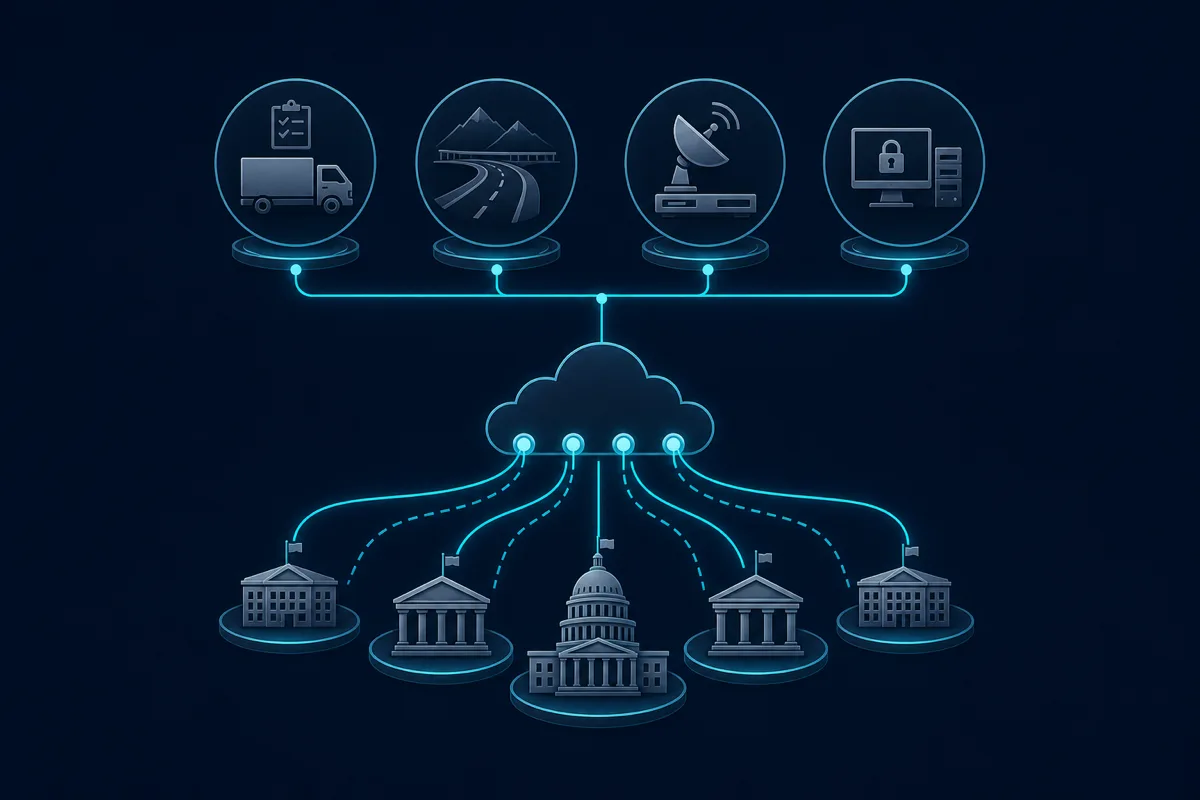
Federal agencies rarely award cloud engineering work as standalone contracts — they use contract vehicles. Understanding which vehicles are used by which agencies, what work each vehicle can support, and how sub-contractors can access work through them is foundational to building a GovCon pipeline for cloud engineering work.
This isn't about becoming a prime on every vehicle — many valuable vehicles require years of incumbency to win. It's about understanding where work is flowing so cloud engineering subs can identify which primes to team with.
What a Contract Vehicle Is
A contract vehicle (also called an IDIQ — Indefinite Delivery, Indefinite Quantity contract) is a pre-competed umbrella agreement that pre-qualifies vendors to perform certain types of work for government agencies. The vehicle itself doesn't fund any work — it establishes a pool of approved vendors.
Work is funded through task orders issued against the vehicle: 1. Agency has a requirement for cloud engineering services 2. Instead of running a full competition for that specific requirement, they use an existing vehicle 3. The agency issues a Request for Task Order Proposals (RTOP) to vehicle holders 4. Vehicle holders (or their teams) respond with proposals 5. Agency awards a task order to the winning proposal
Why vehicles matter for subs: Most significant defense and civilian cloud work is awarded through vehicles. A prime that holds a relevant vehicle can respond to task orders that a non-vehicle-holder can't. Sub-contractors access the work by teaming with a prime that holds the vehicle.
The Major Federal Cloud Contract Vehicles
GSA Multiple Award Schedule (MAS) — IT Schedule: The largest federal procurement vehicle by number of contracts. Roughly 5,000 IT vendors hold MAS contracts. MAS can be used by any federal agency and covers a wide range of IT services and products. For cloud engineering, MAS IT Category SIN 518210C (IT Professional Services) is the relevant category.
What you need to know: MAS is broad and relatively easy to get onto (compared to other vehicles), which means competition is high. Task orders below simplified acquisition threshold don't require competition among MAS holders. MAS has recently started requiring that new schedule holders demonstrate recent, relevant past performance — the old approach of applying with any past performance is no longer sufficient.
OASIS+ (One Acquisition Solution for Integrated Services Plus): GSA's OASIS+ replaced the original OASIS contract. It covers professional services including engineering, IT, and management consulting. OASIS+ has multiple pools organized by small business status and scope. The Unrestricted pool has no business size limitations; the SB (Small Business) pool is restricted to small businesses.
What you need to know: OASIS+ task orders can be very large — it's designed for complex, multi-discipline programs. Primes holding OASIS+ use it for large defense and civilian programs. Cloud engineering subs teaming with OASIS+ prime holders access the largest federal professional services work.
SEWP (Solutions for Enterprise-Wide Procurement): NASA's SEWP vehicle covers IT products and product-related services. SEWP is widely used for cloud service reselling and cloud-adjacent product procurement. Less relevant for pure cloud engineering labor, more relevant for cloud product procurement (buying AWS/Azure/GCP credits, hardware, software licenses).
CIO-SP3 and CIO-SP4 (Government-wide Acquisition Contracts): NITASC's GWAC for IT services used across civilian agencies. CIO-SP4 is the current generation. Covers cloud-native application development, cybersecurity, data analytics, and infrastructure modernization.
Army ITES-4S, Navy SeaPort-NxG, DISA ENCORE: Defense-agency-specific vehicles. Army IT services work often flows through ITES-4S; Navy through SeaPort; DISA-managed programs through ENCORE. Understanding which vehicle a target agency uses determines which primes to identify for teaming.
How Subs Access Work Through Vehicles
The sub-teaming path:
-
Identify target programs: Which agencies / installations have requirements relevant to cloud engineering? USAJOBS IT contract postings, Sam.gov advance notices, agency IT strategic plans, and GovWin all surface upcoming requirements.
-
Identify vehicle holders: Once a target requirement is identified, determine which vehicle it's likely to be competed through (often visible in advance notice). Look up who holds that vehicle on GSA eBuy, SAM.gov, or NITASC's SEWP portal.
-
Target teaming conversations: Contact primes that hold the vehicle and have relevant past performance in the program space. The pitch: "We bring [specific technical capability] that your proposal needs, and we're available to team on [specific upcoming procurement]."
-
Execute teaming agreement: Once a prime agrees to team, execute a teaming agreement before the proposal is submitted. The teaming agreement protects the sub's participation and establishes the sub's scope in the proposal.
View Rutagon's government capabilities → rutagon.com/government
Frequently Asked Questions
Does Rutagon hold any GSA schedule or OASIS+ contracts directly?
Rutagon is registered in SAM.gov and pursuing schedule vehicles as a growth track. For current programs, Rutagon operates as a subcontractor to prime holders on relevant vehicles. Primes seeking cloud engineering subs for programs on GSA MAS, OASIS+, or defense-specific vehicles should contact Rutagon at rutagon.com/contact.
How many OASIS+ prime holders are there?
OASIS+ was heavily oversubscribed relative to the original OASIS — there are hundreds of prime holders across pools. The competition for individual task orders varies by pool and size — SB pool task orders compete only among small business holders, significantly reducing competition. Large unrestricted task orders draw more competition but also represent larger revenue opportunities.
What is a GWAC and how does it differ from a standard IDIQ?
A Government-Wide Acquisition Contract (GWAC) is a task-order contract available to all federal agencies — any agency can use a GWAC to issue task orders without running their own competition. GSA MAS is technically a GWAC. NITASC operates GWACs (CIO-SP4, SEWP). Non-GWAC IDIQs are typically agency-specific (only one agency's components can issue task orders). GWACs are more valuable to prime holders because the potential task order customer base is much larger.
What's the process for a small cloud firm to get onto the GSA MAS schedule?
GSA MAS application is done through the GSA eOffer system. Required: SAM.gov registration, DUNS/UEI, past performance references (typically 2-3 contracts), audited financial statements or detailed bank statements, and completed Price Proposal Template for the SINs you're applying under. The review process takes 3-6 months. Common rejection reasons: past performance not at the required value threshold, insufficient financial documentation, or incomplete technical proposal for the SIN's capabilities.
How do agencies decide which contract vehicle to use?
Agencies use vehicles that: (1) cover the type of work they need, (2) have been pre-competed so they don't need to run a full FAR Part 15 acquisition, and (3) have been authorized for use by their contracting officer. Some agencies have preferred vehicles (Navy uses SeaPort for many services requirements). Others have vehicle agreements that make specific GWACs available for efficient ordering. Program complexity and dollar value also factor in — very large, multi-domain programs may use OASIS+ while smaller, single-agency IT buys might use MAS.