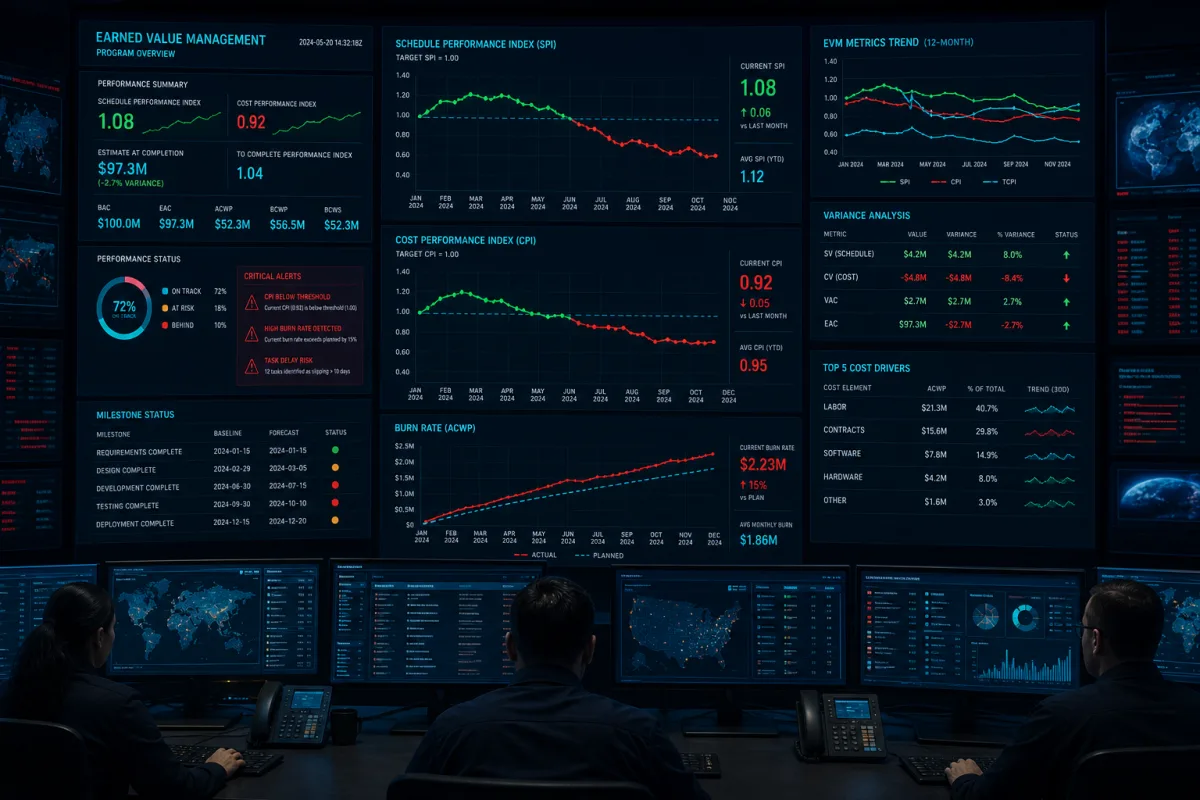
Earned Value Management (EVM) on government IT programs isn't optional for subcontractors who want to protect their prime's performance ratings. Primes on ACAT I programs and many civilian agency major IT investments are required to report EVM to the government. Subcontractors who provide accurate, timely EVM data — rather than vague status reports — become indispensable to the prime's program health management.
EVM Basics for Cloud IT Programs
Earned Value Management is a performance measurement framework that integrates scope, schedule, and cost into a single quantitative picture of program health. The three baseline measures:
Planned Value (PV): What work was planned to be complete by a given date, measured in budget dollars. Also called BCWS (Budgeted Cost of Work Scheduled).
Earned Value (EV): The budgeted value of work actually completed by that date. Also called BCWP (Budgeted Cost of Work Performed). This is the "earned" component — you earn value by completing work, not by spending money.
Actual Cost (AC): What you actually spent to do the work completed. Also called ACWP (Actual Cost of Work Performed).
From these three data points:
- Schedule Variance (SV) = EV - PV (negative = behind schedule)
- Cost Variance (CV) = EV - AC (negative = over budget)
- Schedule Performance Index (SPI) = EV/PV (<1.0 = behind)
- Cost Performance Index (CPI) = EV/AC (<1.0 = over budget)
For cloud IT programs with Agile delivery, EVM integration requires mapping Agile artifacts (story points, sprints, epics) to EVM work packages in the Performance Measurement Baseline.
EVM Requirements by Acquisition Category
Not every government IT program has full EVM requirements — the obligation scales with program size:
| ACAT Level | EVM Requirement | |---|---| | ACAT I (> $635M MDAP) | EVMS compliance required; third-party validation | | ACAT IA (> $165M MAIS) | EVM reporting to Congress, EVMS threshold dependent on contract value | | ACAT II/III | Contractual EVM requirements vary; often included above $20M | | Civilian agency major IT | OMB Circular A-11 exhibit 53/300 requirements; often lighter EVM |
For subcontractors, the trigger is whether the prime's subcontract includes FAR 52.234-4 (EVM systems requirement) or whether the program's CDRL includes a Contract Performance Report (CPR) format. If either is present, the sub's cost and schedule data needs to feed the prime's EVM system.
How Agile Delivery Maps to EVM on Cloud Programs
Traditional EVM was designed for waterfall programs where work is planned in advance and progress is measured against that plan. Agile cloud programs create a tension: Agile values responding to change, EVM values measuring against a baseline.
The DoD's Agile EVM guidance (based on OSD OUSD(A&S) direction) resolves this through:
Sprint-to-work-package mapping: Each sprint maps to one or more EVM work packages in the WBS. Sprint velocity (story points completed) is the earned value mechanism — completing a sprint earns the budget associated with that sprint's work packages.
Phased planning: The Performance Measurement Baseline is set at the iteration or release level rather than at the individual feature level. This allows Agile flexibility within phases while maintaining the top-level baseline.
Earned value method selection: For cloud development work, the "% complete" earned value technique is replaced by Agile-compatible methods: Milestone/Progress Gates (earn value on sprint completion), Apportioned Effort (for support work proportional to development), or Level of Effort (for continuous management activities).
Sub's Responsibility in the EVM Ecosystem
As a subcontractor, your role in the prime's EVM system:
Cost data reporting: Actual labor costs by work package, by reporting period. This feeds the prime's ACWP calculation. Accuracy and timeliness matter — late sub reporting delays the prime's monthly EVM submission.
Schedule status: Which work packages were planned this period, which were completed, and which are incomplete. The prime uses this to calculate SV for your work scope.
Estimate-at-Completion (EAC): Your projection of total cost to complete remaining work. Primes use sub EACs to calculate the program-level EAC. An optimistic or inaccurate sub EAC damages the prime's forecast credibility with the government.
Variance analysis: For any SV or CV exceeding the program's variance thresholds (typically 10-20% of cumulative budget or schedule), a variance analysis narrative is required. Your narrative explains what caused the variance and what corrective action is planned.
The most important contribution a sub makes to the prime's EVM system is honest, accurate data on time. See federal IT subcontractor delivery model for the broader delivery framework within which EVM reporting fits.
EVM for Cloud Infrastructure Costs
Cloud infrastructure costs create unique EVM challenges because they're variable by usage, not flat by period. AWS billing varies month to month based on compute, storage, data transfer, and service usage — not based on how much work was planned.
Approaches for incorporating cloud costs into EVM:
Baseline cloud cost allocation: Build cloud cost estimates into the Basis of Estimate (BOE) by sprint or phase. Establish a baseline monthly cloud budget by environment tier (dev/test, staging, production). Variance from baseline triggers variance analysis.
Tag-based cost tracking: Use AWS resource tags to map cloud spending to WBS elements. This makes the EVM data accurate and auditable. Infrastructure cost overruns (over-provisioning, unoptimized services) show up as CV in the EVM report, creating accountability and the right incentive to optimize. See FinOps GovCloud cost optimization for the tagging and governance structure that supports this.
FinOps integration with program controls: Monthly FinOps reviews align cloud spend to program baseline. Significant deviations from the cloud cost baseline are flagged before EVM reporting, not discovered during it.
Frequently Asked Questions
Is EVM required for all government IT subcontractors?
No. EVM requirements are contractual and program-specific. FAR 52.234-4 flows down to subs on contracts above $20M (threshold varies by agency and program). Many cloud engineering task orders below this threshold may still include simplified schedule and cost reporting requirements. Understand your contract's EVM obligations at the sub level before assuming either full compliance is required or no reporting is needed.
How do story points translate to earned value?
Each epic or feature in the backlog is assigned a budget value as part of the Performance Measurement Baseline. When a sprint completes features representing N story points, the earned value is calculated as (story points completed / total story points) × planned budget for that work package. The key is maintaining a consistent velocity baseline so earned value calculations are stable across sprints.
What's a Contract Performance Report (CPR)?
The CPR is the standard EVM reporting format for DoD programs above certain thresholds. It includes five formats: (1) Work Breakdown Structure, (2) Organizational Categories, (3) Baseline, (4) Staffing, and (5) Explanations and Problem Analysis. Subcontractors on CPR-obligated programs provide data that feeds the prime's Format 1 (WBS) and Format 2 (Org) at minimum.
How does CPI performance affect the prime's CPARS ratings?
CPARS evaluates "Cost Control" as one of the six evaluation areas. A CPI consistently below 1.0 (over budget) directly damages the prime's Cost Control rating. Poor sub CPI performance flows into the prime's overall program cost picture. Primes who've experienced sub cost overruns are increasingly requiring monthly CPI visibility on sub work packages before final CPARS periods.
Can a small cloud sub maintain EVM compliance without expensive software?
Yes. EVM compliance doesn't require Deltek Costpoint or MPM. For sub-tier reporting on programs below the EVMS threshold, a well-structured spreadsheet with timekeeping data, planned values, earned value calculation, and variance analysis narratives meets the requirement. The discipline is what matters — the software is secondary. Primes typically provide their preferred reporting format; subs provide data, not raw system access.
If your prime program needs a cloud IT sub who delivers transparent EVM data on time, contact Rutagon to discuss your program's reporting requirements.