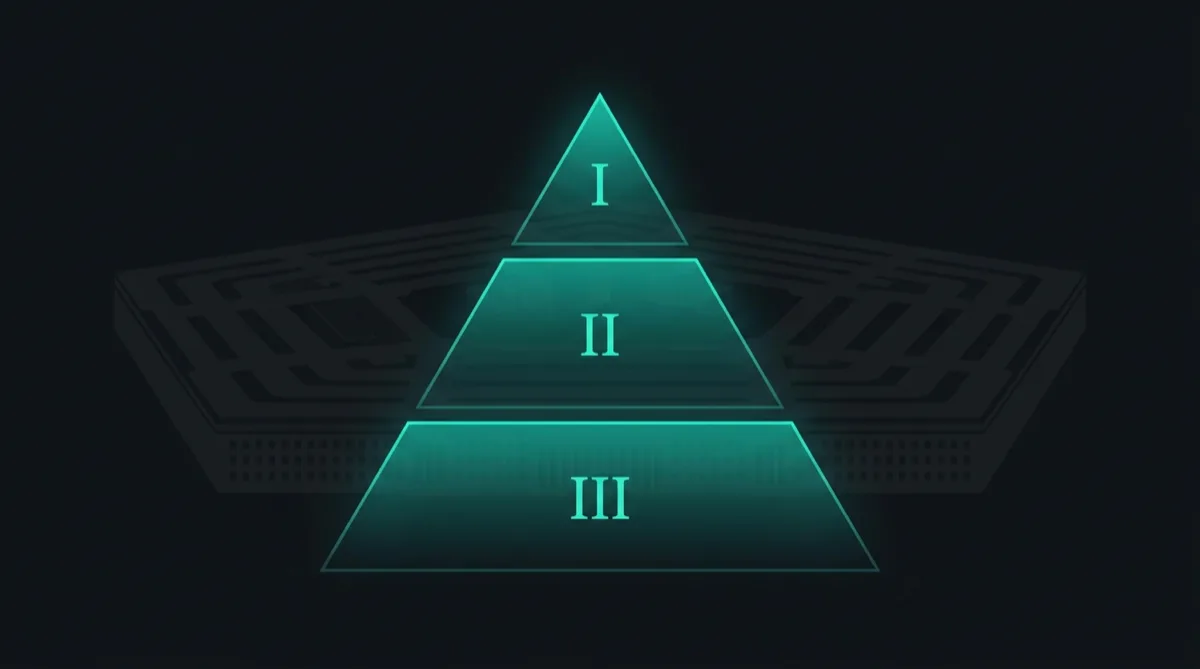
Understanding how the Department of Defense structures major program acquisitions matters for technology companies that want to do more than chase small, one-off awards. Major defense programs — the ones that generate sustained technology work over years — operate through the DoD Acquisition System, which categorizes programs by cost, schedule complexity, and strategic importance.
Knowing where a program sits in the ACAT framework tells you who makes decisions about it, how fast those decisions move, and what delivery expectations apply to technology subcontractors on the program.
The Acquisition Category Framework
DoD assigns every Major Defense Acquisition Program (MDAP) and Major Automated Information System (MAIS) an Acquisition Category based on program cost. The thresholds and oversight requirements differ between hardware programs (MDAPs) and information systems / software programs (MAIS).
ACAT IA — Major Automated Information Systems (Highest)
Threshold: MAIS programs with life-cycle costs exceeding $1.35 billion, annual expenditures exceeding $317 million, or programs designated by the Under Secretary of Defense for Acquisition and Sustainment (USD A&S) due to special interest or risk.
Milestone Decision Authority (MDA): USD A&S or designee
Examples: Large enterprise IT systems, defense-wide ERP programs, major intelligence information systems
Implications for subs: ACAT IA programs move slowly and have extensive oversight. Congressional reporting, periodic Government Accountability Office reviews, and high-scrutiny milestone reviews mean prime contractors manage extensive program management overhead. Subcontractor work on ACAT IA programs is typically long-term (multi-year task orders) but requires significant compliance documentation, configuration management rigor, and formal acceptance testing.
ACAT II — Defense Acquisition Executive Summary
Threshold: Programs not meeting ACAT I thresholds but with life-cycle costs exceeding $480 million or annual costs exceeding $48 million.
MDA: Component Acquisition Executive (CAE) — typically the Service Acquisition Executive for Army, Navy, Air Force, or DIA/NSA equivalents
Examples: Service-specific IT programs, domain-specific C2 systems, component-level infrastructure programs
Implications for subs: More agile decision-making than ACAT IA but still formal milestone reviews. Competitive task orders on ACAT II IDIQ vehicles are where many small business cloud engineering subs find sustained work.
ACAT III — Acquisition Category III
Threshold: All other acquisition programs not meeting ACAT I or II thresholds.
MDA: Program Executive Officer (PEO) or designated authority below CAE level
Examples: The vast majority of IT programs by count — base-level systems, small agency information systems, component tools, and applications
Implications for subs: Fastest-moving. PEO-level MDA means faster decisions, less formal oversight, and more flexibility in contracting approach. Many OTA prototype awards are ACAT III programs. This is where small business cloud subs find the most accessible entry points.
The Software Acquisition Pathway (SWP)
In 2020, DoD established a dedicated Software Acquisition Pathway under DoDI 5000.87 specifically for defense software programs. This pathway recognizes that software development does not map well to the traditional hardware acquisition model — continuous delivery cycles don't fit milestone-based hardware program structure.
Key features of the Software Acquisition Pathway:
Program lifecycle structure: SWP programs use an operational phase with capability drops rather than traditional Milestone A/B/C reviews. Software is continuously delivered to users, not released in major hardware increments.
User engagement: SWP mandates active user engagement throughout the program — not just at requirements definition. User feedback cycles drive backlog prioritization, which requires government product owners with genuine authority to direct development priorities.
Cost accounting: SWP programs can use a capability-based cost model rather than traditional work breakdown structure accounting. Teams are funded by capacity (staff, tools, infrastructure) rather than by specific deliverables.
Applicability: The SWP is available for ACAT I-III programs but is specifically designed for programs that produce only software — not embedded software in hardware platforms.
For technology subs, SWP programs look more like commercial agile software development: sprint reviews with government stakeholders, continuous integration, and demonstration-based acceptance rather than formal test and evaluation cycles.
Milestone Reviews and What They Require
Traditional ACAT programs (those not on the SWP) use Milestone A, B, and C reviews:
Milestone A: Approval to enter the Technology Maturation and Risk Reduction (TMRR) phase. For IT programs, this is early-stage architecture and prototyping.
Milestone B: Approval to enter Engineering and Manufacturing Development (EMD). The program has a mature concept, requirements baseline, and acquisition strategy. Contracts are typically awarded after Milestone B — this is where prime contract awards happen.
Milestone C: Approval for Limited Deployment or Full Deployment. For software, this means the system has passed operational test and evaluation and is cleared for broader deployment.
Technology subcontractors typically enter the program between Milestone B and Milestone C — after the program architecture is established, when development contracts are awarded. Understanding where a target program is in this lifecycle tells you how much runway remains and what the delivery expectations are.
Authority to Operate (ATO) and the Acquisition Lifecycle
Every DoD IT system must obtain an Authority to Operate before deployment. The ATO process intersects with the acquisition milestone structure:
- Programs typically begin the RMF/ATO process during the development phase (between Milestone B and C)
- The ATO is required before Milestone C approval for full deployment
- Continuous ATO (cATO) allows systems under the SWP to maintain authorization through continuous monitoring rather than periodic re-authorization
For technology subs, ATO timing creates a known crunch in every program: the months leading up to Milestone C (or first operational deployment for SWP programs) involve intensive ATO documentation, control implementation, and assessment preparation. Subs that can deliver ATO evidence as part of their normal development workflow — as described in our continuous ATO automation approach — reduce program schedule risk significantly.
What Technology Subs Need to Know
Understand Your Prime's Program Constraints
Before committing to delivery timelines, understand what ACAT level the program is and whether it's on the traditional or SWP pathway. ACAT IA programs have formal acceptance testing requirements that add weeks or months to delivery cycles. ACAT III programs on the SWP may have user acceptance cycles measured in days.
Configuration Management Rigor Scales with ACAT Level
ACAT IA programs require rigorous configuration management: software version control is not enough. You need a software configuration management plan, a software development plan, and formal change control procedures aligned with IEEE 828 or equivalent. ACAT III SWP programs have much lighter touch configuration management documentation.
Past Performance Records Are Program-Specific
Contracting Officers building past performance assessments for major ACAT programs evaluate whether a sub's experience is at comparable program scale and complexity. Demonstrated delivery on a program of comparable ACAT level is more credible than an equivalent dollar value of many small contracts. Building past performance on ACAT III programs creates a foundation for competing on ACAT II programs.
The Delivery Model Matters More Than Technology Choice
For sustained sub work on major defense programs, primes evaluate delivery predictability above technology sophistication. Can you deliver working software at the end of every sprint? Can you generate ATO evidence without being asked? Can you participate productively in milestone reviews without requiring the prime to re-explain government acquisition concepts? The delivery model Rutagon applies to government programs is calibrated to these expectations.
Frequently Asked Questions
What is the difference between a MAIS and an MDAP?
Major Automated Information Systems (MAIS) are DoD programs primarily producing information technology or software. Major Defense Acquisition Programs (MDAPs) are programs primarily producing defense equipment, weapons systems, or platforms. Both have ACAT structures, but the specific cost thresholds and oversight requirements differ. The $1.35B life-cycle cost threshold for ACAT IA applies to MAIS programs specifically. Software IT programs are typically classified as MAIS rather than MDAP unless they are embedded software in a weapons platform.
How does the SWP (Software Acquisition Pathway) affect contract types?
SWP programs commonly use labor-hour or time-and-materials contracts for the development team rather than firm-fixed-price deliverable-based contracts. This reflects the agile development model where specific deliverables are not defined far in advance. The contracting officer and program office focus on team capacity and demonstrated velocity rather than specific line items delivered. This is more comfortable for technology companies used to commercial software development but requires rigorous sprint review demonstration to justify expenditure.
Can a technology company participate as a prime on an ACAT I program?
Technically yes, but rarely in practice for small businesses. ACAT I programs have administrative, financial, and program management requirements (Defense Contract Audit Agency oversight, earned value management systems, etc.) that create significant barriers for smaller companies. The more realistic path for a small technology company on an ACAT I program is as a subcontractor to a large prime that manages the administrative overhead. ACAT III programs are the realistic prime contract target for small business technology companies.
What is the role of a Program Executive Officer (PEO) in ACAT III programs?
The Program Executive Officer serves as the Milestone Decision Authority for ACAT III programs within their portfolio. The PEO is a senior military or civilian official responsible for a portfolio of related programs (e.g., PEO Enterprise Information Systems, PEO Command, Control, Communications — Tactical). For ACAT III decisions, the PEO can move faster than the CAE or USD A&S level — program reviews are internal to the PEO office rather than requiring service-level or OSD-level review.
How do we identify what ACAT level a target program is?
Program acquisition category information is often available in Congressional budget justification documents (Program Acquisition Unit Cost for MDAPs, MAIS reporting thresholds). The Defense Acquisition Management Information Retrieval (DAMIR) system tracks program status for major programs. For market research, GovWin, BGOV, and similar intelligence platforms often include ACAT categorization in program profiles. Program offices may also disclose ACAT level in sources sought notices and draft RFPs.
Rutagon delivers on DoD programs from prototype through production →
Discuss your project with Rutagon
Contact Us →