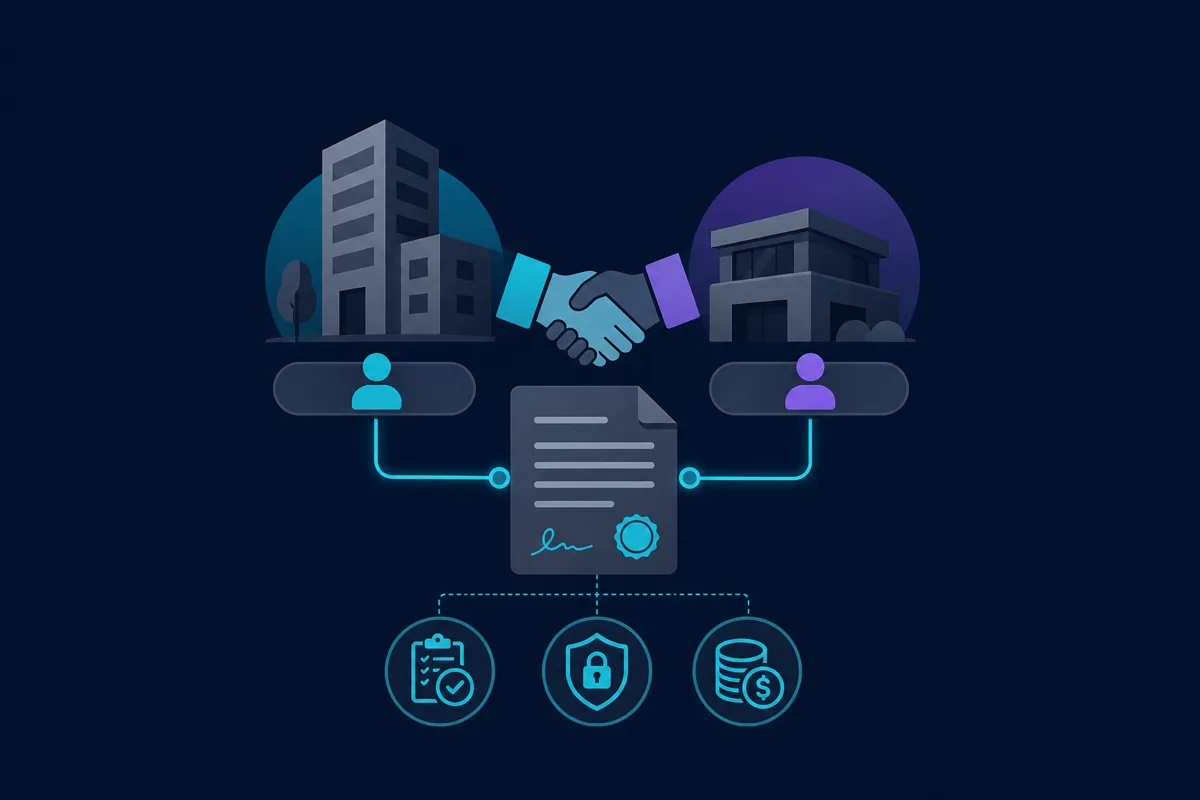
A teaming agreement is the binding document between a prime and subcontractor that defines the scope, obligations, and expectations for how the team will pursue and perform on a government contract. For cloud engineering subcontractors on defense programs, the teaming agreement is the operating framework — it determines what the sub is responsible for, how they get paid, what access they receive, and what happens when things go wrong.
Most teaming disputes arise from agreements that were too vague at the time of signing. Here's what cloud engineering subs should ensure is covered before executing a teaming agreement with a defense prime.
Scope Definition: The Most Critical Term
Scope must be specific. A teaming agreement that says the sub will "provide cloud engineering support" is inadequate — it leaves interpretation open in both directions. The scope should specify:
What the sub will perform: Specific labor categories, specific technical work streams (e.g., "cloud infrastructure engineering, CI/CD pipeline development, security compliance tooling"), and specific deliverables expected of the sub.
What the sub will NOT perform: This is equally important. If the prime intends to keep program management, systems engineering, or certain security functions in-house, that exclusion should be stated — otherwise the sub may have expectations of performing (and billing for) work that the prime intends to perform themselves.
Minimum sub participation commitment: Many teaming agreements specify a percentage of contract value that the prime commits to flow to the sub (e.g., "prime commits to flow at least 15% of contract value to sub"). This protects the sub from being cut out of the program after award. Without a minimum participation commitment, a sub can sign the teaming agreement, contribute to proposal development, and find themselves receiving no task orders after award.
Exclusivity provisions: Does the sub agree not to team with competing primes for the same procurement? This is common in teaming agreements and should be time-limited (expiring if the prime doesn't win, or if the sub doesn't receive minimum participation).
Intellectual Property Rights
Cloud engineering subs often develop reusable tooling, scripts, and configurations during program performance — CI/CD pipeline templates, compliance automation scripts, infrastructure modules. The teaming agreement should specify:
What the prime owns: Work specifically developed for the program and delivered as a contract deliverable (CDRL items) is typically government-owned. This is expected.
What the sub retains: Pre-existing IP that the sub brings to the program (existing Terraform modules, existing compliance tooling) and work developed by the sub that isn't specifically required as a deliverable. Pre-existing IP should be licensed to the prime for use on the specific program, not assigned to the prime.
Government rights clauses: The subcontract will flow down the government data rights clauses from the prime contract. For software development under FAR, this typically means the government receives Unlimited Rights in software developed exclusively with government funds. Understanding which deliverables fall into this category helps the sub protect their background IP.
Payment Flow: Critical Protections
Prime contractors receive payment from the government and then pay their subs. Payment flow risks for subs:
Pay-when-paid vs. pay-if-paid: "Pay-when-paid" means the prime pays the sub within a reasonable time after the prime receives payment from the government — the prime's collection delay passes to the sub, but the prime remains obligated to pay even if the government is slow. "Pay-if-paid" (in states where it's enforceable) means the prime only pays the sub after the government pays the prime — if the government disputes and withholds payment, the prime can withhold payment from the sub indefinitely. Subs should push for pay-when-paid with a defined maximum payment delay.
Invoice submission schedule: When can the sub invoice, at what frequency, and what documentation is required? Mismatches between invoice submission requirements and program cash flow are common friction points.
Dispute provisions: If the prime disputes a sub invoice, what's the resolution process and timeline? Disputes should have a defined resolution path and timeline — not "to be resolved by negotiation."
Access and Clearance Commitments
For cloud programs with classified or sensitive information:
Government access requirements: The teaming agreement should specify what government system access the sub's personnel require, who is responsible for sponsoring and maintaining that access, and what happens to the sub's work authorization if access is delayed or denied.
Clearance sponsorship: For programs requiring personnel security clearances, who sponsors sub personnel for clearances? The prime typically sponsors subs under their Facility Clearance, but this should be explicit — not assumed.
Access timeline risk: What happens if sub personnel clearances are delayed by 3-6 months? Does the sub have work they can perform while clearances process, or does the entire engagement stall?
Dispute Resolution and Termination
Termination for convenience: Either party should be able to exit the teaming arrangement if the prime doesn't win the contract or if conditions change materially. The agreement should define what constitutes a material change (scope significantly altered post-award, minimum participation commitment not met) and the process for exiting.
IP reversion on termination: If the teaming agreement terminates, what happens to work-in-progress? IP the prime has already paid for stays with the prime; IP the sub was developing but hasn't delivered shouldn't automatically transfer.
Non-compete scope: Some teaming agreements include non-compete provisions preventing the sub from pursuing independent contracts in the same program space. The scope and duration of non-competes should be specific and reasonable — a 2-year non-compete covering all defense cloud work is unreasonable; a 1-year non-compete on the specific procurement is more defensible.
Discuss teaming with Rutagon → rutagon.com/contact
Frequently Asked Questions
Should a small cloud engineering sub have a lawyer review the teaming agreement?
Yes — if the program is material to the sub's revenue, legal review is appropriate. Teaming agreements are contracts, and vague terms in a contract are interpreted against the party that drafted them (typically the prime). Legal review doesn't need to be expensive — an attorney familiar with government contracts can review a teaming agreement in 2-3 hours. The cost is trivial relative to the contract value.
What's a typical minimum participation commitment percentage for a cloud engineering sub?
Participation commitments vary by program size and sub's role. For subs who are integral to the technical delivery (rather than supplemental support), 15-30% of total contract value is a reasonable minimum commitment ask. For subs providing a specific technical capability that the prime doesn't have internally, the commitment may be higher. Larger primes with internal capabilities may offer lower participation percentages but access to larger contract vehicles.
What is a flow-down clause in a teaming agreement?
Flow-down clauses pass specific requirements from the prime contract to the subcontract. The prime's government contract includes hundreds of FAR and DFARS clauses; many of these must "flow down" to subcontractors (security requirements, equal opportunity requirements, small business reporting, etc.). The teaming agreement typically references the subcontract that will be executed upon award, and the subcontract includes the applicable flow-down clauses. Subs should review which DFARS clauses are flowing down — security requirements (DFARS 252.204-7012 for cyber incident reporting), CUI handling requirements, and CMMC requirements are the most operationally significant.
Can a sub work with multiple primes pursuing the same procurement?
Yes, unless the teaming agreements include exclusivity provisions. Some primes request exclusivity from subs with unique capabilities — they don't want the sub's technical capability appearing in a competitor's proposal. If a sub signs an exclusive teaming agreement with Prime A, they cannot team with Prime B on the same procurement without breaching the exclusivity commitment. Subs with capabilities that multiple primes are seeking should carefully evaluate whether to grant exclusivity and ensure any exclusivity is time-limited (expiring if the prime doesn't win).
What happens to the teaming agreement if the prime loses the competition?
Most teaming agreements include a termination provision triggered by the prime's failure to win the contract. The agreement expires, exclusivity provisions lapse, and both parties are free to pursue the program under a potential re-competition or with other partners. The sub's proposal contribution (technical writing, pricing analysis) that they developed doesn't automatically entitle them to anything from the prime after loss — this is another reason to scope teaming agreements carefully and not invest more proposal development effort than the minimum participation commitment justifies.