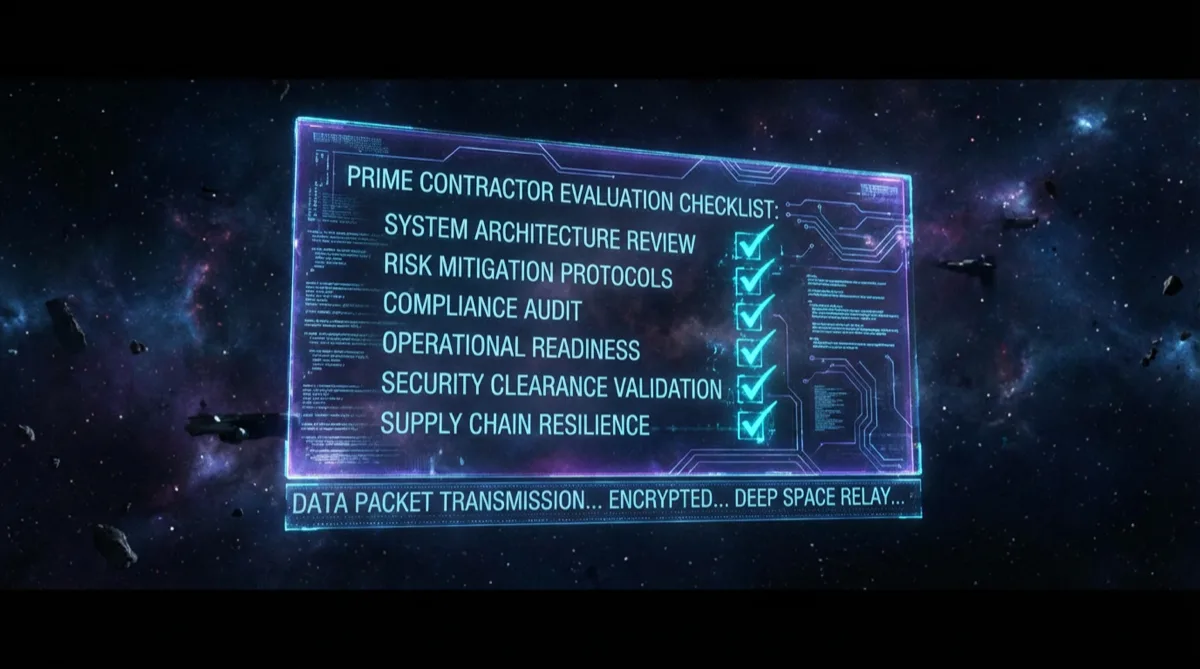
Prime contractor BD teams are under pressure on two fronts when evaluating cloud engineering subs: winning the contract requires a technically credible team, and meeting SBA small business subcontracting goals requires qualified small business partners. Finding a cloud sub that satisfies both requirements — real technical capability AND defensible past performance — is the actual challenge.
Here's what prime BD teams should evaluate when vetting a cloud engineering sub for a defense or federal program.
What Primes Actually Need From a Cloud Sub
Before evaluating subs, be precise about what the program needs:
Technical capability match: Does the sub have the specific cloud skills the task order requires? AWS GovCloud vs. Azure Government matters. Container-native delivery is different from server management. CMMC implementation is different from general security consulting.
ATO experience: Has the sub actually maintained a system through a FedRAMP or FISMA assessment cycle? Many companies claim cloud security expertise; far fewer have generated the evidence packages, managed ConMon deliverables, and responded to 3PAO findings.
Delivery model: Can the sub operate within the prime's delivery cadence? Two-week sprints, documentation in Confluence, PR reviews on GitLab, sprint demos — subs that have operated in government delivery environments don't require hand-holding on process.
Teaming fit: Is the sub company a culture/communication fit? A technically excellent sub that needs constant supervision or creates friction in delivery meetings is a net cost. The best subs are force multipliers.
Technical Criteria to Evaluate
Cloud Platform Depth
Surface-level awareness of AWS or Azure is not the same as production delivery experience. During the evaluation:
- Ask for architecture diagrams from previous work (redacted for client confidentiality). Teams that have shipped production systems have artifacts; teams that haven't can't produce them.
- Ask about specific service experience: "Have you used AWS Organizations with Service Control Policies?" "Have you implemented OIDC-based CI/CD in GovCloud?" The specificity of the answer reveals actual depth.
- Ask about production failures and how they were resolved: Teams that have operated production systems have failure stories. Teams without production experience give theoretical answers.
IaC Maturity
Infrastructure as Code is the baseline expectation for cloud engineering in a compliance environment — not a differentiator. Evaluate maturity:
- Is infrastructure 100% in code (Terraform, Pulumi) or a mix of click-ops and IaC?
- Is state managed remotely with locking, or locally?
- Is there a CI/CD pipeline that runs
terraform planon every merge request andterraform applythrough the pipeline only? - Are IaC changes reviewed by a second engineer before merging?
Click-ops in a FedRAMP environment is a configuration management finding (CM-6). IaC-mature teams don't create this finding.
Security Architecture Capability
For programs involving CMMC Level 2 or FedRAMP workloads, security is architectural — not a late-stage addition:
- Zero-trust credential model: OIDC federation, no long-lived access keys, workload identity rather than static credentials. Ask how they handle CI/CD credential management.
- Vulnerability management: How are CVEs tracked and remediated? Is scanning integrated into CI/CD or run manually on a schedule? What's the process for a Critical CVE in a production container?
- Compliance documentation: Have they generated SSP content, POA&M updates, ConMon reports? These are different skills from just implementing controls.
Delivery Speed Evidence
The ability to ship working software to government programs at a high rate — not just design it — is what differentiates high-value subs from whiteboard consultants.
Indicators of delivery velocity:
- Deployment frequency: How often does the team deploy to production? Teams that ship weekly have better observability, tighter feedback loops, and lower change failure rates than teams that ship quarterly.
- Time to production: For a new government cloud program, how long from kickoff to first meaningful feature in production? Six months to first deploy is a warning sign.
- Existing toolchain: Do they have reusable IaC modules, pre-built CI/CD pipelines, and pre-configured monitoring dashboards that reduce ramp-up time on new programs?
Compliance and Regulatory Evaluation
Existing Certifications and Registrations
Basic verification:
- SAM.gov registration: Active registration is a contract prerequisite. Verify the UEI is active and the cage code matches. Rutagon's UEI is FB2FHEJHM493, CAGE 19ZR7 — public information available on SAM.gov.
- Size standard: Verify the sub qualifies as small business under the relevant NAICS code for the contract.
- Clearances: If the program requires cleared personnel, verify the sub holds a facility clearance or has cleared individuals on the proposed team.
Past Performance Quality
Past performance for a cloud sub should show:
- Programs with similar cloud platform requirements (AWS GovCloud vs. commercial makes a difference)
- Compliance environment experience (FedRAMP, FISMA, CMMC-adjacent)
- Delivery of production systems, not just assessments or studies
- References that can speak to technical quality and delivery reliability
References from program managers and CORs are more useful than contractor peer references. Ask specifically: "Did the sub hit their sprint commitments? Did their deliverables require significant rework? How did they handle unexpected technical challenges?"
Red Flags During Vetting
- Proposing their entire cloud practice on paper with no production track record: Large system integrators sometimes propose technical staff who've never worked together as a team. Evaluate the specific team proposed.
- Unclear on compliance inheritance boundaries: Subs who don't know what FedRAMP controls AWS inherits vs. what the system owner implements don't have real compliance delivery experience.
- No IaC: If the sub manages cloud infrastructure manually (clicking through consoles), the compliance overhead on any FedRAMP program will be significant and ongoing.
- Over-reliance on the prime for security decisions: Security architecture should be the sub's expertise, not something they wait for the prime to specify.
Rutagon is a cloud-native, IaC-first defense technology company. We deliver to government programs with speed, compliance posture, and deep technical capability — available as a subcontractor to primes who need an Alaska-based, SAM.gov-active small business cloud engineering partner.
Explore teaming with Rutagon →
Frequently Asked Questions
What SAM.gov information should primes verify for a cloud sub?
At minimum: active registration status, valid CAGE code, current representations and certifications (especially small business size certification under the relevant NAICS), and no active exclusions (debarment/suspension). You can verify all of this at sam.gov using the sub's UEI or legal business name. Some programs also require subs to be registered with the System for Award Management prior to subcontract execution.
How do SBA small business subcontracting goals work for cloud programs?
Federal contracts over $750,000 (or $1.5M for construction) typically require a Small Business Subcontracting Plan. Prime contractors commit to a percentage of contract value to be performed by small businesses, with separate goals for categories: SB, SDB (Small Disadvantaged Business), WOSB, HUBZone, VOSB, SDVOSB. Cloud engineering programs frequently seek small business subs for technical work categories. Primes that meet their subcontracting commitments build better CPARS records and maintain better agency relationships.
Can a small business sub be the technical lead on a prime's cloud program?
Yes. Many successful delivery models have a prime holding the prime contract (managing administration, prime financials, prime relationship) while a technically capable small business sub leads the engineering delivery. The prime provides contract vehicle access, past performance breadth, and administrative infrastructure; the sub provides technical depth. This model works when the relationship is structured around clear deliverables and trust.
What's the teaming agreement and why does it matter?
A teaming agreement is a pre-award agreement between a prime and sub defining their intent to pursue a specific contract together, the prime's agreement to subcontract a defined scope to the sub, and the exclusivity and performance terms. Post-award, the teaming agreement transitions to a formal subcontract. Teaming agreements should be reviewed by legal — scope creep, IP ownership, non-compete terms, and subcontracting percentage commitments have real consequences if not carefully defined.
What makes an Alaska-based cloud sub valuable for defense programs?
Alaska-based technology companies have proximity to key defense installations (JBER, Eielson AFB, Fort Wainwright, Clear SFS), are strategic to INDOPACOM and Arctic defense programs, and have unique HUBZone and 8(a) eligibility considerations that can provide contract vehicle advantages. Beyond geography, Alaska-based subs with national cloud delivery capability bridge local presence (advantageous for certain contracts) with distributed team delivery. For primes pursuing programs with Alaskan operations components, a local cloud engineering sub with federal delivery credentials is genuinely valuable.
Discuss your project with Rutagon
Contact Us →